
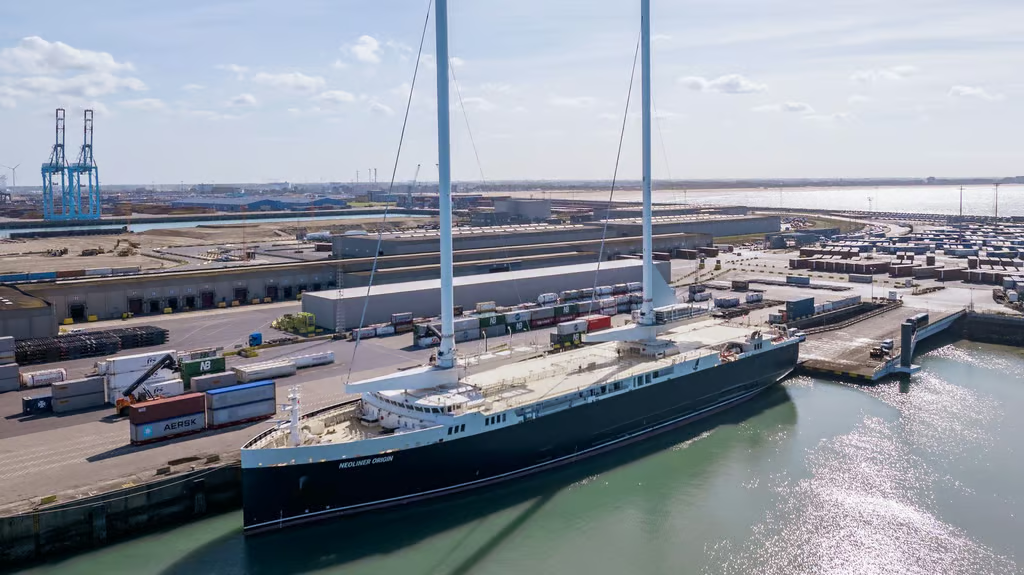
French shipping company Neoline has stated that its wind-powered cargo ship, Neoliner Origin, achieved fuel savings of up to 70% during its first year of commercial operations. This serves as an early indication of whether wind propulsion can significantly lower emissions in transatlantic shipping.
The 136-meter roll-on/roll-off cargo ship began its service in October 2025. It completed nine commercial round trips between Europe and North America, traveling over 62,000 nautical miles and transporting more than 12,000 tonnes of cargo.
According to Neoline's operating results for the first year, the vessel cut fuel consumption by an average of 66% compared to traditional ships, based on the Global Logistics Emissions Council (GLEC) fleet reference. When looking specifically at operations in 2026, the savings were as high as 70%.
The company estimates it saved 3,502 tonnes of fuel during this period, which avoided approximately 11,228 tonnes of CO2 emissions compared to the benchmark.
An additional study compared Neoliner Origin with a simulated standard vessel operating the same routes at 15 knots, showing fuel savings between 62% and 67%. Neoline did, however, note some uncertainty regarding the methods used in these simulations.
As more shipowners look into wind propulsion to cut fuel use and emissions without depending solely on alternative fuels or new bunkering systems, these results are timely.
In contrast to conventional cargo ships that are modified to use wind-assist technology, Neoliner Origin was specifically designed to primarily rely on wind for propulsion. Its SolidSail system supplies much of the energy required for transatlantic voyages.
Yet, Neoline has recognized that technical challenges with the ship's sail system impacted its performance during the first year.
The company mentioned that issues with the sails limited the vessel's ability to operate under full sail, which affected its efficiency.
When functioning properly, Neoliner Origin has frequently surpassed speeds of 15 knots under sail alone. In June 2026, it reached a top speed of 16.6 knots with the engine off.
Neoline is teaming up with French shipbuilder Chantiers de l'Atlantique to resolve these issues, with maintenance scheduled for February 2027 to restore the full capabilities of the SolidSail rig.
The company is now aiming for fuel savings of at least 78% against the GLEC fleet benchmark, with hopes to potentially reach or exceed 80% in 2027.
“This first year of operations confirms the potential of wind propulsion to greatly reduce fuel consumption and CO2 emissions in maritime transport,” said Jean Zanuttini, chairman and CEO of Neoline.
“It has also been challenging, as is typical when developing a prototype vessel, providing us with valuable insights to enhance its performance.”
In addition to its environmental benefits, the first year also served as a test for the commercial viability of a wind-powered cargo service on a regular transatlantic schedule.
Neoliner Origin transported 1,845 cargo units, totaling about 12,063 tonnes and almost 56,000 cubic meters. The cargo included vehicles, containers, large industrial equipment, machinery, and refrigerated goods.
The vessel operates between Montoir-de-Bretagne in France and North America, with stops at Saint-Pierre-et-Miquelon, Baltimore, and Halifax. In September, Neoline expanded its service with a new stop in Zeebrugge, Belgium, to better access European automotive, ro-ro, and project cargo markets.
Neoline has also formed commercial partnerships with CMA CGM and CEVA, while broadening its connections in North America, including with Canadian partner Montship.
During its first year, the ship carried over 170 passengers, reflecting another aspect of Neoline's business model that mixes freight transportation with passenger travel.
These initial results provide an early glimpse of the potential of wind propulsion in commercial shipping, although the technical issues faced also underscore the challenges of integrating this technology into routine service.
For Neoline, the next challenge will be to determine if improvements to the sail system can yield more consistent performance while ensuring reliable cargo operations.
“We are optimistic about our capacity to achieve, and possibly exceed, 80% fuel savings by 2027,” Zanuttini mentioned.