
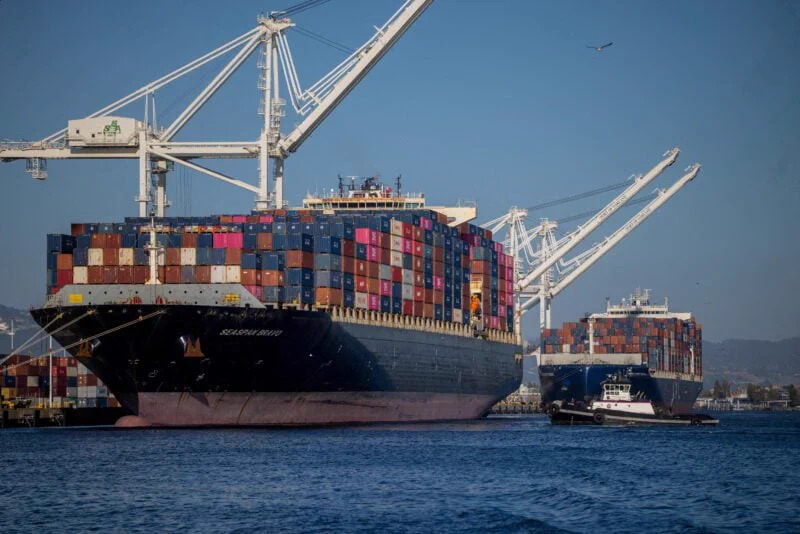
The Trump administration plans to extend the pause on port fees for vessels linked to China for an additional two months, pushing the potential start date for these fees to January 2027. This decision comes as talks between Washington and Beijing continue regarding China's influence in global shipbuilding.
The details of this proposal will be published in a Federal Register notice on October 26, which suggests extending the current one-year suspension until January 9, 2027. The existing pause is set to end on November 9.
This extension would give shipping companies relief from the potentially high fees imposed on vessels that are Chinese-owned, operated, or built, as well as certain foreign-built vehicle carriers docking at U.S. ports.
The U.S. Trade Representative (USTR) noted that the U.S. is actively engaging with China to eliminate the issues identified in the investigation.
If approved, the fee suspension would last from November 10, 2026, to January 9, 2027. During this time, shipping companies would not be responsible for port fees related to the initial Section 301 action. This suspension will also continue for certain duties on equipment like ship-to-shore cranes.
This proposed extension follows an agreement made nearly a year ago between President Donald Trump and Chinese President Xi Jinping to pause these fees as part of a larger trade deal in South Korea.
The U.S. began collecting these fees on October 14, 2025, but they were put on hold on November 10, meaning they were enforced for less than a month. China had also suspended its retaliatory fees on vessels linked to the U.S.
These initial measures came from a Section 301 investigation initiated during the Biden administration after a 2024 petition from labor groups. The findings indicated that China's industrial policies distorted global competition and negatively impacted U.S. business.
The port fees became a key part of the Trump administration's strategy to challenge China’s shipping dominance and encourage investment in American shipbuilding.
Increasing Pressure for Fee Reinstatement
The latest proposal is being made despite rising pressure from some lawmakers and maritime labor groups pushing for the fees' return.
In June, Senators Mark Kelly (D-Ariz.) and Elizabeth Warren (D-Mass.) urged the administration to bring the fees back to help rebuild the U.S. commercial shipbuilding industry.
“Section 301 port fees are critical to revitalizing U.S. shipbuilding,” the senators stated in a letter to USTR Jamieson Greer.
The lawmakers pointed to China’s increasing share of global shipbuilding, noting that Chinese shipyards now produce more than half of all commercial vessels, while the U.S. only contributes 0.1%.
They also questioned whether meaningful concessions had been made by China in return for the fee suspension and how funding for the proposed Maritime Security Trust Fund would be managed without this revenue.
Maritime labor unions have likewise criticized the suspension, claiming it undermines one of the few measures aimed at countering China’s state-supported shipbuilding.
Shipping companies, on the other hand, have welcomed the extra time without the fees.
The original fees could have placed a significant burden on carriers and disrupted shipping operations. During the short time the fees were effective, U.S. carrier Matson reported about $6.4 million in Chinese port fees, while China’s state-owned COSCO estimated it faced $1.5 billion in yearly U.S. charges.
Andy Abbott, CEO of ACL, mentioned that any port fees would negatively affect its expanding export business, causing concern among customers.
“ACL’s unique ships were wrongly classified as vehicle carriers, even though only 1% of our cargo is cars,” Abbott explained. “Our major U.S. customers were worried we might shift our ships to China’s booming trade. This extension allows us to continue serving the U.S. market efficiently.”
Both the International Chamber of Shipping (ICS) and the World Shipping Council supported last year’s suspension, warning that conflicting U.S. and Chinese measures could raise transportation costs and disrupt global trade.
A Wider Discussion on Port Fees
This proposed extension comes amidst broader discussions about a new port fee system under the Maritime Action Plan introduced earlier this year.
Unlike the China-focused Section 301 measures, this plan envisions fees on all foreign-built commercial vessels entering U.S. ports, with proceeds supporting domestic shipbuilding via a proposed Maritime Security Trust Fund.
The plan suggests potential fees ranging from 1 cent to 25 cents per kilogram of imported cargo, potentially generating up to $1.5 trillion over 10 years at the highest rates.
ICS has warned that broad charges like these could substantially raise shipping costs and disrupt global trade, while still supporting efforts to enhance U.S. shipbuilding capacity.
These proposals highlight the challenges the administration faces as it tries to boost American shipyards without increasing costs for U.S. importers, exporters, and consumers.
For now, the USTR’s latest proposal would keep the China-specific port fee actions on hold for an additional two months while negotiations proceed.
The USTR has opened a public comment period on this extension, with responses due by 5 p.m. Eastern Time on October 30. Comments can be submitted via the USTR public comment portal under docket USTR-2026-0694.
The extension is still pending final approval, and it remains unclear if China will prolong its suspension of retaliatory fees on vessels linked to the U.S.