
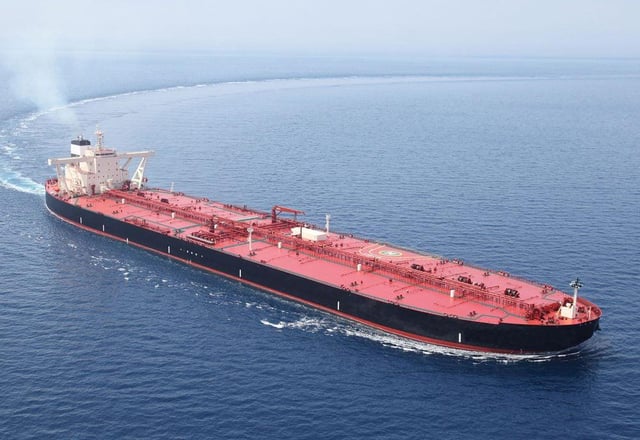
The United States has stated that its maritime blockade of Iranian ports is still in effect. U.S. Central Command (CENTCOM) reported that in the first 48 hours, ten ships were turned back, and no vessels successfully entered or exited Iranian ports by sea.
CENTCOM mentioned that the ships “followed instructions from U.S. forces to turn around and head back to an Iranian port or coastal area.” This is in addition to the six ships that were ordered to reverse course on the first day of the blockade.
“We have fully implemented a blockade of Iranian ports,” said Adm. Brad Cooper, the head of CENTCOM. “In less than 36 hours since the blockade began, U.S. forces have completely stopped any economic trade going in and out of Iran by sea.”
U.S. naval communications have warned that ships trying to dock at Iranian ports might be boarded, redirected, or seized. Mariners have been advised to abandon trips to Iran and “not attempt to breach the blockade,” with the Navy stating that they may use force if there is non-compliance.
U.S. naval vessels are on patrol in the Gulf of Oman as CENTCOM continues to execute a U.S. blockade on ships entering and departing Iranian ports. U.S. forces are present, vigilant, and ready to ensure compliance. pic.twitter.com/dnHR2oz0ZN
— U.S. Central Command (@CENTCOM) April 15, 2026
U.S. officials shared some details about early actions taken during the blockade. A Navy destroyer ordered two tankers leaving the Iranian port of Chabahar to turn around, and both complied.
On Wednesday, CENTCOM reported that the destroyer USS Spruance (DDG 111) stopped an Iranian-flagged cargo ship that attempted to evade the blockade while moving along Iran's coast from Bandar Abbas. “Ten vessels have been turned back, and no ships have gotten through since the blockade started on Monday,” stated CENTCOM.
A significant U.S. force, consisting of over 10,000 personnel, more than a dozen warships, and numerous aircraft, is involved in the blockade, according to military sources.
The blockade specifically targets vessels entering or leaving Iranian ports, but U.S. officials say traffic through the Strait of Hormuz to other destinations is still allowed. Nevertheless, vessel movements in the area have notably slowed as shipowners assess the risks.
Tracking data indicates that several ships have either delayed or reversed their courses near the strait in recent days.
The sanctioned tanker Rich Starry (IMO: 9773301) turned back in the Gulf of Oman after passing through the Iranian-controlled Strait of Hormuz and is now anchored off Iran. Meanwhile, two sanctioned VLCCs, Alicia (IMO: 9281695) and RHN (IMO 9208215), have entered the Persian Gulf empty and may load Iranian crude, according to data from TankerTrackers.
One crude carrier successfully navigated through the strait under the new conditions. The Malta-flagged VLCC Agios Fanourios I (IMO: 9759824) entered the Persian Gulf after waiting offshore for nearly two days and is now headed to Iraq. This vessel also used the Iranian-controlled route close to Iran's coastline.
“U.S. forces are ensuring freedom of navigation for vessels traveling to and from non-Iranian ports through the Strait,” said U.S. Press Secretary Karoline Leavitt.
Analysts caution that it is too soon to assess the long-term effectiveness of the blockade. Some vessels involved in Iranian oil trades do not disclose their positions, complicating tracking efforts.
The blockade comes after negotiations between the United States and Iran broke down. Donald Trump has stated that the goal is to pressure Iran to reopen the Strait of Hormuz and accept U.S. demands.
“China is quite happy that I am permanently opening the Strait of Hormuz. I am doing it for them and for the world. This situation will not happen again. They have agreed not to send weapons to Iran,” Trump shared on Truth Social.
“President Xi will give me a big hug when I visit in a few weeks. We are working together smartly and effectively! Isn’t that better than fighting? BUT REMEMBER, we are very good at fighting, if necessary – far better than anyone else!” Trump added.