
By Brendan Murray
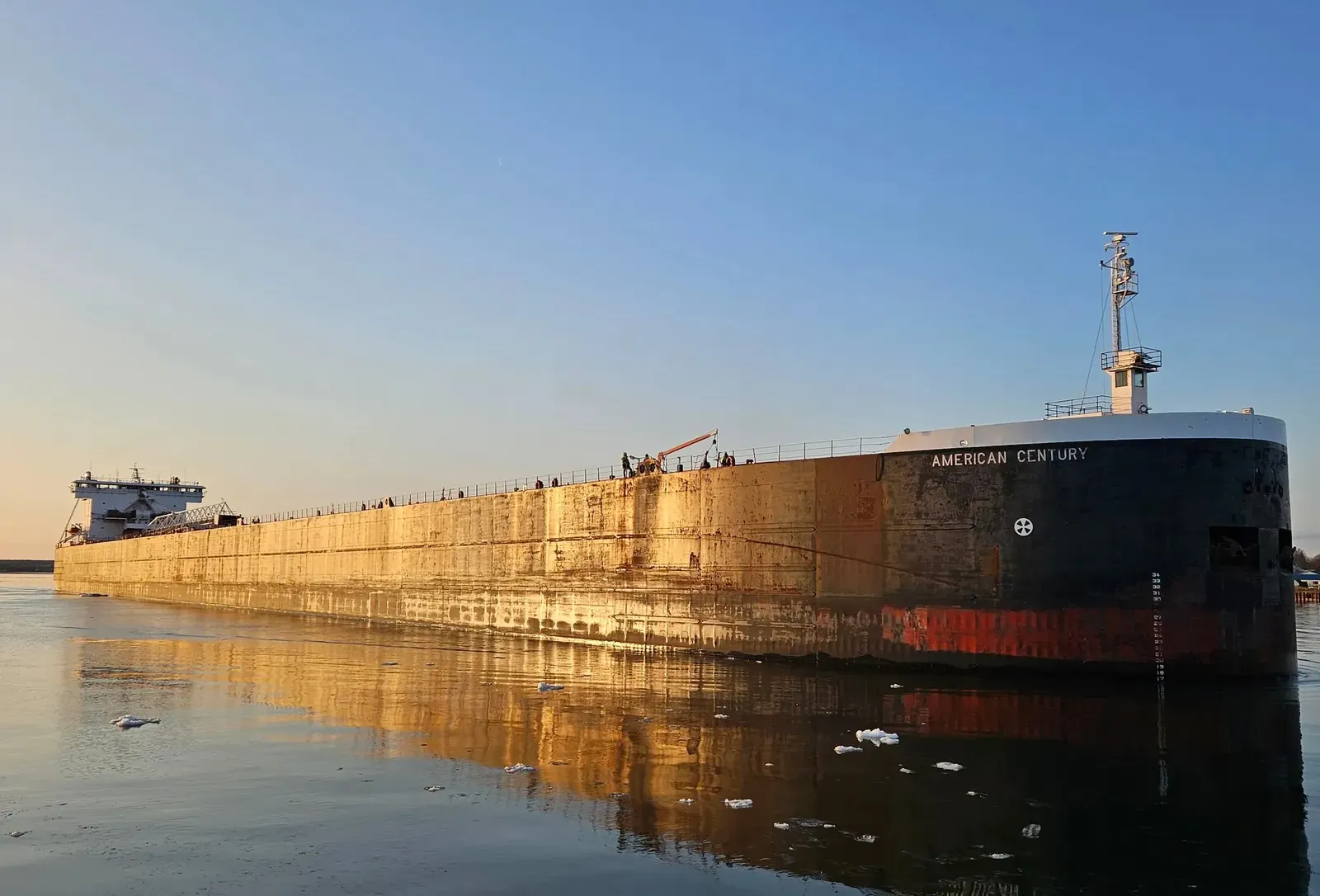
Sep 19, 2026 (Bloomberg) – The American Century always attracts attention when it arrives at the Port of Duluth-Superior to load iron ore from Minnesota. Children cheer as the captain blows the foghorn, and an announcement reminds everyone that this 1,000-foot-long bulk carrier has been sailing the Great Lakes for nearly 50 years.
This moment reflects a bygone era of US industrial power. The ship, built in 1981 in Sturgeon Bay, Wisconsin, uses four powerful General Motors diesel engines that produce more horsepower than twelve Formula 1 cars. In the 1990s, it set records for coal transport. Currently, American Steamship Co., a branch of Mainstay Maritime based in Williamsville, New York, owns it. This company has been around since 1907, founded in Buffalo.
However, while there’s pride in American manufacturing, aging vessels like the American Century rely on a regional economy that closely aligns with Canada. Coal volumes have sharply declined, and US tariffs have complicated iron ore trade. A growing rift between Ottawa and Washington adds to the uncertainty, threatening the supply chains designed for smooth commerce.
“Hope isn’t a strategy, but we expect this trade war will eventually end so we can return to normal operations,” stated Kevin Beardsley, executive director of the Duluth Seaway Port Authority, less than 200 miles from the Canadian border. “Canada is exploring new supply chains, which is a risk as this situation drags on.”
Recently, President Donald Trump has sent mixed signals. He suggested in Ireland that a deal with Canada might come soon but issued new threats about Canada's interest in a partnership with the European Union. Canadian Prime Minister Mark Carney expressed to Bloomberg News that Canada is “ready to engage” in discussions.
This would bring relief to those relying on cargo transport between the two nations.
Up to August, vessel traffic at Duluth-Superior was down 23% from the previous year, according to port data. US-flagged ships saw a 19% decrease, while Canadian vessels dropped by 37%. Coal shipments fell from 4.7 million tons in 2025 to an expected 500,000 tons this year, the lowest since 1973.
The overall decline is primarily due to the closure of a coal terminal, but there’s also been less iron ore transported north. This ore is mined near Duluth, where the richest iron ranges are located, and is mainly shipped to mills in Ohio and Indiana. Trump's tariffs have caused significant harm to Canada's steel industry.
Iron ore shipments from Duluth-Superior are currently 40% lower than in 2025.
Duluth-Superior, the largest port in the Great Lakes by tonnage, serves as a part of a 2,300-mile (3,700-kilometer) trade route connected by the St. Lawrence Seaway and locks. The border between Canada and the US stretches over Lake Superior, Huron, Erie, and Ontario, as well as a section of the St. Lawrence River that leads into a gulf near the Atlantic Ocean north of Nova Scotia.
About two-fifths of the US-Canada border is covered by water, with around 200 million tons of cargo—bulks like coal, grain, iron ore, limestone, salt, sand, and stone—transported annually on the Great Lakes and the St. Lawrence. In comparison, American railroads carry about 1.5 billion tons of raw and finished goods each year.
“Over decades, the Great Lakes, states, and provinces have formed a highly integrated economy that would be the third largest in the world if it were its own country,” said Ian Hamilton, president and CEO of the Hamilton-Oshawa Port Authority (HOPA), a marine port network near Toronto, with over $6 trillion in economic activity across the region.
Lately, Hamilton noted that his US counterparts are confused about why this interconnected market is being disrupted. “We’ve crossed borders to enjoy each other’s hospitality. Why the sudden changes?”
To reduce reliance on the US market, HOPA is working with Sault Ste. Marie, an Ontario town with a struggling steel mill, to propose a new port and improve road and rail links to connect rich resource areas in Canada with domestic markets and international partners.
The US economy could likely manage without as much Canadian trade, but this could lead to higher costs overall. “While the US can survive with less Canadian trade, it will ultimately increase costs for everyone,” Hamilton added.
Collaborative Effort
While politicians haggles, the operational management of the Great Lakes-Seaway system is a joint effort between the two nations. Canada operates 13 locks, while the US manages two.
In a speech in late August, Lana Payne, national president of the labor group Unifor, acknowledged that Canadians built the seaway, though significant upgrades in the 1950s were a collective task after initial reluctance from Washington.
As plans developed, Canadian officials warned the US, “If you don’t want to participate, we’ll do it on our own.” This prompted the US to reconsider its involvement.
Recently, a social media campaign urged Canadians to assert their sovereignty over the “Strait of Our Moose,” referring to the Welland Canal, located in Canada, connecting Lake Erie to Lake Ontario and allowing ships to bypass Niagara Falls. This campaign also mocks Trump's inability to restore trade flows at the Strait of Hormuz amidst the conflict with Iran.
However, Canadian waterways are unlikely to become obstacles in a full-blown trade war. The St. Lawrence River “shall forever remain free and open for commerce to the citizens of the United States,” as stated in the 1871 Treaty of Washington signed by Great Britain and the US.
Tensions do exist in regional shipping, rooted deeper than the tariff disputes. US flag ship owners claim they are at a disadvantage due to regulations favoring Canadian competitors.
Jim Weakley, president of the Lake Carriers’ Association based in Westlake, Ohio, chose not to comment on the trade dispute but mentioned that it “has not affected binational maritime trade on the Great Lakes.” Most business is conducted under long-term contracts, making any impact from market volatility minimal, according to Weakley.
There is a broader issue for his members, echoing the Trump administration’s concerns about trade fairness and China. “Canadian laws and practices threaten the economic viability and efficiency of the US-flagged fleet’s trade,” noted a position paper from Weakley.
‘Canadian Monopoly’
Weakley’s paper states that this situation has created a “Canadian monopoly” on binational Great Lakes trade, listing grievances including Canadian support for “the growth of the Chinese shipping industry and subsidized vessels.”
Canadian operators don’t necessarily prefer to purchase from China, argues Jason Card, vice president of the Chamber of Marine Commerce—a binational group in Ottawa. “Finding a shipyard that can build a laker vessel is challenging due to its unique design,” he explained and expressed support for the Trump administration’s shipbuilding revival efforts.
Card observed that over time, US carriers mainly focused on larger vessels transporting coal and iron ore through western lakes, while Canadian companies found success with smaller boats necessary for navigating the locks.
“Currently, there’s a pinch on steel, and coal is becoming less popular,” he noted.
This is a tough reality for local businesses that rely on ships like the American Century as vital contributors to the economy. Beardsley from the Duluth Port Authority mentioned that iron ore volumes dropped by around 3 million tons last year mainly due to reduced exports to Canada.
On the bright side, there’s an increase in higher-value breakbulk cargo—such as components for wind turbines and industrial machinery—benefiting from an energy sector supporting oil, gas, and wind projects across central North America.
“We’re hopeful that both countries can reach a mutual understanding and agreement that benefits binational trade,” he concluded. “That’s key for the success of our port and the surrounding region.”