
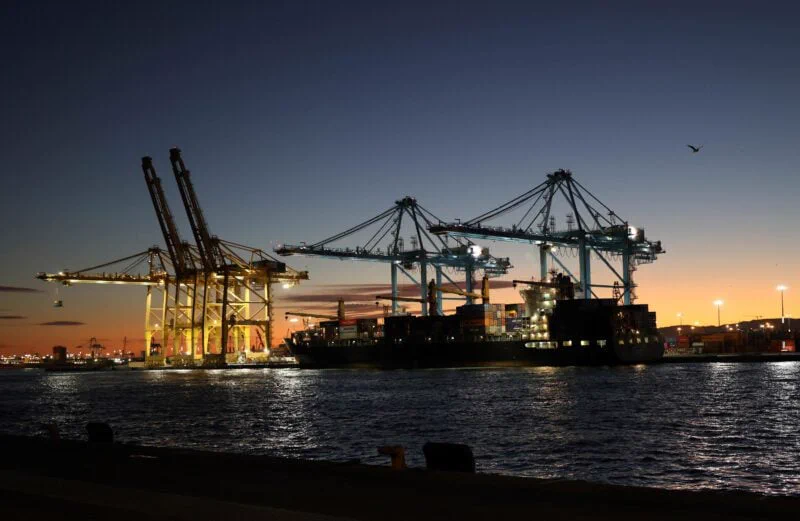
The U.S. Federal Maritime Commission (FMC) has proposed a $200,000 fee for Spanish-flagged ships entering U.S. ports. Additionally, it plans to restrict billions of dollars worth of Spanish imports after finding that Spain's refusal to allow certain U.S.-flagged vessels has negatively impacted American shipping.
This announcement, made on Wednesday, represents a significant escalation in a conflict that began back in 2024 when Spain stopped allowing ships carrying military cargo to Israel to dock at its ports.
After a nearly two-year investigation, the FMC concluded that Spain’s policies forced U.S.-flagged ships to divert to other ports and significantly reduced their activities in Spain.
The proposed measures include the $200,000 fee for each entry of a Spanish-flagged vessel into a U.S. port. There may also be restrictions on imports of Spanish products like cosmetics, oils and fats, ceramics, stone goods, and sugar and candy.
These five categories reportedly accounted for about $3.1 billion in U.S. imports from Spain in 2025, with olive oil alone making up nearly $837 million.
These measures are not yet finalized. The FMC is looking for public feedback before making any decisions and has offered Spain a chance to provide its own input.
U.S.-Flagged Ships Diverting to Morocco
The issue began in November 2024 when Spanish authorities denied port access to the U.S.-flagged vessels Maersk Denver and Maersk Seletar, both run by Maersk Line, Limited, due to cargo linked to Israel. A third vessel, the Maersk Hartford, faced similar restrictions later that month, according to the FMC's latest report.
All three vessels are part of the U.S. Maritime Administration’s Maritime Security Program, which offers financial support to U.S.-flagged commercial ships that are available for national defense needs.
The FMC found that these restrictions have had a long-lasting impact on shipping routes of U.S.-flagged vessels.
Before November 2024, Maersk Line, Limited's ships averaged over seven calls a month at Spanish ports. That traffic has now mostly moved to Morocco, especially to Tangier, which has replaced much of the activity previously seen in Algeciras.
In 2026, Maersk Line, Limited's U.S.-flagged fleet made only six calls in Spain, significantly down from the usual multiple monthly visits before the restrictions were implemented.
The FMC also mentioned confidential evidence showing that nearly all vessels in the Maritime Security Program have ceased calling at Spanish ports due to the restrictions.
Spain asserts that its measures comply with Spanish, European Union, and international laws and are not discriminatory. However, the FMC disagrees, stating its investigation demonstrated that Spain denied docking rights to U.S.-flagged vessels instead of merely imposing rules on specific cargo.
The FMC believes these restrictions weaken the ability of U.S.-flagged ships to compete for cargo moving to and from Spain and could also affect vessels that might be needed for U.S. military operations.
Proposed Trade Restrictions
This new proposal follows a warning in December 2025, in which the FMC indicated it was considering fines up to $2.3 million per voyage, cargo restrictions, and potential entry denials for Spanish-flagged vessels.
The Commission has now narrowed its proposal to a $200,000 fee per voyage and has specified categories of Spanish goods that might face import restrictions.
The proposed trade restrictions could cover around $1.15 billion in oils and fats, $940 million in cosmetics, $635 million in ceramics, $271 million in stone products, and $139 million in sugar and candy, based on 2025 imports.
The FMC may impose restrictions on all five categories or choose narrower measures after consulting the public.
The proposal also gives the FMC the authority to collaborate with the Department of Homeland Security to deny entry or detain vessels carrying restricted goods, regardless of their flag, and to take action against Spanish-flagged vessels that do not pay the required fees.
While the FMC acknowledged that few Spanish-flagged vessels dock at U.S. ports, it noted that the proposed fees alone would not fully resolve the issues found during its investigation.
The Commission plans to increase fees or broaden import restrictions if Spain retaliates against U.S. carriers or shippers.
Public comments will be accepted for 60 days following the publication of the proposed rule in the Federal Register, expected on October 15.
The FMC stressed that these proposed penalties aim to address the shipping conditions created by Spain's port restrictions, rather than the wider political disagreements regarding military cargo transport to Israel.