
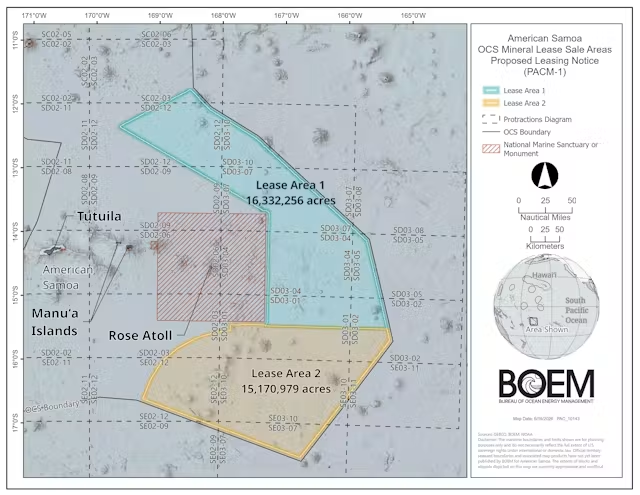
The Trump administration has announced the first-ever offshore mineral lease sale in the U.S., making over 31 million acres of seabed near American Samoa available for companies interested in extracting important minerals from the ocean.
On Monday, the Department of the Interior's Marine Minerals Administration (MMA) released its Final Leasing Notice for an auction set for November 19. This is the last major step before companies can bid for the rights to explore and potentially develop mineral resources on the U.S. Outer Continental Shelf.
The auction, known as PACM-1, includes two lease areas totaling about 31.5 million acres. One area is large, covering 16.3 million acres, while the second spans 15.2 million acres.
According to the final lease terms, each area has a minimum bid of $3 million and a primary lease term of 20 years. For the first five years of mining, production royalties will start at 2%, rising to 5% afterwards.
These areas are believed to have deposits of polymetallic nodules and ferromanganese crusts, which could contain valuable minerals like nickel, cobalt, copper, and manganese. The Trump administration has prioritized increasing domestic supplies of critical minerals as a matter of national security, especially to lessen dependence on supply chains controlled by China.
“Critical minerals are more than commodities; they are crucial strategic assets in global competition,” said Mike Olsen, the acting MMA Director.
Olsen emphasized that the agency understands the cultural, economic, and environmental significance of the waters around American Samoa and aims to balance mineral development with environmental protections and engagement with local communities.
It’s important to note that winning a lease does not give immediate permission to mine. The MMA stated that leaseholders will initially be allowed to conduct preliminary activities like mapping and environmental surveys. More extensive exploration and commercial mining would need separate federal approvals and environmental assessments.
The agency has completed an environmental assessment of the leasing proposal and found no significant impact for the initial activities.
However, environmental groups have strongly criticized the announcement, arguing that opening the deep ocean to commercial mining could have unknown ecological effects.
“These lease sales will unleash the exploitation of our deep seas,” said Julia Singer, Oceana Defense Campaign Manager.
Singer claimed that the administration is ignoring concerns from scientists, local leaders, and communities worried about the environmental risks involved.
Oceana noted that the proposed lease areas are close to the Rose Atoll Marine National Monument, a protected marine zone home to sea turtles, humpback whales, and other species.
Deep-sea mining may involve machines that collect mineral-rich nodules from the sea floor or remove crusts from underwater rocks. Environmentalists warn these activities could destroy sea habitats and create sediment clouds that impact marine life beyond the mining locations.
The leasing proposal has raised concerns in American Samoa, where fishing is vital to the local economy.
Comments from American Samoa Governor Pulaali’i Nikolao Pula emphasized the need for better environmental monitoring, protection for tuna fisheries, and increased oversight of vessels in Pago Pago Harbor during the leasing process.
The governor also urged federal officials to consider the cumulative impacts of mining-related ship traffic, which could strain port infrastructure, waste management, and water quality.
His remarks stressed that any future commercial extraction should be assessed independently of the lease sale and not assumed as a certainty.
The MMA stated it would try to apply the governor's recommendations within existing laws or address them in future regulatory reviews.
The governor also requested a share of federal revenues from mineral leasing for American Samoa. In response, the MMA acknowledged that current law does not allow for such revenue sharing.
This announcement follows various steps by the Trump administration to create a domestic offshore minerals industry.
The government is also advancing another mineral leasing plan near the Commonwealth of the Northern Mariana Islands while NOAA is reviewing requests for deep-sea mineral exploration in international waters under U.S. law.
The MMA was formed in July through the merging of the Bureau of Ocean Energy Management and the Bureau of Safety and Environmental Enforcement, centralizing offshore leasing and safety oversight.
The American Samoa auction is set for November 19, with the final notice to be published in the Federal Register on October 20.
It's uncertain whether the sale will lead to commercial mining, but it represents a key step in the U.S.'s effort to build a deep-sea minerals industry.