
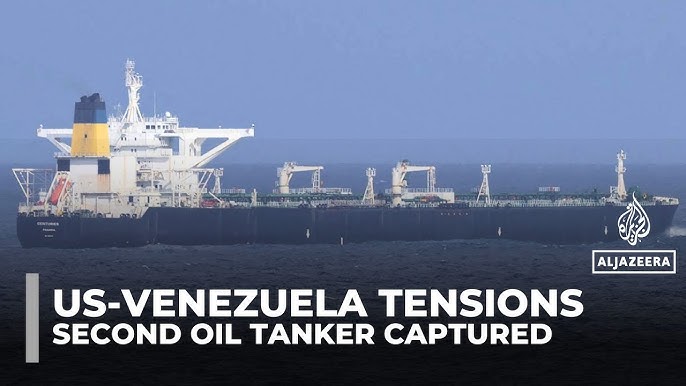
U.S. Intercepts Oil Tanker Near Venezuela
On December 20, the U.S. government intercepted an oil tanker off the Venezuelan coast in international waters. U.S. Homeland Security Secretary Kristi Noem announced this on Saturday, shortly after President Donald Trump declared a “blockade” on all sanctioned oil tankers connected to Venezuela.
This is the second instance in recent weeks where the U.S. targeted a tanker close to Venezuela, amid a significant military buildup in the area.
Noem stated that the U.S. Coast Guard intercepted a tanker that had recently been docked in Venezuela. She added, “The United States will continue to pursue the illegal transportation of sanctioned oil that funds narco-terrorism in the region. We will find you and we will stop you.”
Earlier on the same day, three U.S. officials confirmed the vessel’s interception to Reuters.
When asked for more information, the Coast Guard and Pentagon directed inquiries to the White House. White House spokeswoman Anna Kelly confirmed that the tanker was carrying sanctioned oil. She described the vessel as a falsely flagged ship operating within Venezuela’s “shadow fleet” to traffic stolen oil and support the narcoterrorist regime of Maduro.
The Venezuelan government condemned the tanker’s interception, calling it “a serious act of international piracy.” They denounced the U.S. military for committing “theft and hijacking” of a private vessel in international waters, claiming their crew was forcibly taken.
According to British maritime risk management company Vanguard, the intercepted vessel was the Panama-flagged Centuries, located east of Barbados in the Caribbean Sea.
Jeremy Paner, a partner at the Washington, D.C., law firm Hughes Hubbard and a former OFAC investigator, noted that the Centuries is not sanctioned by the U.S. He commented that the seizure of a non-sanctioned vessel suggests an increase in Trump's pressure on Venezuela and contradicts recent statements about a blockade of sanctioned tankers.
Trump’s Call for a ‘Complete Blockade’
Last Tuesday, Trump announced that he was imposing “a total and complete blockade of all sanctioned oil tankers going into and out of Venezuela.” Since the U.S. seized a sanctioned oil tanker off Venezuela's coast last week, an effective embargo has been in place, causing loaded vessels to remain in Venezuelan waters to avoid seizure.
This crackdown has led to a significant decline in Venezuelan crude exports. While many vessels collecting oil from Venezuela are sanctioned, others transporting oil and crude from Iran and Russia have not faced such penalties. Some companies, especially U.S. company Chevron, continue to transport Venezuelan oil using their authorized vessels.
China remains the largest importer of Venezuelan crude, accounting for about 4% of its imports, with December shipments expected to average over 600,000 barrels per day, according to analysts.
As of now, the oil market is well supplied, with numerous tankers off China’s coast waiting to unload. If the embargo persists, the loss of nearly one million barrels per day of crude could drive up oil prices.
Since the U.S. imposed energy sanctions on Venezuela in 2019, traders and refiners buying Venezuelan oil have turned to a “shadow fleet” of tankers that hide their locations, as well as vessels sanctioned for transporting oil from Iran or Russia.
The shadow fleet is seen as vulnerable to U.S. punitive measures, according to shipping analysts.
The Centuries, which was loaded in Venezuela under the false name “Crag,” is part of this fleet and was transporting around 1.8 million barrels of Venezuelan Merey crude oil destined for China, as per internal documents from state oil company PDVSA.
The tanker departed Venezuelan waters on Wednesday after being briefly escorted by the Venezuelan navy, according to company insiders and satellite images from TankerTrackers.com. The crude was purchased by Satau Tijana Oil Trading, which acts as an intermediary for PDVSA's sales to Chinese independent refiners.
Trump’s campaign against President Nicolas Maduro of Venezuela includes increased military presence in the region and numerous military actions against vessels in the Pacific Ocean and the Caribbean Sea, resulting in over 100 casualties. Trump has also suggested that U.S. land strikes against Venezuela might soon begin.
Maduro has accused the U.S. military buildup of being aimed at toppling him and gaining control of Venezuela's vast oil reserves, the largest in the world.