
The US Coast Guard is stepping up its efforts to block oil tankers off the coast of Venezuela in a bid to cut off crucial economic support for President Nicolás Maduro's government. This blockade is part of the Trump administration's aim to isolate Maduro, whom they accuse of running a drug-trafficking cartel.
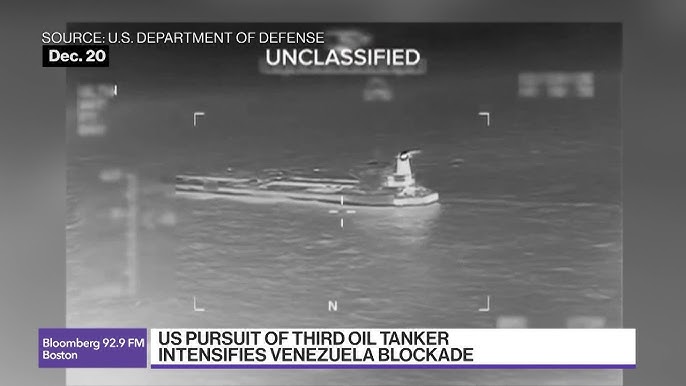
On Sunday, US forces chased the sanctioned tanker Bella 1 as it headed towards Venezuela. They also boarded a ship called Centuries, owned by a Hong Kong company, on Saturday — marking it as the first non-sanctioned vessel to be targeted. Earlier on December 10, another tanker, the Skipper, was intercepted.
These actions signal the most serious effort to disrupt the financial connections that support Maduro’s government, which the US has recently labeled as a foreign terrorist organization. Despite these pressures, Maduro has managed to resist so far, though the blockade is starting to impact Venezuela's economy by limiting hard currency.
On Sunday, Venezuelan officials shared a video of the tanker Canopus Voyager, claiming it is owned by Chevron and transporting over 400,000 barrels of crude oil to Texas. Vice President Delcy Rodríguez mentioned that the shipment is being made “in full compliance with regulations and commitments of the oil industry.”
Venezuelan state oil company PDVSA mostly sends its oil to China, often through obscure intermediaries using older vessels known as dark-fleet tankers. These ships transport sanctioned oil not just from Venezuela, but also from Iran and Russia, with shipments from Russia being essential to mix with Venezuela’s heavy crude.
As Bob McNally from the Rapidan Energy Group pointed out, Washington believes that Maduro relies heavily on oil exports, much more than the US or China relies on Venezuelan oil. With the global oil balance shifting and prices dropping, the US feels it has the upper hand and plans to intensify its pressure on the Maduro regime.
Although the US campaign has grabbed the attention of oil traders, Venezuela's oil exports have significantly decreased over the years, now making up less than 1% of the global demand. The market is well balanced, and China has many other oil sources. As a result, oil prices only saw a slight increase on Monday, with Brent crude rising above $61 per barrel.
China has condemned the US actions, stating they violate international law, and has vowed to support Venezuela in defending its rights.
Conversely, Maduro has accused the Trump administration of trying to seize Venezuela’s oil and install a subordinate government through military actions and covert operations. He has labeled the recent US strategies as aggressions aimed at his regime.
According to Francisco Monaldi, an energy expert at Rice University, the intensified actions indicate a likely drop in oil exports. “These days will be critical,” he stated.
The military presence of the Trump administration in the Caribbean is the largest seen in decades. This shows that all ships near Venezuela are at risk of being stopped, indicating a broad interpretation of what constitutes a target for interdiction.
Defense Secretary Pete Hegseth emphasized that the US blockade on sanctioned oil tankers will remain robust.
Since January 2019, the US Treasury has enforced oil sanctions on Venezuela. Under the Biden administration, a mix of encouraging and punitive measures were adopted to address the democratic decline in the country, allowing Chevron to resume operations with specific conditions.
This year, the US renewed Chevron's license, but ensured that the company would not pay any cash taxes or royalties to the Venezuelan government. Chevron maintains that its operations comply fully with applicable laws and US sanctions.
Although Venezuela's oil industry has faced significant decline, Maduro's government has endured despite sanctions and the departure of around eight million citizens.
As reported by Vice President Rodríguez, the country is currently achieving its oil production target of 1.2 million barrels per day, rebounding from a drop to around 400,000 barrels after the 2019 sanctions.
Both vessels intercepted on the weekend were flying Panamanian flags, but sources noted that a Chinese company owns the oil aboard the Centuries. A White House spokesperson claimed it was operating under a false flag while transporting sanctioned oil. The Skipper vessel, pursued earlier in December, halted near Houston according to tracking data.
Experts believe the US is aiming for a maximum pressure campaign that will ultimately lead to the collapse of Maduro's regime without needing ground troops. They hope to foster a credible threat that might cause key military figures to challenge Maduro and push for his departure.
A shift toward the right in recent elections across Latin America has heightened Venezuela's diplomatic isolation. Countries such as Argentina, Bolivia, and Ecuador recently issued a statement urging Caracas to uphold democratic processes.
Some leaders, however, have expressed concerns regarding the US campaign. Mexican President Claudia Sheinbaum opposed foreign intervention in sovereign matters, while Brazil’s President Luiz Inacio Lula da Silva cautioned that conflict in Venezuela could set a dangerous example globally.
If Maduro's administration cannot export oil, it will have to cut production quickly, as storage facilities are nearing capacity.