
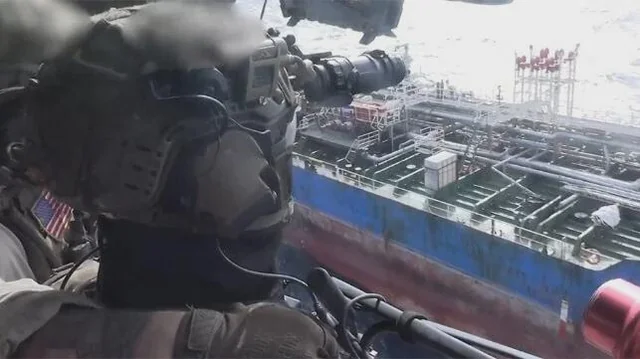
On Tuesday, U.S. Marines boarded and redirected an Iranian-flagged oil tanker in the Gulf of Oman. This action is part of the U.S. effort to enforce its maritime blockade against ships trading with Iran.
The U.S. military's Central Command (CENTCOM) reported that Marines from the 31st Marine Expeditionary Unit boarded the M/T Celestial Sea, which was suspected of trying to breach the blockade by heading towards an Iranian port.
CENTCOM stated, “Earlier today in the Gulf of Oman, U.S. Marines from the 31st Marine Expeditionary Unit boarded M/T Celestial Sea, an Iranian-flagged commercial oil tanker suspected of attempting to violate the U.S. blockade by transiting toward an Iranian port. American forces released the vessel after searching and instructing the crew to change course.”
Footage of the boarding appears to show the same tanker featured in a previous CENTCOM post, which depicted U.S. forces stopping an unidentified merchant ship as part of the blockade efforts against Iran.
CENTCOM forces continue total enforcement of the U.S. blockade against Iran, stopping the flow of commerce into and out of Iranian ports. 89 commercial vessels have been redirected to ensure compliance. pic.twitter.com/0MWwUvkDgS
— U.S. Central Command (@CENTCOM) May 19, 2026
Since the start of enforcement operations, U.S. forces have redirected 91 commercial ships. As of May 20, four vessels have also been disabled for trying to violate the blockade.
The blockade, announced by the Trump administration in April, targets ships entering or leaving Iranian ports, while still allowing commercial traffic through the Strait of Hormuz to non-Iranian destinations.
The maritime enforcement campaign increased significantly earlier this month when U.S. Navy aircraft disabled several Iranian-flagged tankers near the Gulf of Oman.
On May 8, CENTCOM confirmed that U.S. Navy F/A-18 Super Hornets, launched from the aircraft carrier USS George H.W. Bush, disabled the tankers M/T Sea Star III and M/T Sevda with precision strikes.
This operation followed an incident on May 6 involving the tanker M/T Hasna, where an F/A-18 from USS Abraham Lincoln fired cannon rounds into the vessel’s rudder after it allegedly ignored multiple warnings.
CENTCOM has reiterated that these operations aim to enforce the blockade and prevent vessels from reaching Iranian ports.
This ongoing conflict is causing notable disruptions in global shipping and energy markets. Commercial traffic through the Strait of Hormuz remains much lower than pre-conflict levels, as shipowners must contend with missile threats, sea mines, drone strikes, and rising war-risk insurance rates.
Industry organizations like BIMCO and the International Chamber of Shipping have warned that commercial operators are struggling amid rapidly changing military operations, uncertain transit guarantees, and increasing security threats in the Gulf region.
Jakob Larsen, Chief Safety & Security Officer at BIMCO, previously stated that sudden operational changes — such as the suspension of “Project Freedom,” a short-lived U.S. escort initiative for stranded vessels — have complicated risk assessments for commercial shipowners.
There are also growing humanitarian concerns for thousands of seafarers stuck on vessels in the Gulf region, as operators continue to delay or avoid transiting through Hormuz.
May 20, 2026: Iran Establishes New Maritime ‘Oversight Zone’ in the Strait of Hormuz
Iran’s self-declared Persian Gulf Strait Authority (PGSA) has released what appears to be the most detailed description to date of the maritime zone it claims authority over in the Strait of Hormuz. This move escalates Tehran's aim to formalize control over transit through one of the world's key shipping routes.
In a recent post on X, the PGSA stated that Iran's boundaries of its “Strait of Hormuz management supervision area” extend from “the line connecting Kuh Mobarak in Iran and the south of Fujairah in the UAE to the line connecting the end of Qeshm Island in Iran and Umm al-Qaiwain in the UAE.”