
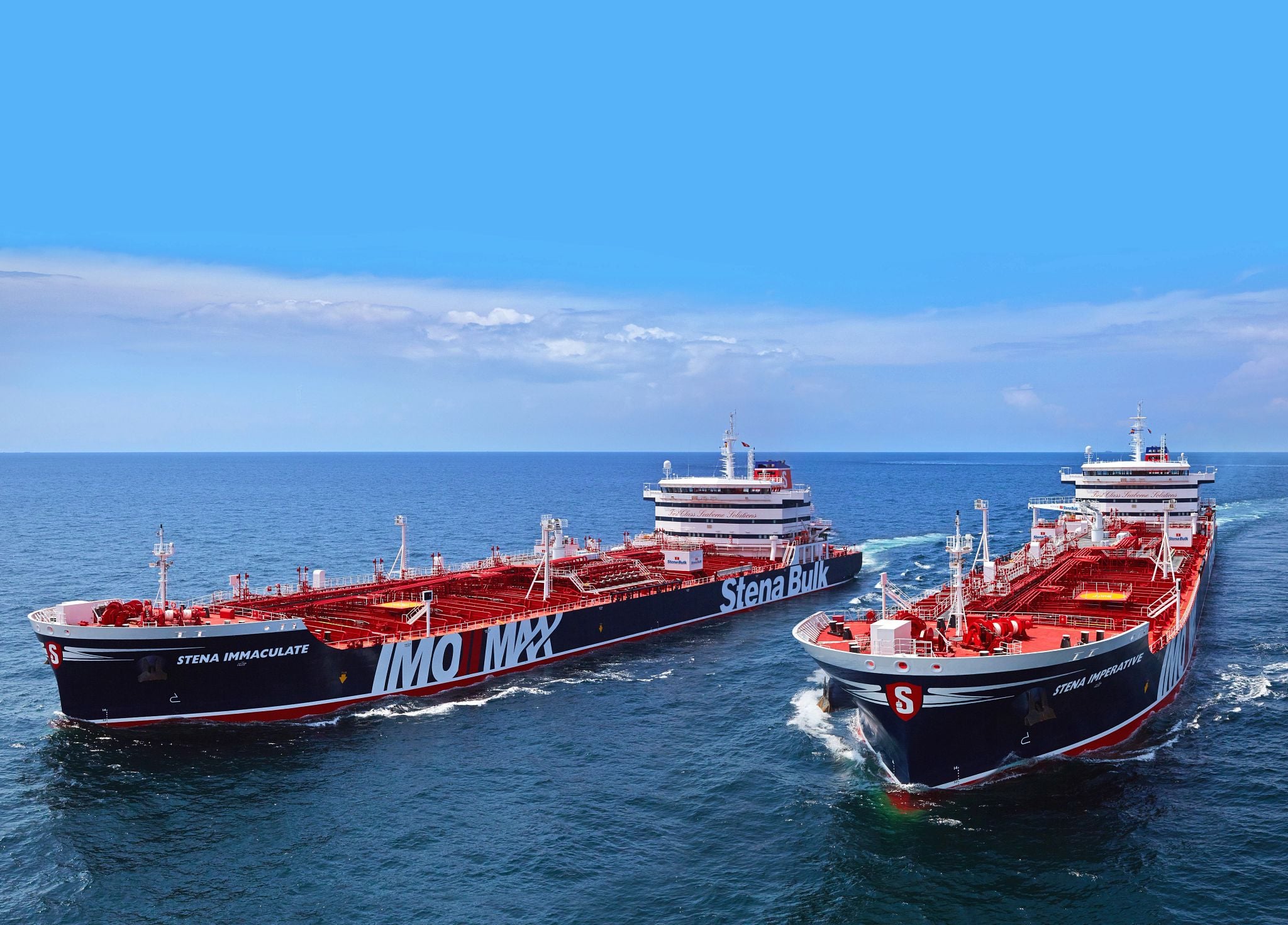
Early Monday, a product tanker managed by Crowley was hit by projectiles while docked at the Port of Bahrain. This incident resulted in the death of one shipyard worker and injuries to two others, marking a concerning increase in violence against commercial shipping in the Persian Gulf.
The U.S.-flagged Stena Imperative suffered damage from two aerial strikes around 2:00 a.m. local time. A statement from Crowley and Stena Bulk confirmed that the strikes caused a fire, but it was quickly controlled. The ship is currently secure at the pier.
All crew members onboard were reported safe and evacuated the vessel, as noted by the United Kingdom Maritime Trade Operations (UKMTO), which received the initial information from the ship’s Company Security Officer. The worker who died was onshore, with two others sustaining injuries.
“We are very saddened by this tragedy, and our thoughts go out to the victims and their families,” the companies stated. “The safety of all individuals and vessels is our top priority at Crowley and Stena. We are taking all necessary actions to ensure their well-being.”
This attack highlights the worsening security situation in the Gulf, which has escalated following coordinated U.S. and Israeli strikes that killed Iran’s Supreme Leader Ayatollah Ali Khamenei and several high-ranking military officials.
The Stena Imperative is part of the U.S. Maritime Administration’s Tanker Security Program, which includes 10 U.S.-flagged vessels assigned to meet Department of Defense fuel needs during emergencies.
The tanker plays an essential role in supplying fuel to the U.S. military. In August 2025, its crew earned CONSOL certification from the Military Sealift Command, allowing the ship to carry out complex resupply operations for U.S. naval forces—an important capability as carrier groups face rising threats.
This strike takes place amidst a debate in Washington regarding the security of U.S. and allied shipyards. In a recent interview, Secretary Hegseth acknowledged existing vulnerabilities in shipyard security and indicated that the Department of War is intensifying its focus on protecting critical infrastructure, although it is unclear how this will apply to foreign facilities.
Recent U.S. and Israeli attacks on Iran have caused significant disruptions to shipping in the Gulf. Since February 28, transits through the Strait of Hormuz have sharply decreased, and numerous tankers have been targeted by missiles or drones in what maritime security officials describe as indiscriminate assaults.
The Joint Maritime Information Center has raised the regional threat level to CRITICAL—the highest warning—indicating that more attacks are very likely. Major shipping lines, including Maersk, MSC, Hapag-Lloyd, and CMA CGM, have paused transits through Hormuz and instructed their vessels to find safe harbor.
In a statement on March 2, the International Chamber of Shipping, European Community Shipowners’ Associations, and Asian Shipowners’ Association called for immediate measures to protect seafarers in the conflict.
“Our main concern is for the safety of seafarers and civilians affected by this situation,” the organizations said, urging strict compliance with Best Management Practices for maritime security and reliance on verified information in this rapidly changing environment.
UKMTO has advised all vessels operating in the region to stay alert and report any unusual activity as investigations into Monday’s incident continue.
The Stena Imperative has previously encountered Iranian forces in the area. In February 2026, it was harassed by Islamic Revolutionary Guard Corps fast boats and a drone while passing through the Strait of Hormuz. Iranian forces reportedly ordered the vessel to stop and threatened to board it, but the tanker carried on under escort from the guided-missile destroyer USS McFaul.
A formal damage assessment is now underway.