
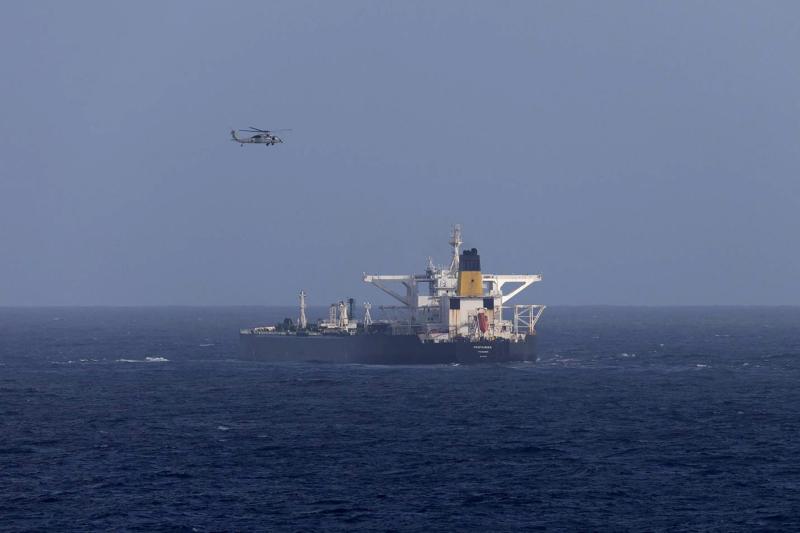
Despite a large military presence, the U.S. Coast Guard does not have enough trained teams ready to take control of the Venezuela-linked tanker Bella 1.
By Idrees Ali, Jonathan Saul, and Trevor Hunnicutt
WASHINGTON/LONDON, Dec 23 — The U.S. Coast Guard is awaiting more personnel before it can attempt to board and seize an oil tanker linked to Venezuela, known as Bella 1, which it has been trying to catch since Sunday, according to a U.S. official and a source familiar with the situation.
The tanker has not allowed the Coast Guard to board. This leaves the task likely to a pair of specialized teams—called Maritime Security Response Teams—who are trained to board ships in such situations, sometimes using helicopters.
This ongoing pursuit highlights the gap between the Trump administration's push to seize sanctioned oil tankers near Venezuela and the limited resources available to the Coast Guard, the agency tasked with carrying out these operations.
Unlike the U.S. Navy, the Coast Guard is authorized to conduct law enforcement operations, including boarding and taking control of vessels under U.S. sanctions.
Earlier in December, Trump ordered a “blockade” against all sanctioned oil tankers entering or leaving Venezuela, part of Washington's broader effort to pressure Venezuelan President Nicolas Maduro.
In recent weeks, the Coast Guard has successfully seized two oil tankers near Venezuela. After the first seizure on December 10, U.S. Attorney General Pam Bondi shared a video showing helicopters approaching a ship while armed agents repelled onto it.
A post on Saturday by the Department of Homeland Security, which supervises the Coast Guard, displayed what looked like Coast Guard officers preparing to depart from the USS Gerald Ford aircraft carrier to seize another tanker called Centuries.
A U.S. official, who spoke on the condition of anonymity, mentioned that the Coast Guard personnel on the Ford were from a Maritime Security Response Team but were too far from Bella 1 to attempt a boarding operation at that moment.
“There are limited teams trained for these types of boardings,” said Corey Ranslem, CEO of maritime security firm Dryad Global and a former member of the Coast Guard.
The Department of Homeland Security did not respond immediately to a request for comment. Reuters could not confirm any other reasons for the Coast Guard's delay in seizing the tanker.
Ultimately, the administration might decide against attempting to board and seize the vessel.
The White House stated that the U.S. is still “actively pursuing a sanctioned dark fleet vessel that is part of Venezuela's illegal sanctions evasion.”
LIMITED RESOURCES
The U.S. Coast Guard is a branch of the armed forces but operates under the Department of Homeland Security.
A large military force, including an aircraft carrier, fighter jets, and other ships, has been assembled in the Caribbean. Recently, Ospreys and additional MC-130J Commando II aircraft arrived in Aguadilla, Puerto Rico, according to another source.
However, the Coast Guard’s resources are significantly fewer.
The agency has long indicated it lacks the capacity to effectively fulfill a growing list of missions, including search and rescue and drug seizures.
In November, the Coast Guard announced it had seized around 49,000 pounds of drugs valued at over $362 million in the eastern Pacific.
“The Coast Guard is experiencing a serious readiness crisis that has developed over decades,” Admiral Kevin Lunday, head of the Coast Guard, told lawmakers in June.
For the fiscal year ending September 2026, the Coast Guard requested $14.6 billion in funding. It will receive an additional $25 billion through significant spending and tax legislation known as the “One Big Beautiful Bill Act.”
“Our Coast Guard is less prepared than at any time in the last 80 years since the end of World War II. The downward trend in readiness we are experiencing is not sustainable,” Lunday stated earlier this year.