
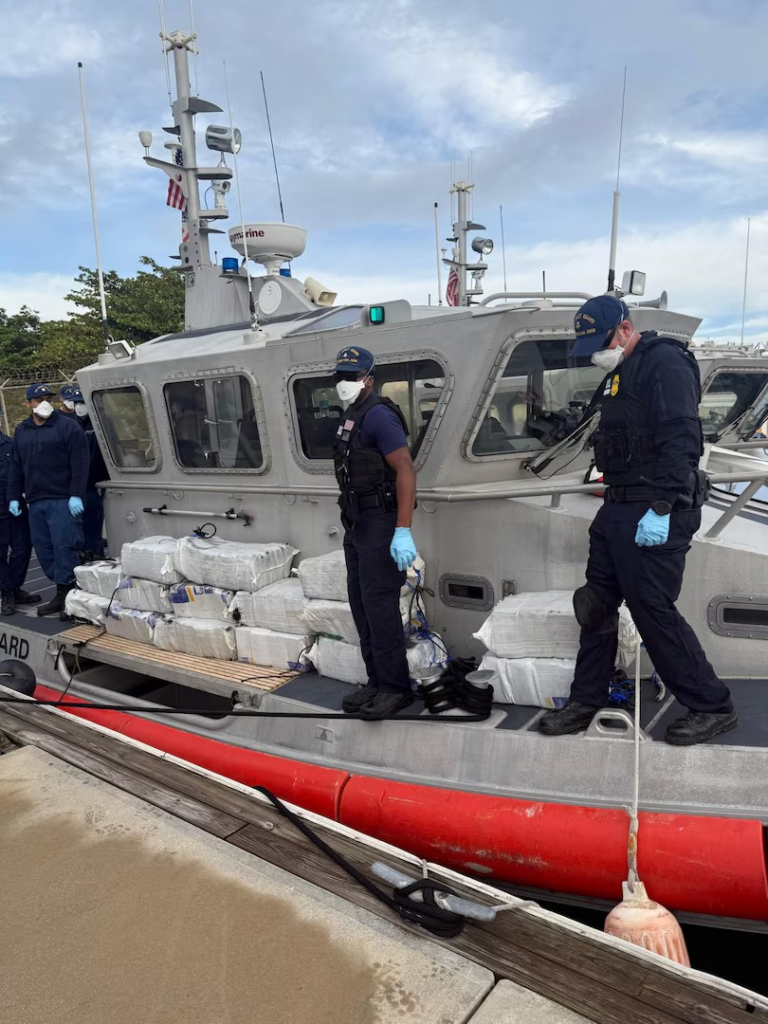
On January 14, a team from the Coast Guard Station San Juan, along with partners from the Homeland Security Task Force – San Juan Region, stopped a drug smuggling boat in the Atlantic Ocean north of Puerto Rico. They seized 16 bales of cocaine worth over $7 million and arrested three individuals.
The operation started when a Coast Guard Air Station Miami HC-144 Ocean Sentry aircraft spotted a suspicious 25-foot panga-style speedboat in international waters north of Vega Baja. Coast Guard watchstanders directed the cutter Joseph Tezanos and a 45-foot Response Boat–Medium to intercept the vessel, while a Customs and Border Protection Air and Marine aircraft provided ongoing aerial surveillance.
The Coast Guard team boarded the boat, detained three men, and recovered 506 kilograms (1,115 pounds) of cocaine. The suspects and the drugs were handed over to the Homeland Security Task Force partners in San Juan for further legal action.
Cmdr. Matthew Romano, the chief of response at Coast Guard Sector San Juan, emphasized the success of collaboration among the Coast Guard, CBP, the Department of Justice, and local law enforcement, stating, “This interdiction highlights the strength of our interoperability and the effectiveness of our combined maritime enforcement.”
This operation is part of the Homeland Security Task Force initiative created by Executive Order 14519, which aims to dismantle international crime organizations, drug cartels, and human smuggling networks in the Caribbean and U.S. maritime areas.
The interdiction falls within what experts are calling the U.S.'s most aggressive anti-drug campaign in modern times.
Since September 2025, the Trump Administration has allowed U.S. military forces to use lethal force against suspected drug-smuggling vessels at sea, marking a significant change from traditional methods focused on interdiction and arrests. The new rules of engagement allow U.S. forces in the Caribbean and Eastern Pacific to target fast boats and semi-submersible “narco-subs,” often under the direction of U.S. Southern Command.
This strategy treats maritime drug trafficking as a national security issue instead of just a law enforcement matter. Instead of mainly looking at seizure volumes, the focus now is on disrupting the trafficking system — destroying vessels, eliminating skilled crews, and undermining logistics networks to make operations more expensive and deter trafficking.
Officials believe that sinking smuggling boats at sea stops traffickers from using the same vessels and crew again, creating a stronger deterrent than just making arrests.
For those in the maritime and shipping sectors, this campaign marks a major change in U.S. maritime enforcement policy, with broad consequences for engagement rules, international maritime law, regional security, and the increasing involvement of military forces in counter-narcotics actions.