
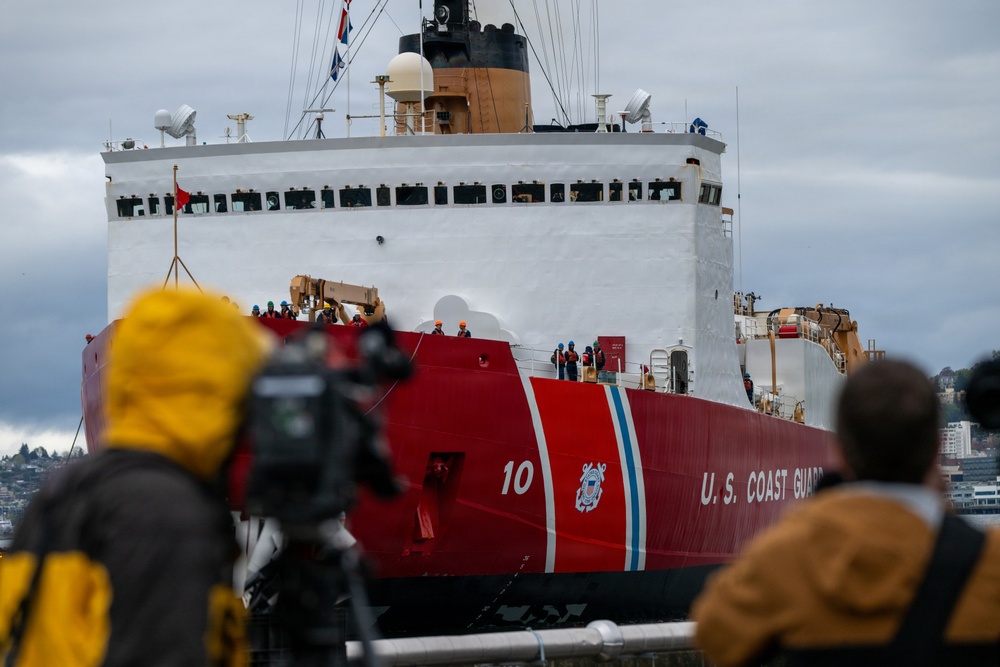
The U.S. Coast Guard's only heavy icebreaker, the Polar Star, has returned to Seattle after a long deployment in Antarctica, where it helped with important resupply operations for American research stations.
This 399-foot icebreaker completed a 146-day mission as part of Operation Deep Freeze 2026, an annual effort led by the military to support the National Science Foundation's Antarctic program.
The Polar Star left Seattle in November and traveled over 20,000 nautical miles during its time in Antarctica, spending more than two months in icy waters.
Captain Jeff Rasnake, the ship's commanding officer, expressed pride in the crew, stating, "I am so proud of how this crew worked together through every single challenge this year’s mission presented."
While working in the Ross Sea area, the crew cut a seven-mile (11-km) channel through ice that was up to eight feet thick. This was crucial for allowing fuel and cargo ships to get to McMurdo Station, the biggest U.S. base in Antarctica.
The icebreaker escorted several vessels through this channel, including a fuel tanker that delivered millions of gallons of fuel and cargo ships that brought essential supplies for year-round scientific study.
Additionally, the crew helped install a new pier for the National Science Foundation, which is seen as a significant improvement for logistics in the future, according to Coast Guard officials. The Polar Star escorted the tugboat that transported the 330-foot-long NSF Discovery Pier.
Cmdr. Samuel Blase, the executive officer of the Polar Star, remarked on the new pier's importance, saying, “The delivery of the new NSF Discovery Pier is a landmark achievement that will significantly enhance the logistical support for the U.S. Antarctic Program for years to come.”
He added that the pier's journey from Oregon to McMurdo Sound was a result of teamwork between the Coast Guard, National Science Foundation, U.S. Navy Seabees, U.S. Army Corps of Engineers, the New Zealand Antarctic Program, and the Tug Rachel.
Operation Deep Freeze is one of the toughest peacetime missions the U.S. military undertakes, involving icebreaking, escort missions, and logistical support in extremely harsh conditions. This year's mission also included helping a cruise ship trapped in ice and conducting five separate vessel escorts.
The Polar Star, which has been in service since 1976, is the only heavy icebreaker the U.S. operates and has now completed its 29th deployment to Antarctica. For nearly 50 years, it has played a vital role in maintaining a U.S. presence in polar regions, allowing access to remote research locations and supporting national interests.
However, the Polar Star is now far beyond its intended service life, highlighting the need for the Coast Guard to develop a new generation of icebreakers under the Polar Security Cutter program. These new ships, which will be larger and more capable than the Polar Star, have experienced delays but are anticipated to replace and enhance U.S. polar operations.