
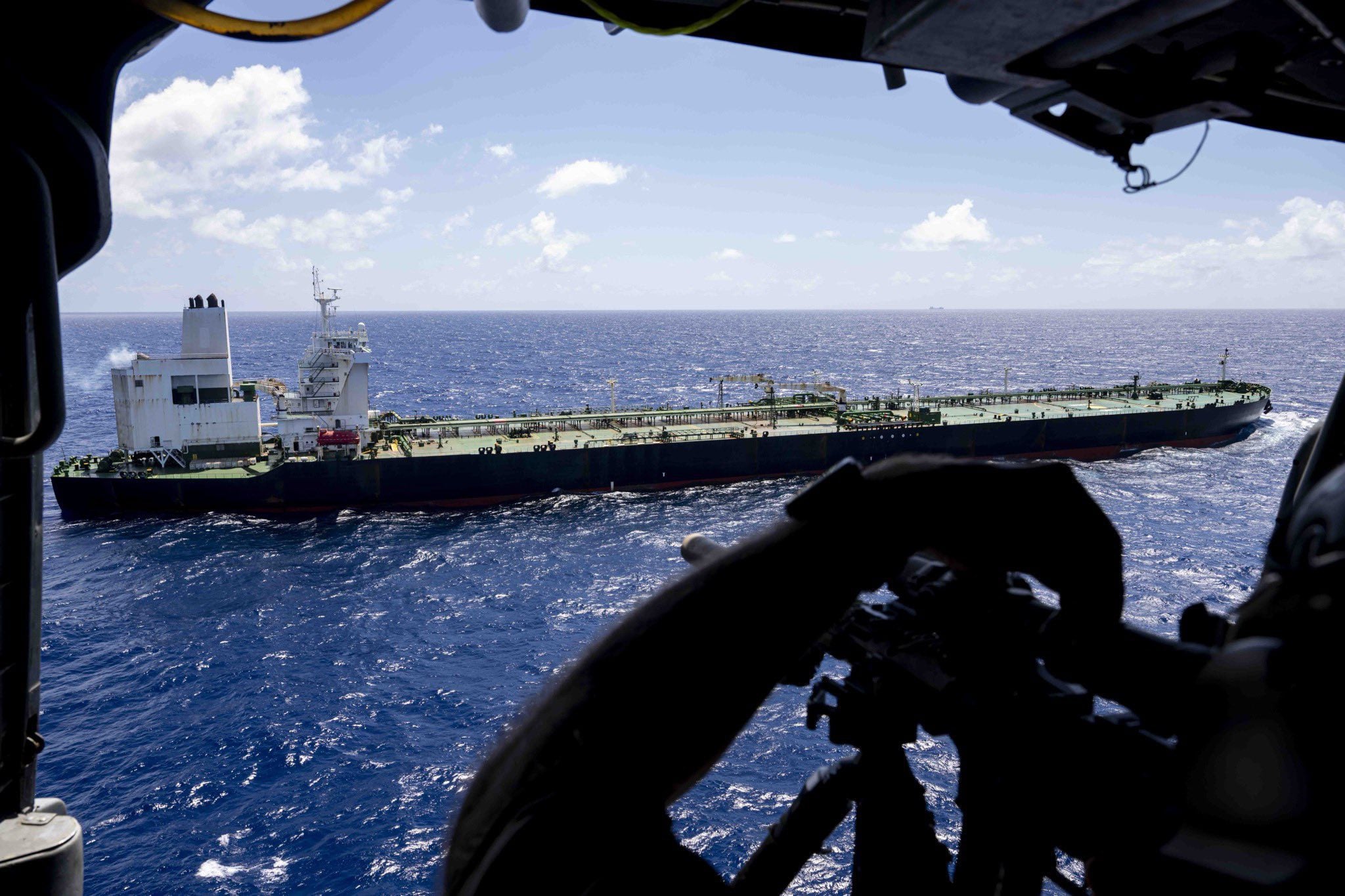
U.S. forces have boarded the oil tanker Bertha in the Indian Ocean, marking the tenth vessel captured in an ongoing campaign against the shadow fleet transporting illegal Venezuelan oil from the Caribbean to the Indo-Pacific region.
The Department of War shared the news on social media, saying, “Three boats tried to escape, and all three have been captured.”
They added, “Overnight, U.S. forces successfully boarded the Bertha without any incidents in the INDOPACOM area. The vessel was operating against President Trump's quarantine of sanctioned ships in the Caribbean and attempted to evade capture.”
This seizure is a major step in a global enforcement operation. The Department of War stated, “From the Caribbean to the Indian Ocean, we tracked it and stopped it. No other country has the global reach or determination to enforce sanctions at this scale.”
Final Target in Sight
As per TankerTrackers, a maritime intelligence firm, Bertha (IMO: 9292163) was the last oil-carrying tanker from a group of sixteen that broke through the U.S. Navy blockade on January 3.
The U.S. imposed sanctions on this tanker in December 2024 due to its involvement in the illegal transport of Iranian oil as far back as 2022. At the time of the sanctions, the vessel was managed by Shanghai Legendary Ship Management Company Limited based in China.
TankerTrackers noted, “The U.S. Coast Guard intercepted Bertha just nine days after our tweet predicting that its capture was ‘only a matter of time.’ The vessel is known by the alias ‘EKTA’ to avoid detection.”
Charlie Brown, Director of the UANI Tanker Tracking Program, said, “Actions like this should bring renewed attention to sanctioned tanker activities in the Eastern Outer Port Limits near the Singapore Strait, where illegal ship-to-ship transfers are a major part of the illicit oil supply chain. Ongoing monitoring, sharing information, and coordinated enforcement are key to addressing the operations of these dark fleet tankers in Southeast Asia.”
Part of a Broader Crackdown
The capture of Bertha follows U.S. forces intercepting the Veronica III on February 15 in the South Indian Ocean, which was carrying Venezuelan fuel oil and crude oil. That tanker left Venezuela on January 3, the same day Venezuelan leader Nicolás Maduro was taken into custody, and was transporting around 1.9 million barrels of oil.
The Veronica III, which was falsely flagged, was also sanctioned by the Treasury Department in December 2024 as part of a larger action targeting 35 entities and ships connected to Iran's oil trade. The tanker was managed by Shanghai Future Ship Management Co. Ltd., a Chinese company accused of aiding illegal Iranian oil shipments for years.
The interception of the Aquila II on February 9, after a 10,000-mile chase from the Caribbean to the Indian Ocean, registered as the eighth seizure in this operation and the first in the Indian Ocean.
This enforcement campaign gained speed after President Trump announced a “complete blockade” on sanctioned oil tankers entering or leaving Venezuela in mid-December. Previous seizures included the Veronica on January 15, the Olina on January 9, and several others in December.
Global Enforcement, Regional Tensions
The Department of War stated, “International waters are not a safe haven for sanctioned operators. Whether by land, air, or sea, we will find you and ensure justice is served.”
Russia has criticized the seizures as illegal and has warned of possible retaliation against U.S.-flagged vessels. However, the U.S. Southern Command defends these actions as lawful enforcement of U.S. sanction policies, backed by a strong military presence in the region.
Targeting the Shadow Fleet
Treasury officials aim to cut off revenue streams linked to sanctioned oil exports while increasing the risks for insurers, traders, and service providers involved in shadow-fleet operations.
Countries like Iran, Russia, and Venezuela use complex networks of older tankers and obscure ship management firms operating in multiple jurisdictions. They employ tactics such as fake paperwork, AIS manipulation, and frequent changes to vessel names and flags to avoid detection.
The operations to pursue and seize these vessels highlight the lengths that sanctioned operators will go to avoid capture and demonstrate the expanding geographical focus of U.S. efforts to stop them.