
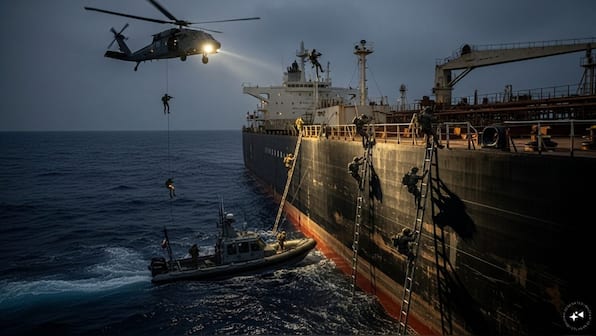
U.S. forces have boarded the oil tanker VERONICA III, which is under sanctions, in the Indian Ocean. This event marks the ninth ship either seized or intercepted as part of a growing effort against the shadow fleet transporting illegal Venezuelan oil, which stretches from the Caribbean to the Indo-Pacific region.
The Panama-flagged VERONICA III (IMO: 9326055) was intercepted overnight without any incidents in the region under U.S. Indo-Pacific Command. This action was taken after the tanker allegedly tried to bypass President Trump’s quarantine on sanctioned oil shipments, according to the Department of War.
“We defend the Homeland forward. Distance does not protect you,” stated the Department of War in a social media post. “The vessel tried to defy President Trump’s quarantine and hoped to escape. We tracked it from the Caribbean to the Indian Ocean, closed the distance, and shut it down. No other nation has the reach, endurance, or will to do this.”
According to maritime intelligence firm TankerTrackers.com, the VERONICA III left Venezuela on January 3, 2026—the same day Venezuelan leader Nicolás Maduro was captured—while carrying around 1.9 million barrels of crude oil and fuel oil. The tanker has been involved in transporting oil from Russia, Iran, and Venezuela since 2023 and is known in tracking circles by the nickname “DS VECTOR.”
A Vessel with a History
The VERONICA III has been on the radar of U.S. authorities for some time. The vessel was first sanctioned by the Treasury Department on December 3, 2024, as part of a larger action that targeted 35 entities and vessels connected to Iran's oil trade.
The Treasury identified the tanker as being managed by Shanghai Future Ship Management Co. Ltd., a Chinese company accused of facilitating illegal Iranian oil shipments for years. The company’s history includes a 2021 incident where one of its managed vessels was seized by Indonesian authorities for illegally transferring oil from an Iranian-flagged tanker, which caused an oil spill while both ships attempted to hide their identities by turning off their AIS.
Treasury documents reveal that the VERONICA III has transported hundreds of thousands of metric tons of Iranian crude oil on behalf of the National Iranian Oil Company and China Concord Petroleum Company, which is designated by the U.S. since at least 2022.
Part of a Broader Campaign
This interception occurs just days after U.S. forces intercepted the Aquila II on February 9, following a 10,000-mile pursuit from the Caribbean to the Indian Ocean. This operation marked the eighth tanker seizure in the ongoing crackdown.
The enforcement campaign has intensified sharply since President Trump announced a “complete blockade” of sanctioned oil tankers entering or leaving Venezuela in mid-December. Previous seizures include the Veronica on January 15, the Olina on January 9, the M Sophia and Marinera on January 7, and the Skipper and Centuries in December.
“The Department of War will deny illicit actors and their proxies freedom of movement in the maritime domain,” asserted the department. “International waters are not a sanctuary. By land, air, or sea, we will find you and deliver justice.”
Russia has criticized the interdictions as illegal and has warned of possible retaliation against U.S.-flagged vessels. U.S. Southern Command has defended these actions as lawful enforcement of U.S. sanctions policy, backed by a substantial military presence including carrier strike groups and amphibious forces in the region.
Disrupting the Shadow Fleet
Treasury officials assert that the campaign aims to cut off revenue tied to sanctioned oil exports while raising risks for insurers, traders, and service providers that continue to back shadow fleet operations.
Iran, Russia, and Venezuela depend on a wide network of aging tankers and obscure ship management firms operating across various jurisdictions, utilizing tactics such as false documentation, AIS manipulation, and frequent changes to ship names and flags to avoid detection.
The pursuit and capture of VERONICA III highlight how determined sanctioned operators are to avoid detection and showcase the growing reach of U.S. efforts to stop them. The campaign now spans three oceans and shows no signs of slowing down.