
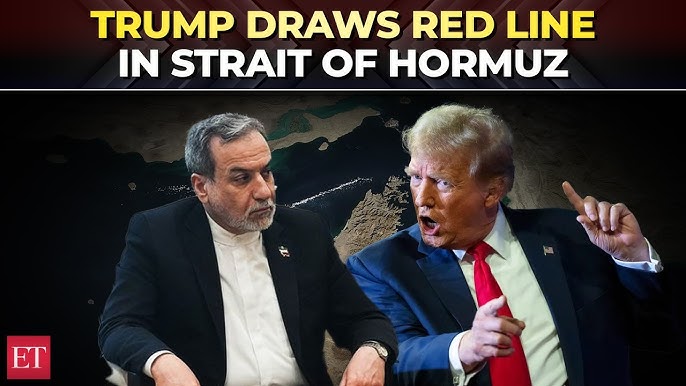
The United States is set to create a blockade on maritime traffic connected to Iran. This move is a significant step up in the ongoing crisis in the Strait of Hormuz and adds new risks for shipping globally.
After negotiations in Islamabad failed over the weekend, President Donald Trump announced that U.S. forces would start a blockade of maritime routes linked to Iran, targeting ships going in and out of Iranian ports. He warned that vessels paying "tolls" to Iran might be intercepted on the open sea.
Trump stated on social media, “No one who pays an illegal toll will have safe passage on the high seas,” and mentioned that U.S. forces would also begin clearing mines in the waterway.
By Sunday, U.S. Central Command confirmed the blockade would officially start at 10:00 a.m. ET on Monday, April 13.
"The blockade will be enforced fairly against vessels from all nations entering or leaving Iranian ports and coastal areas," CENTCOM said, noting that the initiative applies throughout the Persian Gulf and the Gulf of Oman.
Importantly, CENTCOM added that U.S. forces “will not obstruct freedom of navigation” for ships passing through the Strait of Hormuz that are headed to non-Iranian ports.
Late on Sunday, Trump reiterated this timeline, emphasizing the shift to active enforcement.
On Monday, U.S. Central Command clarified that the blockade would apply to “all vessel traffic regardless of flag,” according to a notice for mariners. The directive warns that “any vessel entering or leaving the blocked area without authorization is subject to interception, diversion, and capture,” while confirming that neutral passage through the Strait of Hormuz to non-Iranian destinations will not be hindered.
The blockade will cover “all of the Iranian coastline, including ports and oil terminals,” although humanitarian supplies like food and medical items will be allowed, subject to inspection.
This U.S. action does not fully close the Strait of Hormuz, but it may create more challenges for shipping markets.
The U.S. is essentially placing limits on Iranian trade without completely blocking the waterway itself. Ships can still pass through the strait, but they cannot stop at Iranian ports or carry cargoes connected to Iran.
This creates additional uncertainty. A ship transporting oil from Iraq or the UAE might have no official limits, but a tanker visiting an Iranian port—or even thought to be involved with Iranian trade—now faces the risk of U.S. interception.
The blockade adds to an already complicated situation influenced by Iranian actions in the strait. Iran has been affecting routing decisions, advising vessels to use alternative paths near Larak Island due to fears about possible sea mines. Additionally, Tehran has warned that foreign military presence near the strait could be seen as a ceasefire breach.
This situation raises the risks for shipowners. On one hand, Iranian control and the threat of mines discourage traffic. On the other, U.S. enforcement brings risks of interception for port calls, cargo origins, or compliance with Iranian instructions.
The outcome is not clear; instead, it increases uncertainty.
The blockade also signifies a major change in U.S. policy. In March, the U.S. Department of the Treasury allowed the sale of Iranian oil already in transit to continue, releasing an estimated 140 million barrels to help stabilize global markets.
This followed a waiver allowing Indian refiners to accept Russian oil cargoes already at sea, another step to ensure steady supply despite disruptions related to Hormuz.
Both actions represented a strategy to avoid supply shocks by facilitating oil flows. The new blockade seems to contradict that strategy.
Rather than promoting oil flow, the U.S. is now preparing to restrict it, raising the stakes for traders and complicating already strained supply chains.
Mine Clearance Indicates Greater Risks
Meanwhile, U.S. naval forces are taking steps to address the ongoing physical dangers that deter shipping, specifically mines placed by Iran earlier in the conflict.
Guided missile destroyers, USS Frank E. Peterson (DDG 121) and USS Michael Murphy (DDG 112), have begun operations to set the stage for mine clearance in the strait, with additional unmanned systems expected to follow.
“Today, we started the process of creating a new passage,” said CENTCOM commander Adm. Brad Cooper, noting that a safe route would be shared with the maritime community.
This move seems to bolster claims that Iran has mined this critical global energy passage, but confirmation of that is secondary. The threat itself has been enough to paralyze shipping, and the effort to establish a "safe pathway" underscores the larger issue: confirming a viable channel does not guarantee confidence in its safety.
Despite the ceasefire, shipping activity through Hormuz remains much lower than normal. Only a few vessels have made the transit in recent days, and although some tankers began leaving the Gulf over the weekend, many operators still hesitate due to uncertainties about routing, enforcement, and associated risks.
Additionally, oil prices have climbed back toward $100 per barrel following the collapse of negotiations, highlighting growing worries about supply disruptions related to the strait, which handles about 20% of the world’s seaborne energy shipments.
For the shipping industry, the key question is no longer merely whether Hormuz is open. It’s whether it can serve as a reliable commercial channel under these current conditions.
The U.S. blockade on Iranian ports does not shut down the Strait of Hormuz, but it changes how it operates. Previously, it was a single point affected by disruptions; now, it is becoming a controlled corridor defined by enforcement and risk.
Ships can still pass, but not freely, and there will be consequences for those that do. Until these conditions change, the world’s most vital energy route will technically remain open but will still experience significant disruptions and will be far from normal.