
By Michael Nienaber, Alberto Nardelli, Andrea Palasciano, and Josh Wingrove
June 16, 2026 — US President Donald Trump continues to assert that the Strait of Hormuz, a crucial route for oil and liquefied natural gas that typically carries one fifth of the world's supply, will reopen by Friday.
However, during the Group of Seven summit, where discussions about Iran likely took center stage, it became evident that Trump's European allies do not share his positive outlook. They doubt that trade can resume by the end of the week as he has promised, and they have real questions about the agreements made before committing to mine-clearing missions and patrols.
A G7 official, who requested anonymity to discuss internal matters, mentioned that reaching a consensus on how to approach the situation in Iran is proving to be challenging. It seems unlikely that a joint statement will be made, a common occurrence during Trump's presidency.
Even Italian Prime Minister Giorgia Meloni, who has mostly avoided offending Trump, stated that her country's participation hinges on stopping hostilities in Lebanon, where Israel has conducted military strikes recently. She is not the only one skeptical of Trump's ambitious timeline.
Adding to the uncertainty, even within Trump's administration, some high-ranking officials are hesitant to claim that normal navigation through the vital waterway can be restored immediately.
One senior US official explained that traffic in the strait would gradually increase, possibly taking up to two weeks for shipping to significantly pick up — and even longer to reach the levels seen before the US and Israel attacked Iran in February. Mines remain in the strait that need to be cleared, and different shipping companies have varying levels of comfort when it comes to navigating Hormuz.
This official also mentioned that a memorandum of understanding between the US and Iran would specify that the strait would be open without tolls for 60 days, and the US expects this stipulation to be part of any final agreement. The fact that free navigation, once guaranteed, is now a point of negotiation adds to the complexity.
According to oil industry leaders, the White House has been informed for months that allowing tolls for safe passage through the Strait of Hormuz would be unacceptable for the US. The White House is aware of the industry's position, according to a source familiar with the discussions who spoke on condition of anonymity.
While both the US and Iran have claimed they have reached an interim agreement to reopen the strait, their public descriptions of it differ due to the lack of an official document.
“Iran's explanation is terrible, while our version makes sense,” commented Senator Lindsey Graham, a Republican from South Carolina and a close Trump ally. “Let's examine it and see what it really says.”
The agreement is set to be signed in Switzerland on Friday. US officials have given varied timelines for when the complete text will be available, with Trump saying it could happen by the end of the week at the earliest and another senior official suggesting within the next two days. Vice President JD Vance is expected to be the administration's representative at the signing.
Next, G7 leaders will focus on creating a framework for de-mining the waterway, which requires cooperation from Iran and other involved parties, Bloomberg reported previously. European leaders plan to seek Trump's approval for the mission at the G7.
The challenge they face is that Trump has downplayed their role and the potential difficulties they might encounter in providing assistance.
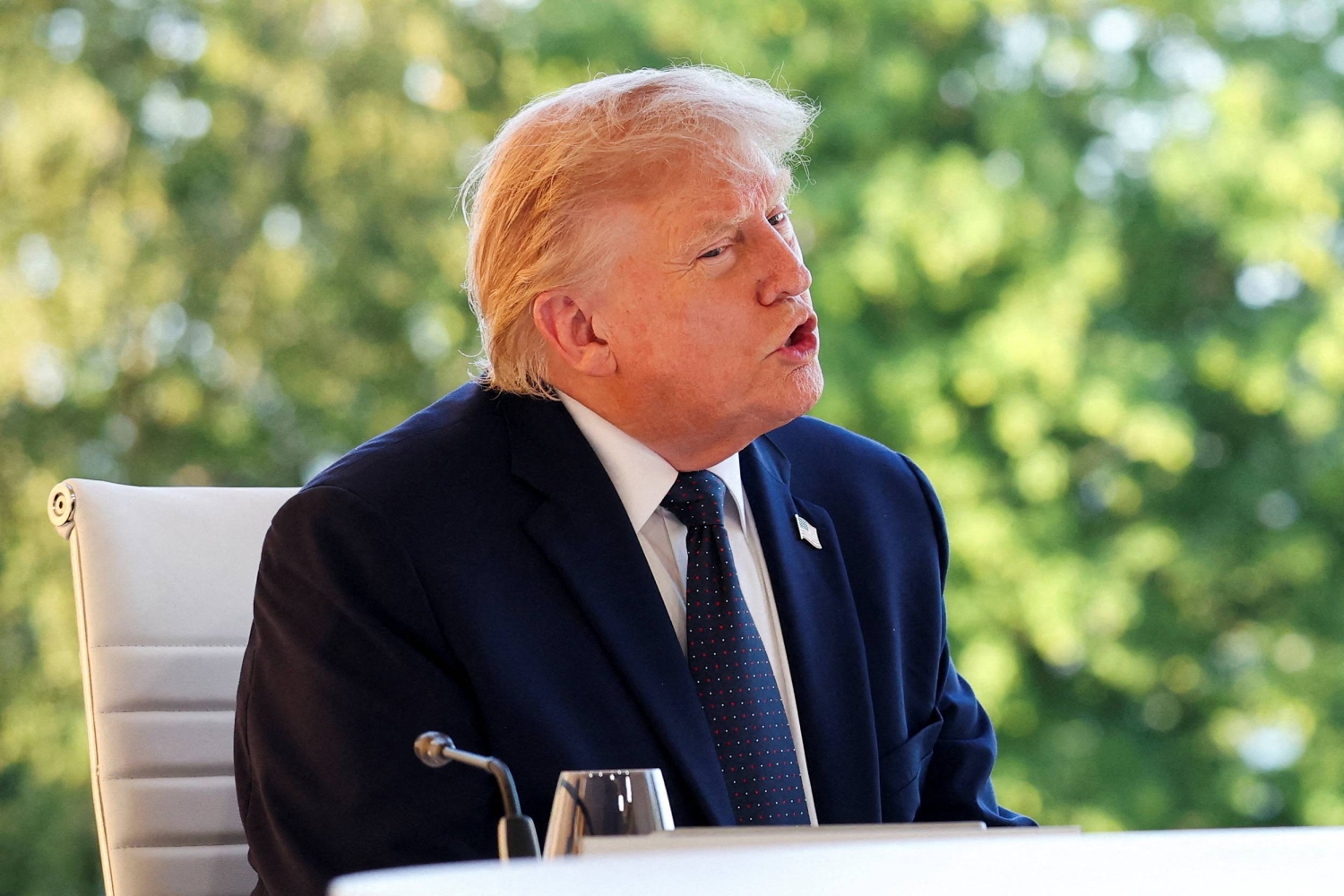
“Ships are beginning to go out now, and by Friday it will be fully open,” Trump stated during the summit in Evian. “They are doing some search for a few mines that have already been spotted, but essentially, ships are starting to move.”
Moreover, deployments will not commence until there is a final agreement between the US and Iran that reinstates full and unrestricted commercial navigation rights and ensures a safe environment for military assets in the strait, Bloomberg has previously reported.
“A permanent ceasefire would be necessary for Canada to participate in this,” Canada’s foreign minister, Anita Anand, mentioned to reporters in Parliament on Monday.
This could take weeks rather than days, according to warnings from German officials, as any direct involvement would require an international mandate. Additionally, clearing the mines could be a complex and lengthy process.
It remains uncertain how many mines are in the strait or if any were placed there at all. At various points, Iran has claimed it had mined the narrow waterway. As early as mid-March, the UK indicated it appeared Iran had indeed done so, while the US disagreed.
Ensuring the strait is free from mines will be a meticulous task, said Caitlin Talmadge from MIT, adding that progress would be expedited if Iran shares any information it has about mine placement.
European countries have a fair amount of mine-clearing capabilities, but those vessels may find themselves in a precarious position if hostilities resume.
“Mine clearance operations need to occur in a safe environment,” she explained. “If Iranian attacks continue, relevant vessels, especially mine countermeasure ships, could be at risk since they generally cannot defend themselves.”
Despite their concerns, European nations are pressing ahead with their preparations.
French President Emmanuel Macron and UK Prime Minister Keir Starmer have taken the lead in rallying US allies to develop a plan to help reopen the strait following a final peace agreement. Over 15 countries have pledged equipment and personnel for the mission.
As the host of the summit — and this being his last G7 as leader — Macron is particularly invested in the outcome.
“This is a matter of great importance for world peace, and it will lead to the reopening of Hormuz,” Macron stated. “It will ensure peace in Lebanon. We are ready to share the burden and be part of the international commitment.”