
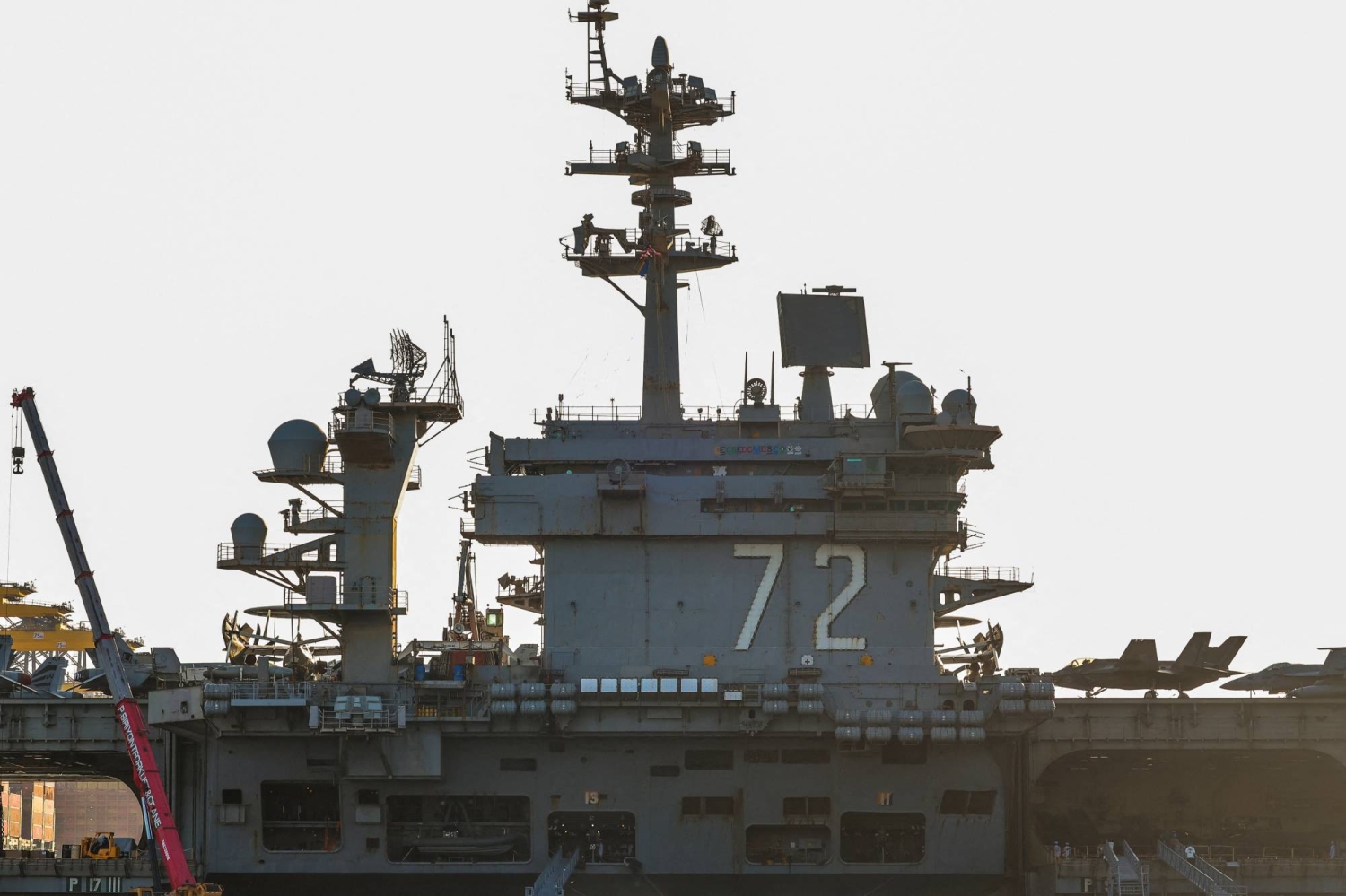
(Bloomberg) — The Pentagon is sending an extra aircraft carrier along with 10,000 sailors and Marines to the Persian Gulf. This move provides American commanders with more options if President Donald Trump decides to increase military actions against Iran.
The USS Theodore Roosevelt has departed from its base in San Diego and is en route to the Middle East.
Once the Roosevelt arrives, the US could have three carrier strike groups in the region, matching the levels seen in late April. However, there hasn't been a decision yet on whether to maintain that number, according to the official.
The USS George Washington is currently in the region, but the George H.W. Bush has temporarily left, as the official noted. Before recent operations against Iran, the last time the US had three carrier strike groups in the Middle East was in 2003, during the early invasion of Iraq.
US Central Command, which manages military operations in the Middle East, stated, “we don’t discuss unit schedules for operational security reasons.”
These carrier movements happen as Trump mentioned that military strikes against Iran could be “possible” after the midterm elections in November.
On Monday, the USS Makin Island amphibious readiness group left for the Middle East. This group includes an assault ship, aircraft, and 2,200 Marines, which gives Centcom more options. Meanwhile, the USS Boxer amphibious readiness group is currently operating near the Strait of Hormuz.
In the past few weeks, the US has also sent two additional missile batteries to protect oil and gas facilities in Qatar and Saudi Arabia. This deployment aims to reassure US allies that Washington will safeguard key energy installations if Trump authorizes new attacks.
Maintaining three carriers in the region could strain the Navy's readiness, according to naval analyst Ronald O'Rourke.
This strain is evident from the extended deployments of the USS Abraham Lincoln, which recently reached Thailand after a nine-month mission, and the USS Gerald Ford, which was sent to the Middle East after operations against Venezuela and spent 11 months at sea.
“Keeping even two carriers in that area for a long time would stress the carrier fleet,” said O'Rourke, a retired analyst from the Congressional Research Service. “But maintaining three carriers over an extended period would add even more strain.”
As tensions rise in the Middle East, investors are weighing the risk of inflation from increasing oil prices against the possibility that the US Federal Reserve will take a more cautious approach to tightening. Oil prices have risen due to concerns about military action, with Brent crude increasing by 0.4% to $102.74 a barrel, following a 4% gain on Thursday.
There has been a lull in significant US or Iranian military actions as efforts continue to revive diplomatic negotiations. However, discussions to resolve the now eight-month war are stalled, particularly over Iran’s control of the Strait of Hormuz.
Iran’s Foreign Minister Abbas Araghchi has recently indicated in private talks that Tehran might allow nuclear inspectors back into bombed facilities in exchange for relief from sanctions.