
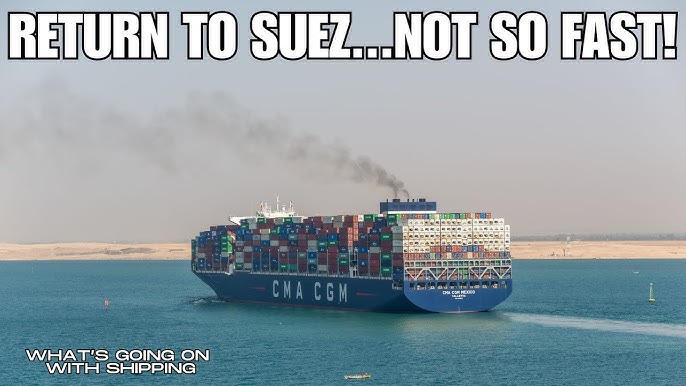
A French shipping company's sudden shift on Suez Canal routes raises doubts about the stability of the Red Sea.
Just after Maersk announced that it would resume service through the Suez Canal for the first time in over two years, competitor CMA CGM has decided to change its plans. The French carrier is now rerouting three major shipping services from Asia to Europe back around the Cape of Good Hope. This has sparked new concerns about the reliability of global shipping routes.
CMA CGM explained that their choice was influenced by "the complex and uncertain international context". This is surprising since they had previously been one of the most proactive carriers in returning to the Red Sea, as noted by analysts from Xeneta.
This situation contrasts sharply with Maersk, which recently confirmed it would continue its Middle East-India-U.S. East Coast service via the Suez route, following successful trial runs. Many viewed Maersk’s decision as a hopeful indicator after almost two years of avoiding the Red Sea.
The Cost of Unpredictability
According to Destine Ozuygur, a Senior Market Analyst at Xeneta, CMA CGM's sudden reversal highlights a significant issue in the shipping industry: unpredictability.
"Shippers want predictable supply chains," Ozuygur said. "When carriers initially decide to return to the Red Sea and then change their minds — even for valid safety reasons — it risks damaging trust and reliability."
Ozuygur further warned that "unpredictability is harmful to supply chains. Shippers prefer certainty over import dates, even if it means longer shipping times around the Cape of Good Hope."
The effects can be substantial. Data from Xeneta indicates that transit times on CMA CGM's FAL1 service, which connects China and Singapore to six European ports, had improved from 105 days to 98 days when the Suez Canal reopened. However, these improvements may now be undone, putting shippers at a disadvantage.
Ozuygur posed the question, "What if a shipper paid a higher rate for the FAL1 or MEX service based on quicker delivery through the Suez Canal, only to find their shipments delayed by a week?"
Ripple Effects Across Services
There's also uncertainty regarding CMA CGM’s INDAMEX service, which connects India to the U.S. It is still planned to go through the Suez Canal, but shippers are now doubtful whether that will change.
Xeneta data shows that the transit time from Port Qasim in Karachi to New York has already improved from 40 days to 36 days since returning to the Suez Canal in January. "CMA CGM hasn't commented on the INDAMEX service, but shippers will likely worry about delays given the recent changes in FAL and MEX services," Ozuygur noted. "Should shippers prepare for a transit of 40 days or 36 days? How will this affect their warehousing and associated fees?"
"When this uncertainty extends across all services and carriers, the risk of widespread disruption becomes evident," the analyst cautioned.
A Crisis Years in the Making
The Red Sea crisis began on November 19, 2023, when Iranian-backed Houthi forces captured the Galaxy Leader off Yemen amid the onset of the Gaza War. Following that event, over 100 merchant ships were targeted, leading to four ships being sunk, one captured, and at least eight sailors losing their lives.
This disruption reduced traffic in the Red Sea by about 60 percent, forcing ships to navigate far longer routes around southern Africa. Before these attacks, the Suez Canal handled approximately 12 percent of global trade and processed about 80 container ships weekly.
Interest in normalized traffic surged following a ceasefire in Gaza in October 2025 and a decrease in Houthi attacks. During the week ending January 11, 26 container ships passed through the canal — the highest weekly total in over a month, though still significantly below historical levels.
CMA CGM even took bold steps, sending the 23,000-TEU CMA CGM Jacques Saade, the largest vessel to navigate the canal in two years, through the route in late December. However, the carrier has since retracted, citing ongoing geopolitical issues, including instability in Iran and warnings from U.S. President Donald Trump regarding potential intervention.
Market Implications
This uncertainty comes at a critical time for container shipping. Rerouting ships around the Cape of Good Hope is presently consuming about 2 million TEUs of global shipping capacity, with the crisis estimated to have decreased overall shipping capacity by 8 percent.
Spot rates from the Far East to North Europe, the Mediterranean, and the U.S. East Coast — three routes that typically transit the Red Sea — have all dropped over 50 percent since early 2025. According to Xeneta’s Peter Sand, "Carriers are already facing losses, and freight rates may decline by up to 25 percent globally in 2026, even if there are no changes in the Red Sea situation."
A major shift back to the Red Sea could flood the market with capacity, driving rates even lower. However, the ongoing back-and-forth nature of the situation might worsen the impacts. "Shippers should prepare contingency plans because a significant return of services could lead to major disruptions in global ocean supply chains," Sand warned.
For now, the industry is divided. While Maersk moves cautiously with its MECL service, many carriers are still uncertain. The same week that saw 26 Suez transits, traffic around the Cape of Good Hope climbed to 203 voyages — more than double the previous week's numbers, according to maritime consultancy Drewry.
Drewry analyst Philip Damas pointed out, "The return to the Suez Canal is a key factor for capacity, freight rates, and transit times this year." Carriers are keeping a close watch on insurance costs, competitor behavior, and potential port congestion risks.
Whether the Red Sea is truly reopening or just offering a temporary reprieve remains uncertain — a situation that every new transit will continue to evaluate in real-time.