
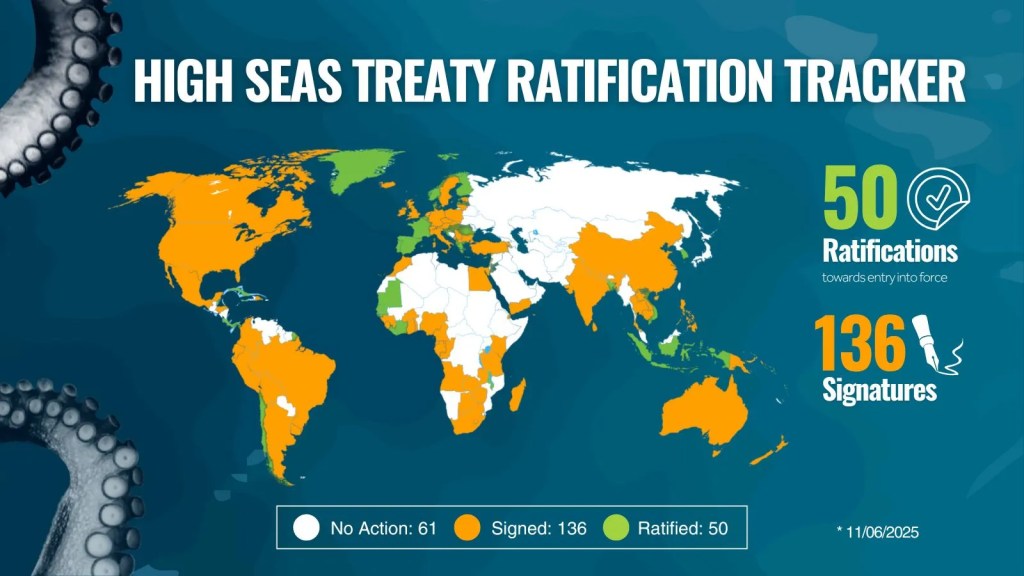
SINGAPORE, Jan 17 (Reuters) – A new global treaty aimed at protecting biodiversity in the high seas officially started on Saturday. This treaty gives countries a legal framework to address challenges like overfishing and aims to ensure that 30% of ocean environments are protected by 2030.
The U.N. treaty, known as the Biodiversity Beyond National Jurisdiction (BBNJ), was finalized in March 2023 after 15 years of discussions. It will allow for the establishment of a global network of "marine protected areas" in vast ocean ecosystems that were previously unregulated.
“This covers two-thirds of the ocean and half of the Earth's surface. For the first time, it has a comprehensive legal framework,” said Adam McCarthy, an official from the Australian foreign ministry and co-chair of the treaty’s preparatory committee, during a media briefing.
The treaty achieved the necessary 60 national ratifications on September 19 last year, allowing it to come into effect within 120 days. Since then, ratifications have grown to over 80, with countries like China, Brazil, and Japan joining in.
Other nations, including the UK and Australia, are expected to ratify the treaty soon. Although the United States signed it during the previous administration, it has yet to ratify.
“While we only needed 60 ratifications for it to enter into force, it’s crucial for its implementation that more countries ratify the treaty,” said Rebecca Hubbard, director of the High Seas Alliance, a coalition of environmental groups. “We’re aiming for all UN member states to ratify the treaty.”
The treaty requires countries to conduct environmental assessments of activities affecting ocean ecology. It will also create mechanisms for nations to share the benefits from the "blue economy," including "marine genetic resources" used in industries like biotechnology.
Environmentalists note that more than 190,000 protected areas need to be created to achieve the "30 by 30" target of bringing 30% of oceans under formal protection by 2030. Currently, only about 8%—or 29 million square kilometers (11.2 million square miles)—is protected.
However, the treaty may not effectively address one of the biggest threats to marine environments—the push to extract mineral resources from the ocean floor.
“The BBNJ is very ambitious, but there are clear limitations,” McCarthy said. “The issue of mining in the seabed falls under the International Seabed Authority (ISA), and that’s not something the BBNJ will address.”