
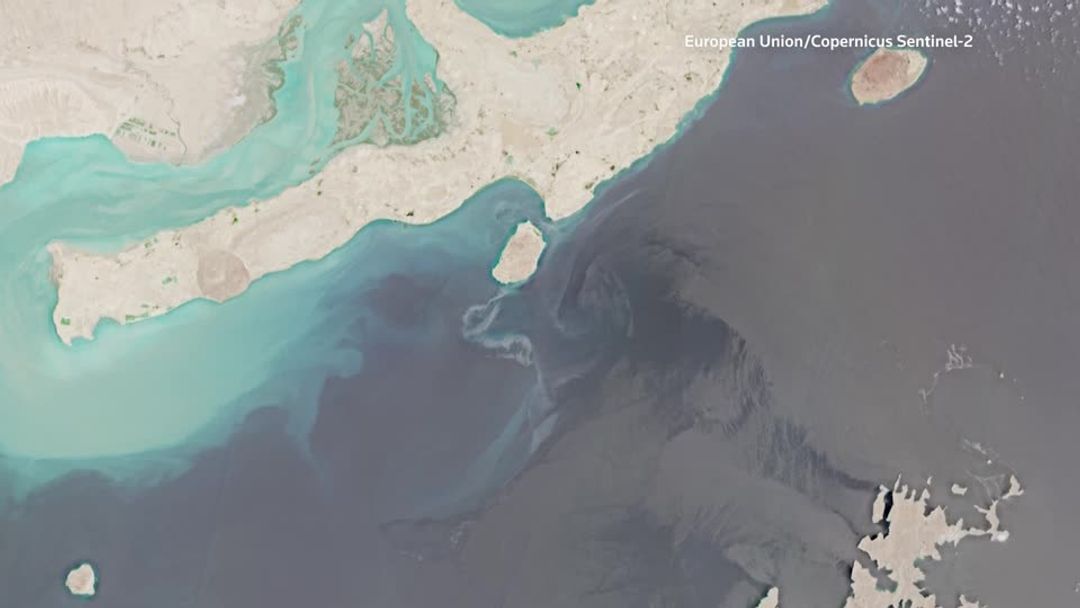
August 14 (Reuters) — Recent satellite images and videos have confirmed the presence of two oil slicks in Iranian waters. This situation raises concerns about environmental harm in the Gulf amid ongoing attacks on oil tankers and other vessels by Iran and the United States.
An environmental crisis is currently taking place off the coast of Oman, outside the Strait of Hormuz. A grounded tanker named Caroline Bezengi is leaking Russian crude oil into a protected marine area, creating an extensive oil slick estimated to be around 2,000 square kilometers.
It's important to note that the Caroline Bezengi incident is not connected to the tensions between Iran and the U.S.
The two new oil slicks are located within the Gulf.
NEAR DOLPHIN-SHAPED ISLAND
One slick has been observed near the southern tip of Qeshm Island, a large island shaped like a dolphin located in the Strait of Hormuz near Iran’s coast, according to images captured by Copernicus’s Sentinel-2 satellites.
Wim Zwijnenburg, an environmental researcher at the Dutch peace organization PAX, noted that the darker sections of the slick likely contain heavy fuel oil, while a lighter section extends approximately 160 km.
A dark, bubbling liquid was filmed washing up on the shores of Suza on Qeshm Island, contrasting sharply with the surrounding turquoise water, in a video shared on August 11.
“This is the largest slick I have seen in recent months, especially since the conflict between Iran and the U.S. escalated,” said John Amos, CEO of SkyTruth, a group that uses satellite imagery to monitor oil spills, referring to it as “a major incident.”
A second slick was detected near the smaller Sirri Island, which is located about 100 km southwest of Qeshm and is home to some Iranian offshore oil and gas operations, as shown in satellite imagery.
The satellite images of Qeshm Island were taken on August 10, while those of Sirri Island were captured on August 13.
DRY BULK CARRIER WAS ATTACKED
The slick near Qeshm Island is believed to have originated from a leak in the Minoan Pioneer, a Liberia-flagged dry bulk carrier, according to Samir Madani, co-founder of TankerTrackers.com.
The Minoan Pioneer was struck by an unknown projectile near Oman’s coastline in what is suspected to be an Iranian attack while passing through the Strait of Hormuz on August 3. One crew member is reported missing, as noted by maritime security sources.
This leak is believed to be the cause of the slick affecting Qeshm Island, according to a maritime security source.
Esmaeil Baqaei, spokesperson for Iran’s Ministry of Foreign Affairs, stated on the platform X that oil pollution from the Gulf has reached Qeshm Island, and initial evidence suggests a foreign bulk carrier as the source.
Reuters has not been able to independently verify the cause of either slick or identify the substances involved.
A source involved in the salvage operation for the Minoan Pioneer, who wished to remain anonymous due to the sensitivity of the issue, informed Reuters on Friday that a tugboat sent to assist the grounded vessel had difficulty approaching it due to permission issues with Iranian authorities.
The ongoing conflict in the region has complicated efforts to assess and clean up oil spills in the Gulf, according to Brian Barnes, a satellite oceanographer and research assistant professor at the University of South Florida.
“The longer the oil leaks into the environment, the more it can spread and harm ecosystems and coastlines,” he warned.