
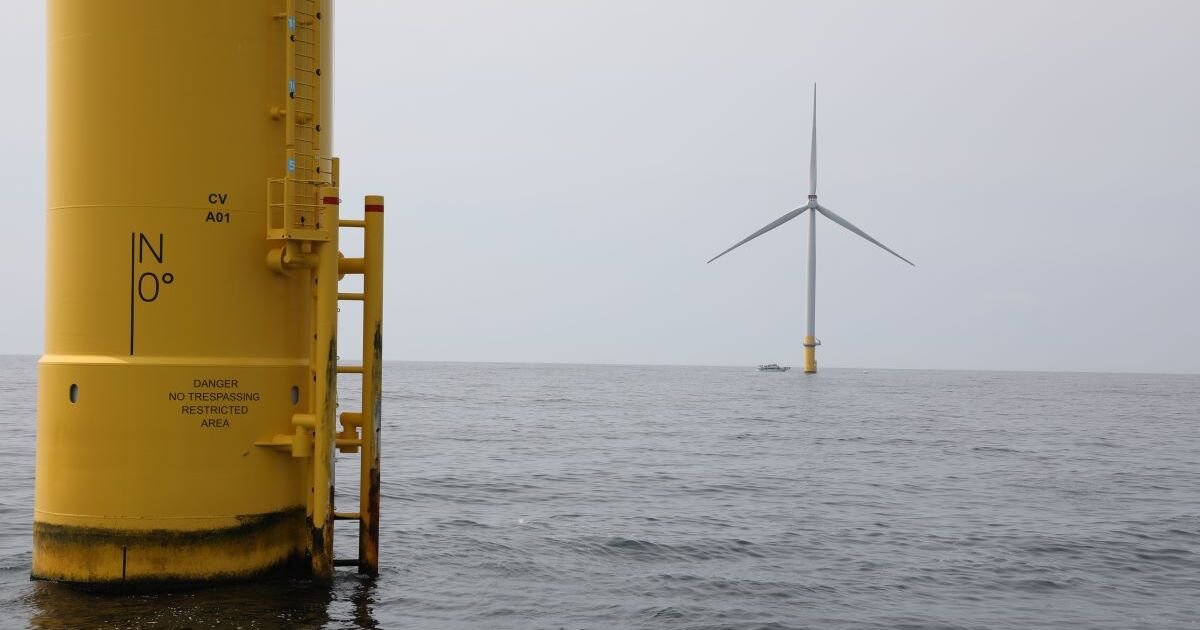
The installation of turbines has started at the biggest offshore wind project in the U.S., just days after a federal judge lifted a suspension imposed during the Trump administration. Senator Tim Kaine announced that the first permanent turbine tower has been installed at the Coastal Virginia Offshore Wind (CVOW) project.
Local media captured footage of the U.S.-flagged Wind Turbine Installation Vessel (WTIV) Charybdis setting up the first of 176 turbine towers, located 27 miles off Virginia Beach. This marks an important step for the $11.2 billion project, especially after weeks of legal uncertainty that threatened to delay construction.
On social media, Kaine shared, “Today, I toured the Portsmouth Marine Terminal and was updated on the progress made on the Coastal Virginia Offshore Wind project. This incredible project will boost offshore wind in Virginia, lower costs, and grow the local economy.”
The turbine installation follows a ruling by Judge Jamar Walker on January 16, which allowed Dominion Energy to resume work while appealing the Interior Department’s suspension of CVOW along with several other offshore wind projects. This ruling was a significant victory, especially after similar decisions in favor of other projects, like Equinor’s Empire Wind in New York and Ørsted’s Revolution Wind in the Northeast, which were also halted under a December 22 Interior order citing national security concerns.
During the hearing, Judge Walker determined that the Interior's broad stop-work order was not specifically designed for Dominion’s project, indicating that the national security issues cited were mainly relevant to wind farm operations rather than construction.
For Dominion, the timing was crucial, as the company had already invested nearly $9 billion into the CVOW project, incurring losses of about $5 million per day due to the construction pause. After the ruling, they expressed their commitment to safely restarting work to ensure CVOW begins delivering energy soon.
The Interior Department had initially ordered the suspension on December 22, citing new national security information. However, the series of court defeats suggests that the administration may struggle to maintain this policy under legal review.
Charybdis Delays Add Pressure
In addition to the legal issues, CVOW has faced operational challenges, particularly related to the Charybdis, the first U.S.-built wind turbine installation vessel in compliance with the Jones Act. Delays in commissioning have pushed the start of turbine installation from an initial September target to late November 2025, complicating an already intricate project.
The Charybdis, built at the Seatrium AmFELS shipyard in Brownsville, Texas, needed to address about 200 quality assurance issues before it could operate fully. Made with over 14,000 tons of domestic steel, it represents one of the largest investments in U.S. offshore wind maritime infrastructure.
Power by Spring, Completion by Year-End
Despite these challenges, Dominion says CVOW is on track to start delivering power by late Q1 2026, with the entire project expected to be completed by the end of the year. Once operational, the facility will consist of 176 turbines capable of generating 2.6 gigawatts, enough to supply electricity for about 660,000 homes.
Project costs have increased from $10.7 billion to $11.2 billion, attributed to higher expenses for grid upgrades and tariffs. Nevertheless, Dominion still views CVOW as a cost-effective energy solution, estimating it will add about 43 cents per month to the typical residential electricity bill.
The project has already created around 2,000 direct and indirect jobs in the U.S. and has generated over $2 billion in economic activity. It builds on Dominion's two-turbine pilot project, operational since 2020, making CVOW one of only a few offshore wind farms currently producing power in the U.S.
While construction resumes, the ongoing legal battles and the administration's stance against offshore wind continue to cast uncertainty over the industry. Experts believe that the high-profile lawsuits now underway could influence the future of offshore wind investment in U.S. waters for many years to come.