
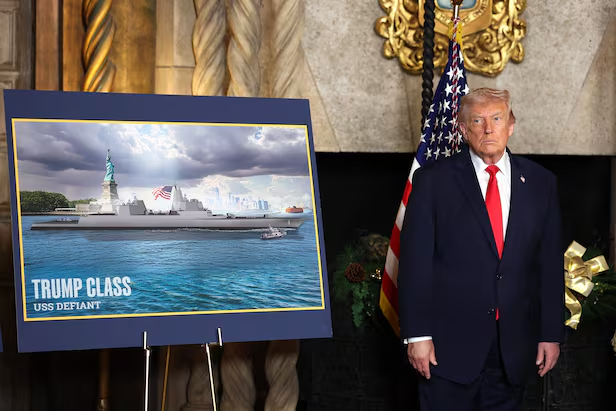
President Donald Trump's plan to allow foreign shipyards to build for the U.S. Navy is facing pushback from American shipbuilders and lawmakers. They argue this policy could lead to job losses and a decline in essential industrial capabilities just as Washington is investing billions to strengthen the domestic maritime industry.
The opposition arises after Trump's national security memorandum on August 13, which allows foreign shipbuilders to construct the first two boats for specific Navy programs at their facilities before moving subsequent production to the U.S.
This strategy, referred to as the “Finland Model,” is based on the U.S. Coast Guard’s Arctic Security Cutter program. To qualify, foreign builders must either build or buy a majority stake in a U.S. shipyard, hire and train American staff, share shipbuilding technologies, and create a U.S. supply chain.
The model could be used for three types of vessels: a new surface combatant for anti-submarine and surface warfare, Consolidated Cargo Replenishment at Sea tankers, and roll-on/roll-off ships.
The White House claims this method will speed up ship delivery and bring foreign investment, technology, and shipbuilding expertise to the U.S. They have previously tried a similar approach with icebreakers, stating that foreign construction would be a temporary solution until domestic capacity can be improved.
However, U.S. shipbuilders express concern that each vessel built abroad represents work that could have supported American shipyards.
Matthew Paxton, President of the Shipbuilders Council of America, stated that while foreign investments in U.S. shipyards are welcomed, outsourcing ship construction undermines the federal Maritime Action Plan and jeopardizes investments in both commercial and government shipbuilding. “Every hull built abroad means jobs and industrial potential lost for American shipyards,” Paxton urged the Department to reconsider and direct funding to U.S. shipyards.
This situation highlights a growing conflict within Trump's broader Maritime Dominance agenda.
The Maritime Action Plan acknowledges the need for foreign-built ships as a temporary measure while U.S. shipbuilding capacity is restored, but insists that domestic production should take precedence.
Trump's Navy directive extends this idea by allowing qualifying foreign builders to produce Navy vessels abroad, as long as they invest heavily in American shipbuilding.
South Korean company Hanwha and Italy's Fincantieri are seen as likely beneficiaries. Hanwha bought Philly Shipyard in 2024 and committed $5 billion to expand it, while Fincantieri has invested over $800 million in U.S. shipyards in the last decade. Following Trump's announcement, stock prices for both companies increased.
Congress Pushes Back
Resistance is growing in Congress, where some lawmakers are attempting to limit the Navy's ability to outsource ship construction.
Representative Jared Golden, a Democrat from Maine whose district includes General Dynamics Bath Iron Works, criticized Trump's directive for conflicting with the “America First” message. He stated, “It's hard to take the Administration's 'America First' language seriously when it seems intent on sending American shipbuilding jobs away and letting foreign businesses acquire American shipyards.”
Golden successfully added a stipulation to the House-passed fiscal 2027 National Defense Authorization Act (NDAA) that prevents funds from being used for contracts regarding battle force ships made in foreign yards.
This provision targeted an earlier Pentagon proposal that allowed U.S. ships to be partially built overseas. The House passed its NDAA version in July.
Golden noted that Senate discussions are looking at similar restrictions, which could lead to a confrontation between Congress and the White House over the foreign construction plan.
"Congress needs to take its responsibility seriously to protect national security and American jobs,” Golden emphasized.
If these restrictions become law, they could complicate the surface combatant aspect of Trump's Finland Model. The final impact on replenishment tankers and roll-on/roll-off ships will depend on how they are classified and funded.
The presidential memorandum acknowledges Congress's role, allowing the Secretary of War to make national security decisions with waivers for building U.S. Navy vessels in foreign shipyards. However, Congress must be notified at least 30 days before a qualifying contract can be executed.
A Broader Maritime Debate
This conflict arises as the administration also faces criticism regarding its extended emergency Jones Act waiver for foreign vessels.
The waiver has enabled foreign-flagged ships to transport energy and other goods between U.S. ports due to disruptions caused by the Iran conflict. U.S. maritime groups argue that allowing foreign ships in domestic markets can reduce demand for American vessels and undermine investment in the industrial base Trump aims to strengthen.
Recently, the administration tightened the waiver process, requiring voyage-by-voyage approvals and ensuring that Jones Act-qualified ships are available before a foreign vessel is granted authorization.
These disputes reflect the ongoing challenges facing the U.S. domestic shipbuilding industry.
Trump's strategy increasingly relies on foreign capacity as a temporary solution, while foreign companies must invest in U.S. yards and share their expertise. The administration says its aim is to restore capacity and competition after years of delays and growing backlogs in Navy shipbuilding.
Critics warn that even allowing the first ships to be built abroad could weaken the demand necessary to rebuild domestic shipbuilding capacity.
This disagreement appears to be evolving into a larger confrontation between the White House, Congress, and the U.S. shipbuilding industry regarding the future of American naval vessel production.