
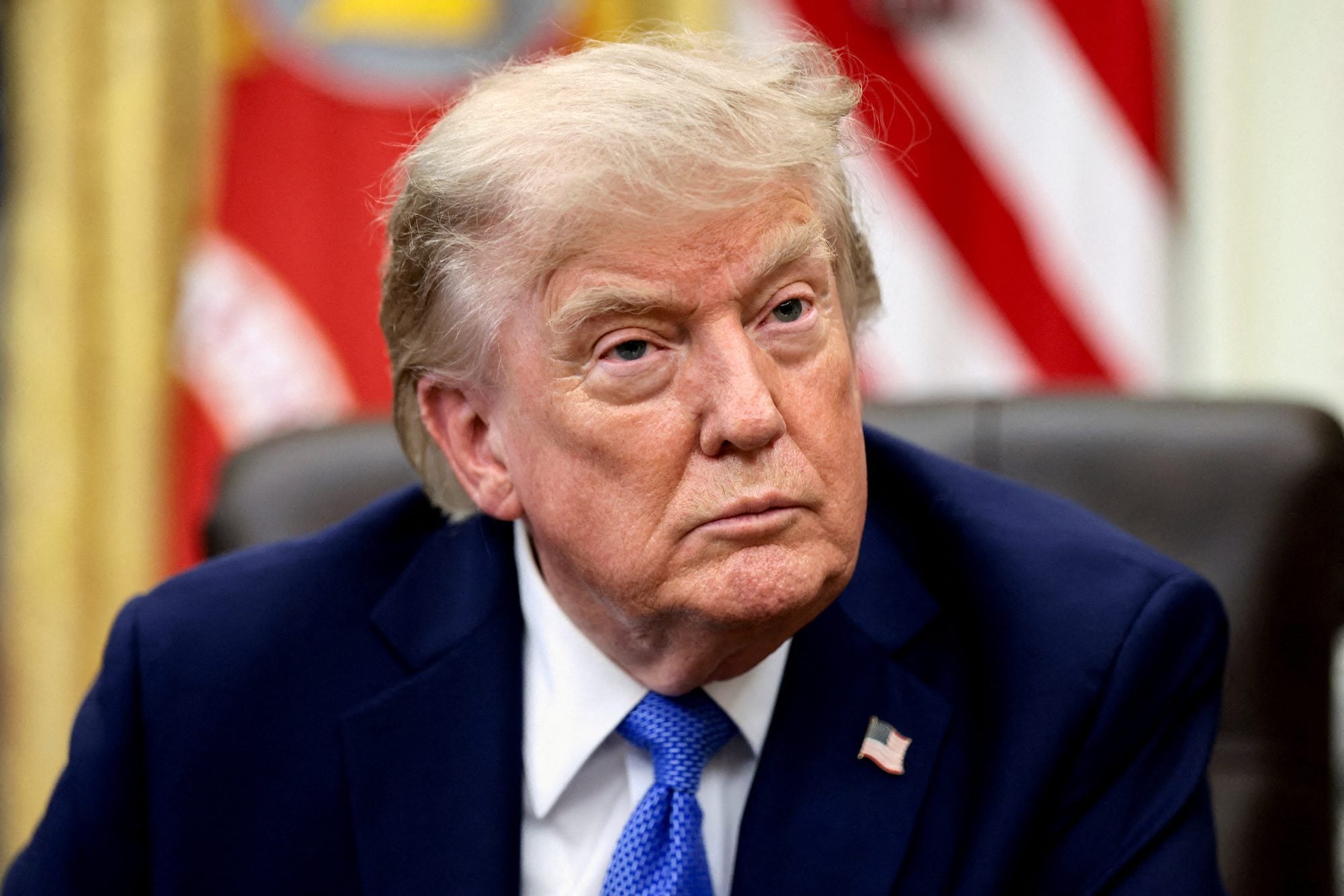
The hopes for peace in the Middle East have taken another hit, as President Donald Trump announced he won't be extending the expiring agreement with Iran amidst rising violence in Lebanon.
When asked if he would seek an extension of the memorandum of understanding signed in June, which is set to expire on Monday, Trump replied simply, “No.” This agreement was intended to give the US and Iran a chance to negotiate a lasting peace deal in 60 days.
With the Iran conflict nearing six months and tensions over the Strait of Hormuz escalating, both sides have declared the agreement ineffective. Despite this, Trump stated that the US still has leverage over Iran, pointing out the naval blockade affecting Iranian ports.
He reiterated his plan to declare the waterway as American territory, asserting that the US retains full control.
On Monday, the price of Brent crude oil rose above $90 a barrel due to new concerns about the conflict, causing a stir in global energy markets. The price has surged over 7% since the start of last week as hopes for a quick reopening of Hormuz have diminished; this strait previously handled a fifth of the world's oil and gas traffic.
Any renewed conflict could further complicate the stalled negotiations between the US and Iran. Trump is facing difficulties finding a way out of a war that is increasingly unpopular domestically and poses risks to Republican prospects in the upcoming midterm elections. Last week, Treasury Secretary Scott Bessent indicated that the US is about to introduce new economic measures against Tehran that will be unprecedented.
Oman is currently in discussions with Iran about the management of the Strait of Hormuz, but the US is not involved in these talks. During an earlier phone interview with Fox News, Trump warned that if “Oman interferes, we’ll bomb the s—— out of them,” without providing further details. He previously issued a similar threat in May. Although Oman is not a formal US military ally, it has been a close security partner.
Iran announced that a “shipping map” has been completed as part of a larger agreement on traffic governance in the strait, but discussions are ongoing, and a formal deal isn't guaranteed to lead to reopening.
The possibility of an agreement has been complicated by security issues and “obstructionist behavior,” as stated by Iran’s Foreign Ministry spokesman Esmail Baghaei. Iran insists that the US must lift its blockade.
On Fox News, Energy Secretary Chris Wright claimed that the US military is currently “bringing out eight or nine million barrels of oil per day” from the region, while Iranian oil exports have dropped to “zero barrels per day.”
Trump stated that back channels with officials from Iran's Islamic Revolutionary Guard Corps are still active, a claim later dismissed as “delusion” by a spokesman for the IRGC, according to state-run media.
Tensions in the Middle East escalated further over the weekend when Israel's military announced it had killed a senior Hezbollah commander, Abu Hassan Alaa, in southern Lebanon. The Israeli strikes resulted in eleven casualties, which Prime Minister Benjamin Netanyahu described as retaliation for an assault by Hezbollah that injured three Israeli soldiers.
Recently, Israel has also targeted Hamas in Gaza, while the Yemen-based Houthis have attacked ships in the Red Sea. Several vessels have been hit by projectiles in the Strait of Hormuz. Meanwhile, Israeli settlers have surrounded Palestinian homes, drawing international disapproval. Netanyahu has downplayed this violence, attributing it to a small number of extremists.
Despite years of sanctions damaging Iran's industrial capacity and limiting crude exports, the US blockade has not succeeded in persuading Iran to abandon its nuclear program or reduce its control over the Strait of Hormuz.
Iran has reportedly used the relative calm to prepare for a potential larger conflict, according to the Wall Street Journal, which cited Iranian and Arab officials. Tehran has placed hard-line veterans in significant security roles and has increased missile and drone production.
In the meantime, Jared Kushner, Trump’s son-in-law and peace envoy, is visiting the Middle East this week in an effort to expedite a US-negotiated ceasefire in Gaza. He is scheduled to meet with Netanyahu in Jerusalem, alongside former UK Prime Minister Tony Blair and Nickolay Mladenov, the top envoy for the Board of Peace.
On Sunday, Kushner met with Hamas leader Khalil al-Hayya in Egypt, as reported by the Associated Press, citing sources from both the region and Hamas.
In a statement, Hamas urged mediators and the US-led Board of Peace overseeing the ceasefire to pressure Israel into approving a roadmap outlining future steps in the truce.