
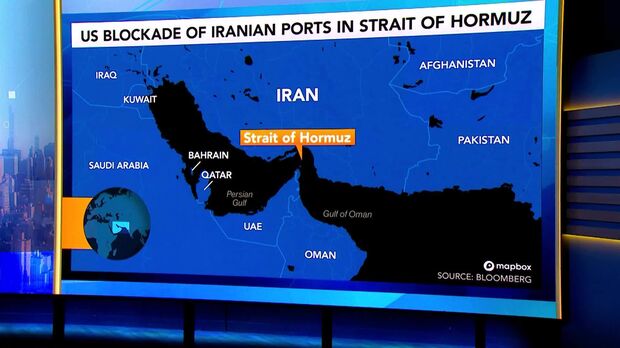
By Fiona MacDonald and Zainab Fattah – President Donald Trump stated he would escalate US bombings against Iran until the country stops its attacks on ships in the Strait of Hormuz and agrees to reopen this crucial waterway.
For the fourth consecutive day, American forces targeted Iranian military sites, leading to further retaliatory strikes from Tehran on US bases in Gulf states, including Kuwait and Bahrain.
An interim peace agreement between the US and Iran, signed about a month ago, has nearly fallen apart in the last week as both sides dispute control over the vital strait, through which major energy exports from Saudi Arabia, Qatar, and the United Arab Emirates pass. Oil prices rose for the third day on Wednesday, with Brent crude reaching nearly $86 per barrel, marking a 13% increase this week.
After Iran began attacking vessels it claims are crossing the chokepoint without permission, Trump decided to end a waiver on Iranian oil sanctions and reimpose a naval blockade, while ramping up military strikes. He has primarily targeted military installations in southern Iran, such as radar, missile, and drone facilities. The current bombing campaign is still significantly less intense than it was during the peak of conflict in March and early April when cities like Tehran were under constant attack.
Trump promised more bombings on Wednesday night, stating he would continue until Iran complies.
“We’re going to hit them very hard tomorrow night,” he told Fox News on Tuesday. “Then we’ll hit them hard the following night. Next week, they’ll really face severe actions because we will target their power plants. We plan to destroy all their bridges unless they come to the negotiating table.”
He stated that energy sites in Iran would be the last targets hit.
The president, facing lower approval ratings in the US due to rising discontent with the war, appears increasingly frustrated with Iran's ongoing maritime assaults. Both sides accuse each other of violating the vague terms of the recent memorandum of understanding regarding vessel passage through Hormuz.
In addition to reopening the strait, the preliminary deal was meant to facilitate extensive discussions about limiting Iran’s nuclear program and achieving a lasting peace. However, these negotiations have stalled as both sides concentrate on the situation in Hormuz.
Iran has shown no signs of retreating. On Wednesday, the Islamic Revolutionary Guard Corps (IRGC) announced that the strait will remain closed until the US halts its strikes and the blockade of Iranian ports.
“The region’s oil and gas exports must be accessible to all or to none,” the IRGC stated, according to Iran’s Press TV.
US airstrikes have reportedly resulted in over 30 civilian deaths in recent days, as claimed by the Iranian government. On Wednesday, Tehran’s military reported that seven individuals were killed in a missile strike on a barracks in Iranshahr, southeastern Iran.
Trump had recently abandoned a plan to impose a 20% fee on cargo shipments through the strait after appeals from US Gulf Arab allies. He announced this decision on Tuesday, just a day after suggesting the fee, which would have cost the largest oil tankers around $35 million.
Instead, he stated that this "reimbursement fee," intended to compensate the US for ensuring safe passage through the strait, would be replaced by trade and investment agreements between the Gulf states and the US. Countries like the UAE, Saudi Arabia, and Qatar had previously expressed intentions to invest trillions of dollars in the US over the coming decade, but there are no indications that they will increase those commitments in light of Trump’s reversal.
Nevertheless, the US has maintained its decision to resume the naval blockade, a move that has irked the Islamic Republic and could further undermine its struggling economy. The blockade, which was first established in April, was lifted last month after the memorandum was agreed upon.
Trump’s change regarding fees at Hormuz highlights the unpredictability of US policy toward the strait, which previously accounted for about one-fifth of global oil and liquefied natural gas shipments before the conflict. US officials have fluctuated between asserting that passage should remain free and debating who, if anyone, should be entitled to charge for transit.
This situation illustrates the complexities Trump is facing as he tries to conclude a conflict he initiated with Israel in late February, claiming it was essential to prevent the country from developing nuclear weapons. Tehran has consistently denied such intentions, although it has enriched uranium close to weapons-grade levels.