
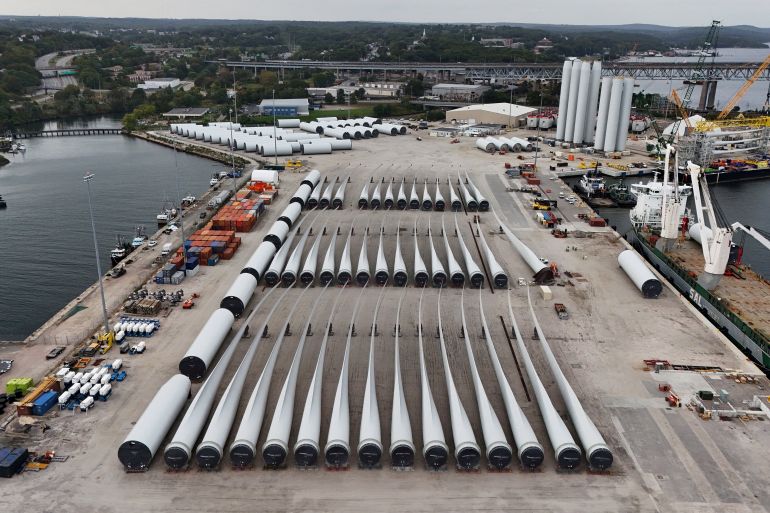
On Monday, the Trump administration announced an immediate halt to all large-scale offshore wind projects currently under construction in the United States. This decision was made due to national security concerns identified by the Department of Defense in recent reports.
The Department of Interior explained that this pause will give federal agencies time to collaborate with leaseholders and state partners to evaluate how to address the national security risks associated with these projects. Five key projects impacted by this decision include Vineyard Wind 1 by Avangrid and Copenhagen Infrastructure Partners, Coastal Virginia Offshore Wind (CVOW) by Dominion Energy, Empire Wind by Equinor, and both Revolution Wind and Sunrise Wind by Orsted.
Together, these five projects have a power capacity of about 5.9 gigawatts.
Doug Burgum, Secretary of the Interior, stated, “The primary duty of the United States government is to protect the American people. Today’s action addresses emerging national security risks, including the rapid advancement of adversarial technologies and the vulnerabilities created by large offshore wind projects close to our east coast population centers. The Trump administration will always prioritize the security of Americans.”
The Department highlighted unclassified government findings, suggesting that the large turbine blades used in offshore wind projects can cause radar interference, known as "clutter." This clutter can hide actual moving targets and create false alarms. A report from the Department of Energy in 2024 indicated that while increasing the radar threshold for false alarms can lessen some clutter, it may also lead to missing real targets.
This announcement, first reported by Fox News, arrives as the offshore wind industry faces major regulatory and financial hurdles. Earlier this month, a federal judge in Boston overturned a prior administration order that had stopped all federal approvals for new wind energy projects, labeling the agencies' actions as unlawful and arbitrary.
U.S. District Judge Patti Saris sided with a coalition of 17 Democratic-led states and the District of Columbia, stating that agencies did not provide reasonable justifications for their actions related to the order issued by Trump on January 20, his first day back in office.
New York Attorney General Letitia James, whose state spearheaded the legal challenge against the Interior Department's order for Equinor to stop construction on Empire Wind, called the ruling “a big victory in our battle against the climate crisis.”
The American offshore wind sector has seen its project pipeline shrink by over half in just one year, according to a November report from the Energy Industries Council. The pipeline fell from 45 projects to 23, with planned capacity dropping from 55.9 gigawatts to 25.4 gigawatts between the third quarters of 2024 and 2025.
President Trump's One Big Beautiful Bill Act set critical deadlines that require projects to begin construction by July 4, 2026, to qualify for tax credits for up to four years, or to start generating power by December 31, 2027. Approximately 83% of projects do not meet these deadlines.
The financial impact of project delays has been significant, with stoppage costs reportedly reaching up to $50 million per week for the Empire Wind project and more than $15 million weekly for Revolution Wind. Equinor has reported a $763 million impairment related to Empire Wind 1 and South Brooklyn Marine Terminal development in its second quarter financial results, which is part of a larger $955 million write-down linked to regulatory changes and increased tariff exposure.
Additional cost pressures have come from trade actions that impose tariffs of 10 to 15 percent on goods from the EU and UK, and up to 50 percent on certain steel and aluminum products, all of which are essential for components like blades, towers, nacelles, and cables. The Department of Transportation's decision to withdraw $679 million in port grants has further delayed crucial infrastructure improvements.
Despite these challenges, some state-level support is still in play. The New York State Energy Research and Development Authority recently announced a $300 million competitive solicitation to boost maritime port development projects intended to strengthen the state's offshore wind supply chain.
Rebecca Groundwater, EIC Global Head of External Affairs, noted, “Clear policies will be crucial in determining whether these projects move forward or remain stalled. Investors need stable and predictable frameworks to move from uncertainty to action and help the US regain momentum in offshore wind development.”
In September, Secretary Burgum mentioned that given the current administration's stance, there appears to be no future for offshore wind projects. He remarked at an energy conference in Milan that subsidies have been restricted, suggesting it’s unlikely that more offshore wind projects will be built in America.
The declining project pipeline coincides with what industry observers perceive as a broader strategy against the emerging US offshore wind sector, with the administration halting new offshore wind leasing and permitting, trying to revoke existing approvals, and stopping projects that are already under construction.
Today’s move, according to the Department of Interior, ensures that the national security risks related to offshore wind projects are being properly managed and that the U.S. government maintains its capability to protect its citizens effectively.