
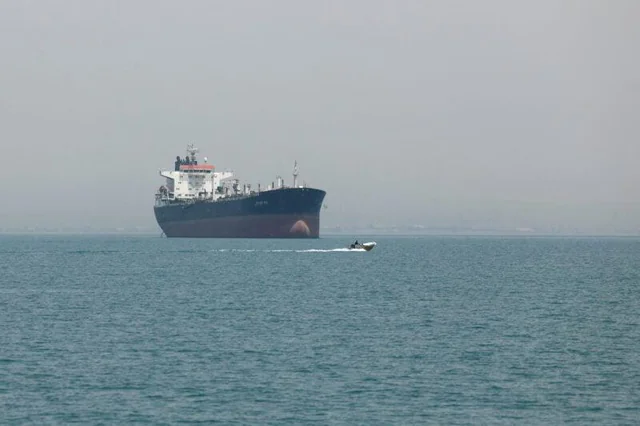
U.S. Energy Secretary Chris Wright announced that the military assisted in transporting over 15 million barrels of oil and petroleum products through the Strait of Hormuz on Tuesday. This number is quite surprising and does not align neatly with commercial shipping data.
“On Tuesday, the U.S. military helped to ship more than 15 million barrels of oil and products out of the Strait of Hormuz. When combined with pipelines, the total amount leaving the region is closer to 20 million barrels,” Wright stated.
He added that the average amount passing through Hormuz each day is now above 8 million barrels. “Thanks to the U.S. Navy, oil is definitely flowing through the Strait of Hormuz,” he emphasized.
However, the administration has not provided detailed data regarding individual vessels to support these claims.
Wright’s remarks come after an Axios report from August 19, which mentioned that a U.S. military-organized shipping route along the southern Omani side of Hormuz has been operational, moving 15 to 20 tankers in and out each night under military protection. U.S. officials told Axios that around 10 million barrels are being transported daily, and on particularly busy nights, this number can reach 15 million to 20 million barrels.
On Saturday, Axios reporter Barak Ravid reported that the operation seems to be speeding up, with about 40 tankers moving in and out through the southern deep channel on Friday night. Three U.S. officials told Ravid that approximately 16 million barrels of oil were moved out of the Strait during this operation.
This indicates a significant increase from the previously noted range of 15 to 20 tanker movements per night.
However, data from commercial vessel tracking still shows much lower levels of typical commercial traffic. The U.S.-led Joint Maritime Information Center stated on Thursday that commercial traffic through Hormuz remains at “reduced levels,” with independent tracking showing only a few or no tankers moving in either direction.
The JMIC separately counted 42 vessel transits facilitated by the U.S. over August 18-19, averaging about 21 per day. These figures are derived from U.S. NCAGS data and reflect the number of vessels rather than the amount of oil, without specifying how many were tankers or their direction and cargo.
JMIC's separate tracking of non-facilitated tanker traffic recorded just three crossings per day on August 17, 18, and 19.
Similarly, Kpler reported that confirmed crossings through Hormuz dropped by 19.5% last week to 95, with no crossings noted via the Omani route or the established Hormuz Traffic Separation Scheme.
TankerTrackers.com also expressed doubts about the figures reported by Axios, suggesting that U.S. officials might mean 10 million barrels per convoy rather than per day, pointing out that industry estimates are much lower.
“Officials tend to choose favorable data. The averages over a longer time period are what really count. Convoy movements involve a limited number of tankers at once due to restricted air support, likely moving loaded tankers one night and empty ones the next,” stated TankerTrackers.com.
JMIC continues to classify the threat level in the Strait of Hormuz as SEVERE, anticipating that traffic will remain low through both the Iranian-controlled northern route and southern Omani corridor because of ongoing attacks, U.S. blockade measures, and rising regional tensions.
For context, before the conflict, Hormuz typically saw around 138 vessel transits each day.
Currently, the U.S. may be transporting much more oil through Hormuz than commercial tracking can capture. However, the accuracy of Washington’s substantial claims about oil flows remains challenging for the shipping industry to verify independently.