
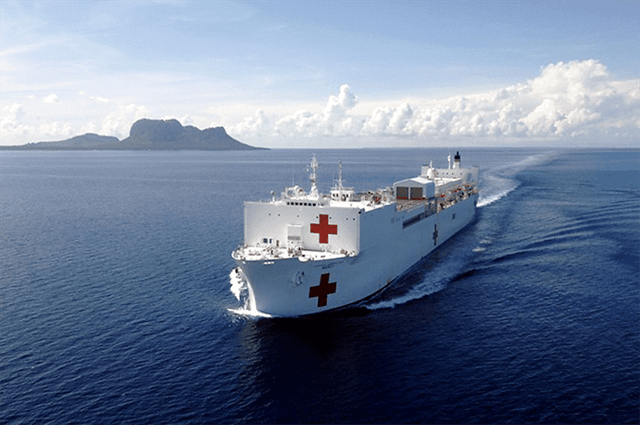
Sending the U.S. Navy hospital ships USNS Mercy or USNS Comfort to Greenland in late winter would encounter significant challenges due to extensive sea ice, a shortage of icebreaker escorts, and shallow ports that can’t accommodate the ships’ deep drafts.
President Trump's idea to send a hospital ship to Greenland could face serious environmental and logistical issues that make it unrealistic in February or March, when Arctic sea ice typically reaches its highest levels.
The two hospital ships are converted oil tankers without the necessary ice-strengthening features, making them susceptible to damage from thick pack ice or heavy drift ice, which are common around Greenland during late winter. This is especially true for the west coast, which is generally more ice-prone compared to the east and southern areas.
Sending a large non-ice-class ship into Arctic waters without proper escort would be risky, as Arctic maritime experts point out that sea ice and icebergs could drift south into the Labrador Sea.
“At this time of year, the ice pack is at its maximum extent. The map clearly shows the boundary of the sea ice in the Labrador Sea. The Baffin Sea is not accessible,” explains Hervé Baudu, Professor Emeritus of Maritime Education at the French Maritime Academy (ENSM).
A bit further south, sea ice conditions might improve, but issues with icebergs and port facilities would still pose challenges.
“If a non-ice-class ship wants to reach Nuuk or even Ilulissat, it will encounter some open water but will definitely face icebergs from the glacier nearby. Docking in Nuuk would be complicated due to short piers,” Baudu added.
Any such mission would likely need an icebreaker to escort the hospital ship. However, the U.S. has a limited number of icebreakers available. The heavy icebreaker USCGC Polar Star is currently in Antarctica, while the medium icebreakers USCGC Healy and the recently acquired USCGC Storis are stationed in Seattle. Analysts say diverting them north quickly would be challenging and could impact the Coast Guard's operations in the Arctic this summer.
Even if arrangements for ice navigation were made, Greenland's limited port infrastructure presents another issue. Nuuk's harbor depth is about 10.5 meters, which is not enough for ships that draw about 10 meters, like the Mercy and Comfort. Other ports in Greenland are even shallower.
This would mean the vessels would have to anchor offshore, complicating operations.
While the southwest coast of Greenland typically has less ice than the east coast, there is still winter drift ice and later in spring, icebergs moving south due to currents from Baffin Island and Labrador.
Anchoring a 270-meter non-ice-class ship in icy waters, with strong winds and freezing conditions, would introduce unique risks. Reports from the area in late winter often talk about gale-force winds and severe icing challenges.
The U.S. Navy has a lot of experience sending hospital ships to tropical or temperate areas for disaster relief, but there are no records of a U.S. hospital ship operating in Arctic waters.
Additionally, the ships might not even be available. According to the Military Sealift Command, the Mercy is currently under maintenance.
An MSC spokesperson mentioned that the ship is being repaired at Alabama Shipyard due to issues with a ballast tank and is scheduled for a regular overhaul and drydocking on the West Coast next month.
Even aside from maintenance schedules, the combination of sea ice, lack of escort ships, shallow port depths, and complicated offshore anchoring makes a winter deployment to Greenland very impractical.
Furthermore, there is a political obstacle: the government of Greenland has indicated that it neither needs nor wants such a mission.