
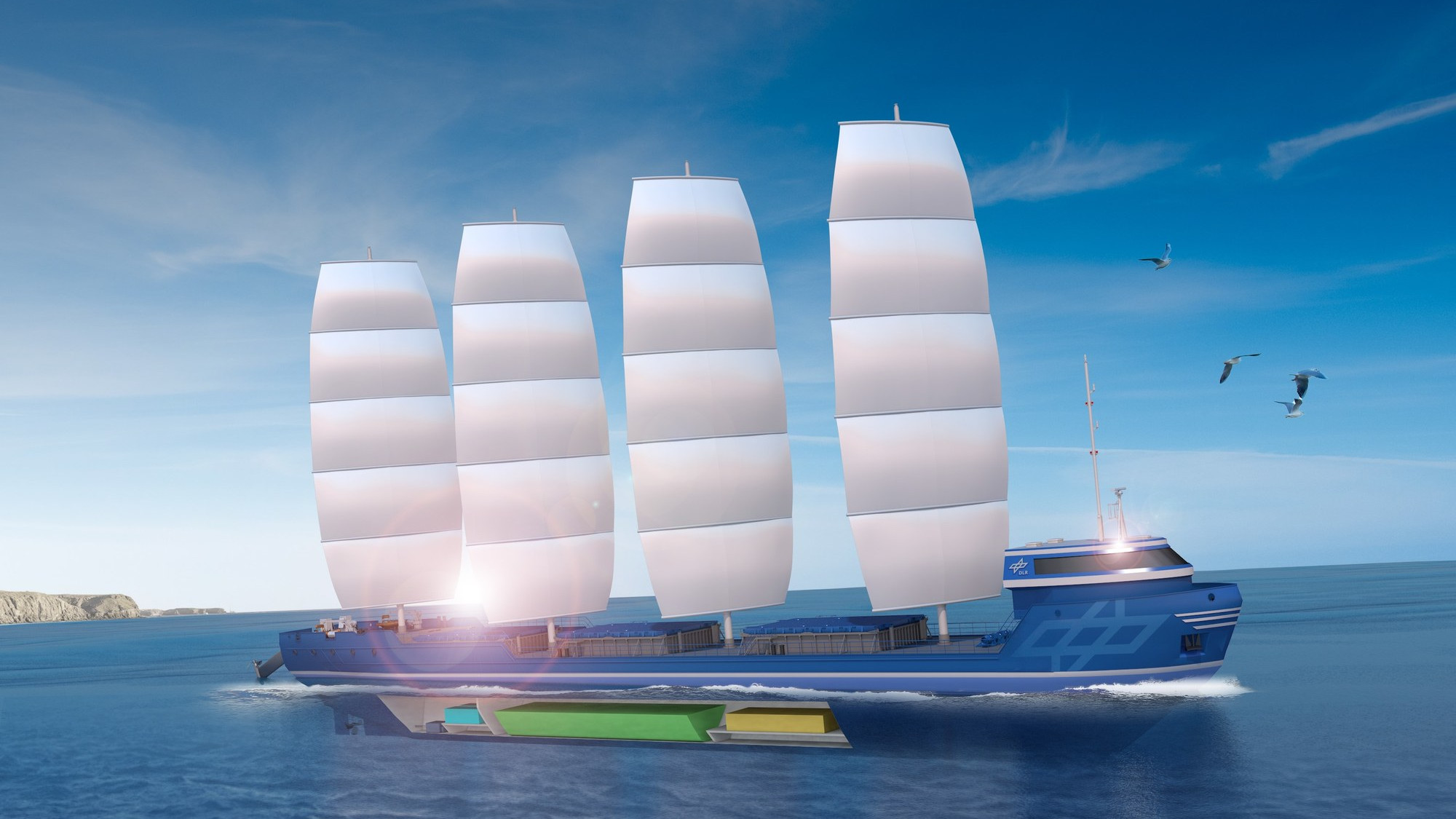
For over a hundred years, commercial shipping has been moving away from sails, but now they are making a comeback.
Shipowners worldwide are adding tall rotor sails, rigid wings, and suction-based systems to all types of vessels, including bulk carriers, tankers, and containerships. LNG carriers might be next in line.
The goal isn't to revert modern cargo ships back to sailing ships. Instead, these systems are meant to complement traditional engines by using wind to cut down on fuel consumption when possible.
What began as a niche experiment is beginning to evolve into a significant aspect of commercial shipping.
According to the International Windship Association, over 100 large merchant ships now have modern wind propulsion systems, totaling more than 5 million deadweight tons in carrying capacity.
While this is still a small portion of the global fleet, the ships are getting larger, the owners are more experienced, and the projects are becoming bolder.
In 2026, there have been several indicators that wind-assisted propulsion is moving beyond trial phases.
A significant announcement this month came from Maersk, which plans to install a 35-meter rotor sail on one of its 8,700-TEU containerships, with testing set to start in 2027 on regular Atlantic routes.
This project could mark the first use of a rotor sail on a containership.
Rotor sails appear as large vertical cylinders rather than traditional sails. They rotate as wind flows around them, producing aerodynamic lift through the Magnus effect and creating thrust that lessens the strain on the ship’s engines.
Although the concept is over a century old, advancements in modern materials and control systems are making it feasible for much larger ships than previously thought possible.
Vale's 400,000-dwt Sohar Max, one of the biggest ore carriers globally, is already equipped with five 35-meter rotor sails, which are expected to reduce fuel consumption by up to 6%. Vale also plans to implement rotor sails on future ethanol-powered large ore carriers.
Next in line are oil tankers.
Two VLCCs being constructed for Japan’s Idemitsu Tanker are slated to have Norsepower rotor sails when they begin operations in 2028, introducing wind-assisted propulsion to some of the largest ships in service.
LNG shipping may follow closely behind. Recently, Korean Register, HD Hyundai Heavy Industries, BAR Technologies, and the Liberian Registry unveiled plans to research a 174,000-cubic-meter LNG carrier equipped with BAR Technologies’ WindWings.
This design relocates the ship's accommodation block forward, making room for large sails on deck. The project will evaluate the technical, safety, and regulatory hurdles of applying this system to LNG carriers.
This is important since LNG carriers are among the most advanced and tightly scheduled vessels in commercial use.
If wind propulsion can be effectively utilized in this sector, it will strongly support the argument that this technology is becoming mainstream.
Not every project focuses solely on assisting an engine.
For instance, France's Neoliner Origin, delivered in 2025, has two 76-meter carbon-fiber masts with around 3,000 square meters of sail area, aiming to use wind as its primary means of propulsion across the Atlantic. This 136-meter ro-ro vessel can transport cars, containers, and other cargo between Europe and North America.
Airbus is taking a similar approach with a new generation of ro-ro ships intended to carry aircraft components across the Atlantic, combining wind propulsion with alternative fuels and optimized routing.
This creates an unusual combination of old and new: some of the world's most advanced supply chains are once again turning to one of shipping's oldest power sources.
The sails themselves are also evolving rapidly.
Some systems feature spinning cylinders, while others mimic aircraft wings mounted vertically on the deck. Bound4blue's eSAIL utilizes suction to enhance aerodynamic lift, and other developers are experimenting with rigid foils, automated wings, and soft-sail systems.
Maersk Tankers is deploying eSAIL systems across several MR tankers, with the juice carrier Atlantic Orchard being outfitted with four 26-meter suction sails.
In most cases, crews aren't manually adjusting sails on deck. These systems are highly automated, adjusting based on wind speed, direction, and the ship's own speed and heading. Weather-routing software can also help vessels change course slightly to capture more wind without significantly disrupting their schedules.
The integration of these systems is becoming more crucial. Norway has recently launched the WINTEGRATE program, bringing together companies like Kongsberg Maritime, DNV, Odfjell, Norsepower, and bound4blue.
The goal is to stop viewing wind propulsion as just a separate piece of equipment on a ship and instead incorporate it with engines, batteries, power-management systems, and voyage planning.
This shift could be vital for the future of wind propulsion technology.
While the physics behind wind propulsion remain unchanged, the economic landscape has shifted.
Shipowners face increasing pressure to cut down on fuel usage and emissions, as many low-carbon fuels are still expensive, scarce, or unavailable on a large scale.
In contrast, wind is free.
Moreover, wind offers a unique advantage in the drive for decarbonization in shipping: a technology that can often be retrofitted to existing vessels.
The savings depend heavily on the ship type, route, and weather.
Industry estimates typically suggest that fuel savings for retrofit projects can range from single digits to lower double digits, while ships built specifically for wind propulsion could achieve much higher savings.
Although this may not seem groundbreaking, for a massive ocean-going vessel consuming thousands of tons of fuel each year, even small savings can quickly accumulate.
There are still many challenges to address.
Wind is unpredictable, sails occupy deck space, and systems must be durable enough to withstand rough weather, corrosion, and cargo operations. Additionally, bridges, cranes, and terminals might limit how tall or where equipment can be placed.
Certain routes are also much more conducive to wind propulsion than others.
Regulations are still evolving as well.
The International Maritime Organization has started creating interim safety guidelines for wind propulsion and wind-assisted systems, with the first guidelines expected to be released later this decade.
However, the industry now has something it lacked just a few years ago: real operational experience.
Tankers, bulk carriers, ro-ros, and general cargo ships are gaining commercial sea time with these systems. Shipyards are learning how to install them. Classification societies are drafting new rules. Manufacturers are ramping up production.
That doesn’t mean commercial shipping is returning to the age of sail.
Engines will continue to be essential for timeliness, maneuvering, adverse weather, and port operations. Many ships will also depend on alternative fuels, batteries, and other efficiency technologies.
Wind will simply become an additional part of the propulsion mix.
This might be the most significant change.
After over a century of trying to minimize reliance on wind, shipping is starting to recognize that there's little reason to ignore free energy when the wind is blowing in the right direction.