
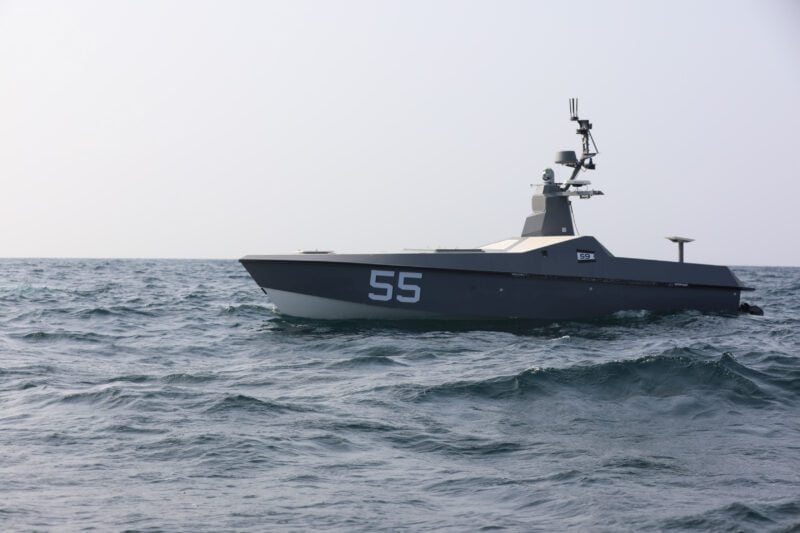
By Chris Servello (OpEd) After years of testing and discussing the role of unmanned surface vessels in the Navy, it's becoming clear what these systems can actually do, and the results are promising.
Recent operations in the Persian Gulf have shown their effectiveness. The USS Theodore Roosevelt Carrier Strike Group has deployed with a medium unmanned surface vessel, and industry is providing increasingly advanced platforms. Senior leaders in the Department of War and the Navy are shifting their focus from the potential of unmanned warfare to integrating it into routine operations.
This is progress, and credit goes to the Navy, its sailors, and industry partners.
However, the next steps will be more challenging.
The Navy must decide how it plans to utilize unmanned vessels, what missions they will undertake, and how it will organize, train, and maintain the teams operating them. It's time to move from merely proving these systems work to making them a standard part of fleet operations.
Experimentation has brought us this far, and it will remain crucial. However, relying solely on experimentation is not a strategy—continuing this approach wastes time and resources.
Leadership Signals the Right Direction
At the recent Association of the United States Army conference, Secretary of War Pete Hegseth emphasized autonomous warfare as a key priority. His Project Agincourt initiative and plans for an Autonomous Warfare Command aim to speed up how the military develops, purchases, and implements unmanned capabilities.
Hegseth also pointed out an often-overlooked aspect of introducing new technology: the necessity to reform organizations, training, and procurement practices, rather than just acquiring new equipment.
The military has always had access to intriguing technology. The real challenge lies in enabling commanders to use it effectively.
Acting Secretary of the Navy Hung Cao provided examples of where this transition is occurring.
At AUSA, Cao highlighted an unmanned surface vessel that aided in the recovery of two downed Army Apache pilots near the Strait of Hormuz. He also mentioned unmanned underwater systems aiding in mine clearance operations, and announced that the Theodore Roosevelt Carrier Strike Group had deployed with a medium unmanned surface vessel.
These developments are significant as they illustrate unmanned systems moving from demonstrations to real missions.
Cao referred to this technology as a force multiplier, which is the correct perspective.
The aim isn’t just to increase the number of unmanned vessels in the water; it’s about providing commanders with more choices, extending the fleet’s reach, reducing risk to sailors, and allowing manned warships to focus on missions that require them.
Lessons from the Persian Gulf
The Fifth Fleet deserves recognition for advancing unmanned maritime operations.
For years, Task Force 59 collaborated with industry and regional partners to incorporate unmanned systems into one of the most challenging maritime environments. Not every test succeeded, but the Navy learned to operate these systems alongside manned forces, integrate their technologies, and enhance maritime awareness.
This effort is yielding results.
In June, when two Army aviators crashed near Oman, a 24-foot Saronic Corsair unmanned vessel assisted in their rescue. The vessel managed to recover the soldiers and transport them to a location for helicopter evacuation. This was not just a demonstration but a real rescue, showcasing the Navy’s capabilities at a critical moment.
BlackSea Technologies, now part of AEVEX, highlights another example. Its Global Autonomous Reconnaissance Craft (GARC) extends surveillance and reconnaissance capabilities without needing a manned warship for every mission.
BlackSea also responded to an urgent need for unmanned mine countermeasure capabilities in the Persian Gulf. With mines threatening shipping in the Strait of Hormuz, the Navy required ways to tackle this risk without unnecessarily endangering sailors and costly vessels. BlackSea’s response illustrates the vital partnership the Navy needs with industry: identifying urgent problems, communicating the requirements, and allowing companies to respond quickly.
These examples are significant for various reasons. The Saronic's response highlighted the importance of having an unmanned vessel available for unexpected emergencies, while BlackSea demonstrated how industry can quickly address emerging operational needs.
The Strait of Hormuz is an excellent place for learning. It’s crowded, geographically constrained, and strategically important, where commercial shipping operations intersect with military activities, and threats can arise quickly.
It also reinforces an important lesson: unmanned vessels don’t need to be large, expensive, or capable of everything. Sometimes a small platform that excels at a specific mission is precisely what the fleet needs.
However, these insights should extend beyond the Persian Gulf. The experiences of the Fifth Fleet should inform how the Navy employs unmanned vessels in other locations.
Once a system proves it can complete a valuable mission, the focus should shift to how quickly it can be made available to more commanders, not just scheduling more demonstrations.
Significance of the Theodore Roosevelt Deployment
The deployment of the Leidos-built Seahawk medium unmanned surface vessel with the Theodore Roosevelt strike group represents another crucial step forward.
Both Seahawk and its sister vessel, Sea Hunter, have played key roles in helping the Navy develop autonomous navigation, collision avoidance, communications, and manned-unmanned operations.
Now Seahawk is actively deployed with a carrier strike group.
A carrier strike group isn’t a testing ground; it has missions and schedules, and commanders require reliable equipment. An unmanned vessel must effectively contribute without causing more complications.
Significant questions arise here: How will the commander employ it? Who will control it? What if communication fails? Who will maintain it? How will it integrate with aircraft and surface combatants? What missions can it undertake that free up a destroyer, helicopter, or aircraft for different tasks?
These questions are critical, but they only scratch the surface of what we need to understand today.
Perhaps one of the greatest advantages of this deployment will be discovering unexpected uses for this technology. Experienced sailors and commanders might discover practical applications that engineers never considered.
This could involve an unforeseen surveillance mission, a new method to extend the strike group’s reach, or tasks that would otherwise consume valuable resources.
Some of the best ideas may arise simply because the Seahawk is available when an unexpected challenge occurs.
Of course, the deployment will also uncover problems, which is perfectly acceptable. It’s better to identify these issues through real operations than to spend years anticipating everything in a testing scenario.
The Navy needs to quickly absorb both expected and unexpected lessons from this deployment and apply them effectively.
Success should not only mean that the Seahawk completes its deployment but also that the Navy develops a practical model for utilizing unmanned vessels in various formations while gaining insights into missions that were not initially envisioned.