
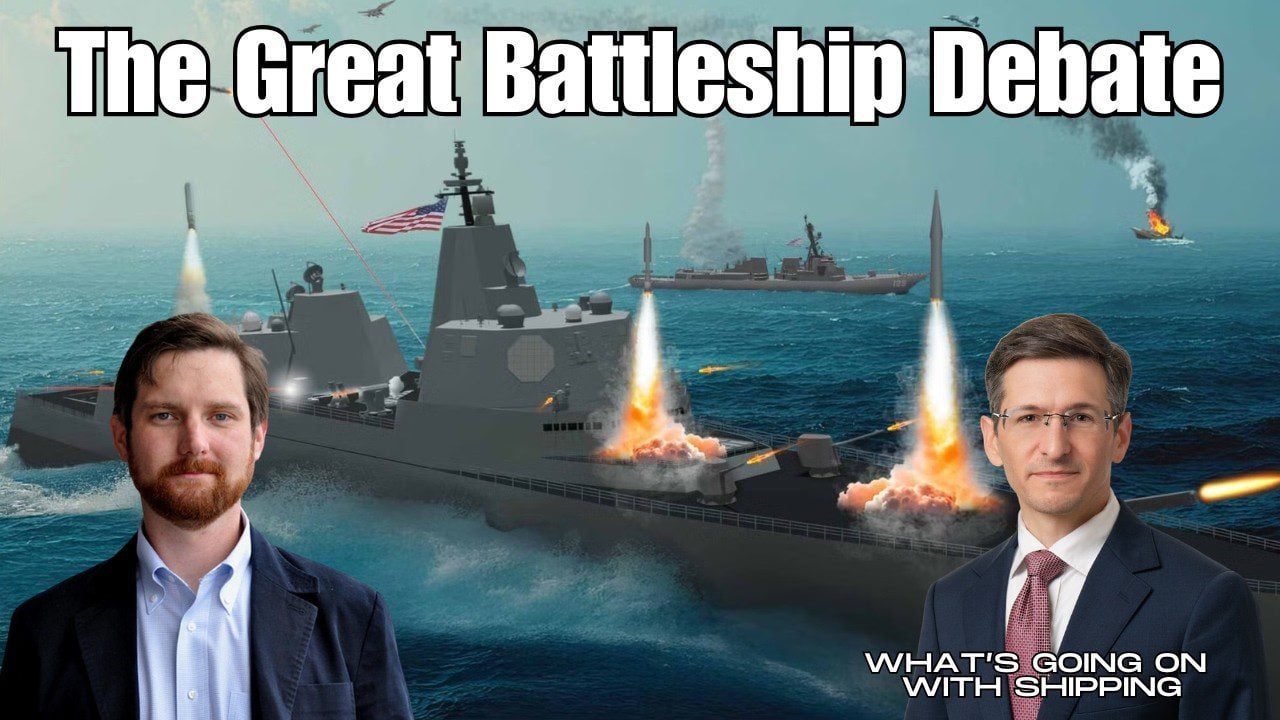
The U.S. Navy has not added a battleship to its fleet since 1944, but Donald Trump is now proposing to build up to 25 new ones. The first, named USS Defiant, will weigh over 35,000 tons and will be equipped with hypersonic missiles, lasers, and a powerful 32-megajoule railgun. It is expected to cost more than a nuclear aircraft carrier. Shipyards like Bath Iron Works and Ingalls Shipbuilding are quietly expressing interest, while new players such as Hanwha’s Philly Shipyard and California Forever are starting to make their presence known.
On the recent episode of Sal Mercogliano’s What’s Going On With Shipping, gCaptain founder John Konrad discussed these plans with Dr. Zack Cooper from the American Enterprise Institute in what Sal terms The Great Battleship Debate. This hour-long conversation featured no prepared remarks, no protecting carriers’ interests, and no censorship. Instead, it was two individuals with differing opinions analyzing the same ships, shipyards, and the threat posed by China, while openly discussing what the Navy should consider building.
Check out the full debate here: The Great Battleship Debate
Cooper presents a strong argument. He represents the consensus that views battleships as a distraction from other crucial priorities. Cooper argues that a 35,000-ton flagship could become a target for China’s military, suggesting that less expensive, smaller vessels with greater numbers could be more effective. He supports his points with credentials, including his book Tides of Fortune from Yale University Press and his experience with the National Security Council and the Office of the Secretary of Defense. He clearly explains why many naval experts think the BBG(X) (now referred to as BBGN) is more about vanity than necessity.
On the other hand, Konrad took a more challenging position.
This is not because the previous Secretary of the Navy, John Phelan, handled the unveiling of plans at Mar-a-Lago perfectly. Konrad acknowledges that the issues responsible for delaying the Constellation-class frigate were not addressed ahead of this new program's announcement. The shipyards are currently not prepared, and that is recognized at all levels of the Navy.
But a significant question remains. Many in Washington seem hesitant to confront it.
If American aircraft carriers must maintain a distance from threats in the South China Sea, who will defend them? If destroyers exhaust their ammo in the first week of a conflict, who will restock them? If a wave of missiles targets the Red Sea, the Black Sea, or the Strait of Hormuz, especially after the Navy has decommissioned older ships, what will hold the defenses? Advocates for drones suggest they are the solution, although this theory hasn't been challenged in a real conflict where the enemy actively fights back. Current strategies appear reliant on theoretical plans rather than practical exercises involving real modern threats.
This is the focus of the debate. Mercogliano breaks it down into five crucial questions:
- How does the BBG(X) align with a naval structure that struggles to deliver new destroyers on time?
- Is the Trump-class a genuine advancement in naval technology, or merely a vanity project from the Pentagon?
- Do regions like the Red Sea, Black Sea, or Strait of Hormuz truly necessitate a 35,000-ton battleship, or is that an unsuitable choice for these specific conflicts?
- Is American industry capable of building this new battleship? Bath and Ingalls are unable to meet current timelines, and Hanwha’s Philly Shipyard won't deliver its first new LNG carrier until 2028, with MR tankers following in 2029.
- If this battleship is not the solution, then what is, and what's the timeline for that solution? The looming missile-cell shortage by the early 2030s will occur regardless of the existence of the Defiant.
These questions are urgent. The Navy is diminishing while threats are escalating, yet much of the defense commentary has been stuck debating the relevance of past modifications. Despite its imperfections, Konrad asserts that U.S. destroyers are effectively protecting merchant vessels in key areas, though they quickly run out of ammunition and fuel.
“The battleship offers more ammunition and fuel capacity,” Konrad notes. “It also provides better defense and bombardment options for Marine landings.”
While Konrad and Cooper disagree on their conclusions, they share a recognition of the importance of the issues at hand, engaging in a genuine public debate.
This is the type of dialogue that Combatant Commanders, Chief of Naval Operations Daryl Caudle, and other officials involved in the BBG(X) program should conduct openly in the Pentagon, with the industrial stakeholders included. Given the current climate, Mercogliano took to YouTube to facilitate this discussion, moderated by a maritime historian from Campbell University, as few in Washington or the media are willing to tackle these challenging subjects as the 2026 timeline approaches.
The problem for America isn't one of capacity or will; it lies with those in Washington more inclined to post on LinkedIn than to address these essential questions.
Sal posed the questions. Zack provided answers. So did Konrad.
Press play.
After the debate was filmed, the Navy announced that the new battleships would be nuclear-powered, a proposal both Cooper and Konrad supported. Read the update HERE.
Watch the full debate: