
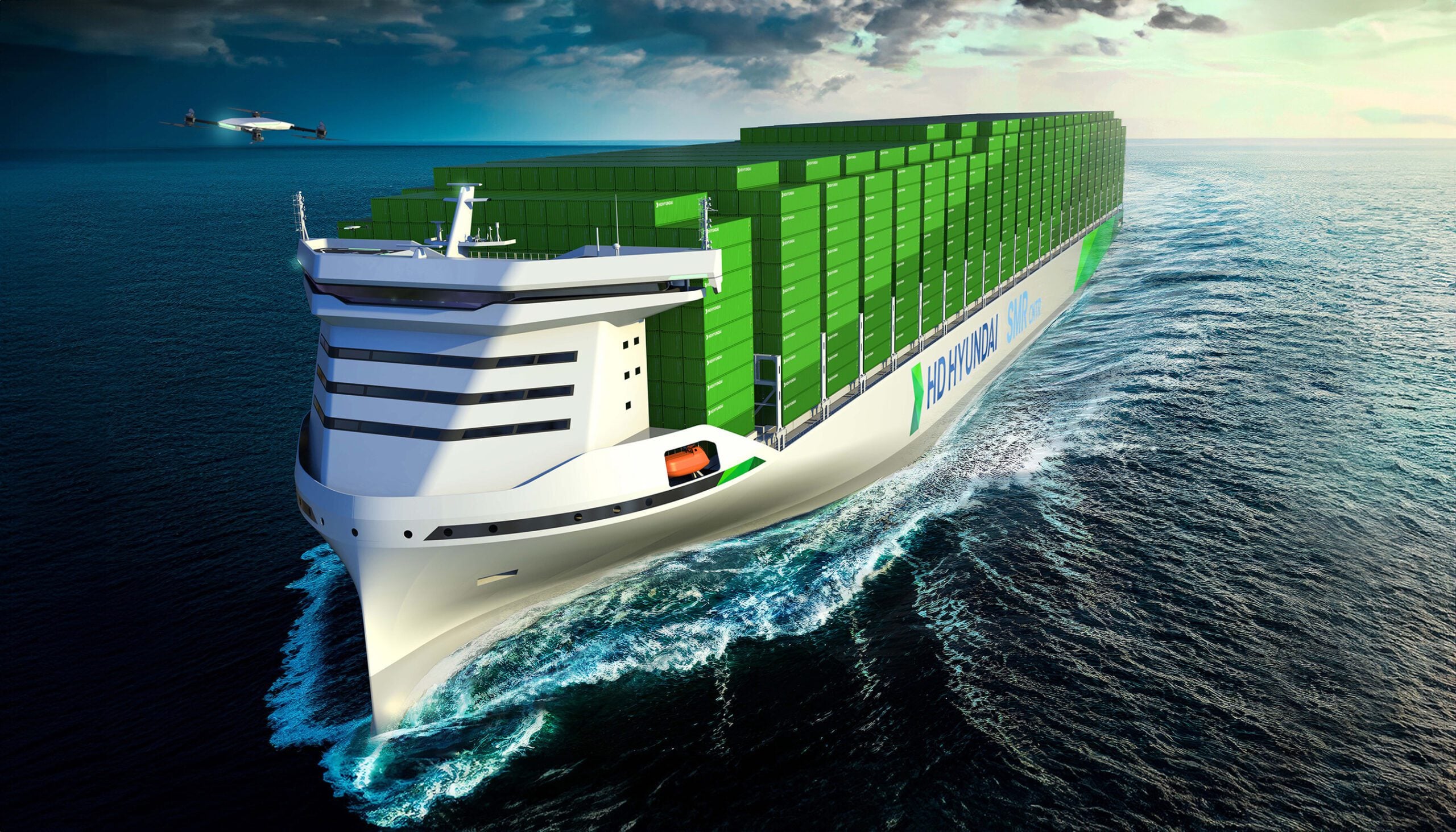
By Paul Morgan (gCaptain) – Thorium, a plentiful but often overlooked radioactive metal, is becoming a key fuel for new compact molten salt reactors. These reactors could change how ports create marine fuels and assist in the energy transition. China has recently demonstrated the world's first experimental proof of the thorium breeding cycle. Meanwhile, Danish engineers are designing reactors that can be built in a factory and fit into shipping containers, suggesting that progress may happen faster than many in the shipping industry expect.
For the past ten years, the maritime industry has been looking for a solution to transition to cleaner energy. LNG caused issues with methane slip, green methanol is hard to find, ammonia has toxicity and combustion issues, and batteries can't provide enough energy for long sea journeys. Now, an old idea is being revisited with new interest: thorium as nuclear fuel.
Thorium has been considered a potential nuclear fuel for over fifty years but was set aside after early pioneers like NS Savannah, Germany's Otto Hahn, and Japan's Mutsu showed it was possible but didn't succeed commercially. High initial costs, regulatory challenges, and public opposition stopped its development. What has changed now is not the goal but the technology and, most importantly, the fuel itself.
Thorium is not fissile by itself. Unlike uranium-235, it can't sustain a nuclear reaction unless it is bombarded with neutrons in a reactor, turning into uranium-233, which is fissile. This breeding process is what makes the thorium fuel cycle work. Thorium is abundant—three to four times more than uranium—and is found in countries like India, Brazil, Australia, the USA, Norway, and Canada, without being concentrated in politically unstable areas. The conventional uranium supply chain is mainly controlled by Russia, which poses risks that Western nations are beginning to tackle. Thorium provides a way around this dependency. Additionally, advanced thorium cycles are expected to produce over eighty percent less long-lived radioactive waste compared to traditional uranium, making waste management simpler and quicker.
The key technology for utilizing thorium is the molten salt reactor, first tested at Oak Ridge National Laboratory in the 1960s, where it ran for more than 15,000 hours. In these reactors, the fuel is mixed in liquid fluoride salt instead of being made into solid rods, enabling them to operate at atmospheric pressure and avoiding the risks that come with high-pressure systems. If a molten salt reactor overheats, the salt expands and naturally slows the reaction. In a crisis, a frozen salt plug melts, draining the fuel into a containment tank and stopping the reaction without needing operator intervention. High operating temperatures above 600 degrees Celsius also allow these reactors to be used for hydrogen production, ammonia synthesis, and desalination, in addition to generating electricity. The ability to dissolve fuel in salt enables continuous refueling while removing byproducts during operation, making these reactors more efficient.
This capability highlights a significant shift in how we view nuclear fuel. Unlike traditional marine fuels, which represent a total and permanent cost, nuclear fuel can retain value long after it's used. Even after years, there's still substantial energy potential in used fuel, where new fissile isotopes can be generated. The so-called spent fuel is better seen as used fuel—a resource with ongoing value. In the thorium cycle, uranium-233 can be extracted and reused in future cycles. Techniques like the PUREX process, which has been in use at France’s La Hague facility for decades, allow for the separation of usable materials from used fuel, effectively closing the energy loop. This creates a fuel model that acts more like a long-term energy asset than a commodity. In shipping, the preferred commercial approach is leasing reactor and fuel systems from specialized providers under energy-as-a-service deals, where operators pay for power while the fuel remains within a managed supply chain, allowing value to be recovered over time.
The major shift from theory to practical application for thorium occurred in China. In October 2024, the Shanghai Institute of Applied Physics added thorium fuel to the operational 2-megawatt thermal TMSR-LF1 reactor in Gansu Province—the first instance of thorium being used in a molten salt reactor worldwide. This reactor ran for ten consecutive days with thorium, successfully confirming the breeding process was working. In November 2025, the institute announced that TMSR-LF1 had achieved full conversion of thorium to uranium-233, providing the first experimental data on thorium breeding in an operational reactor. Earlier, in April 2025, Chinese scientists showcased continuous refueling without shutting down the reactor. China's next step is a 100-megawatt thermal demonstration reactor aimed for 2035, which will also produce electricity and hydrogen.
While China is advancing its plans, Copenhagen Atomics is developing what it hopes will become a commercially viable version of the same technology. Founded in 2014, this Danish company is working on a thorium molten salt reactor designed to fit into a standard 40-foot shipping container. With a target of 100 megawatts thermal, they aim for assembly-line production of at least one unit per day, with a goal of generating clean power for under $20 per megawatt-hour. They have already built two non-fission prototypes and conducted over 10,000 days of testing on components.
In July 2024, Copenhagen Atomics announced its prototypes are ready for a critical experiment at the Paul Scherrer Institute in Switzerland, planned for 2026 and marking the first test of a thorium molten salt reactor in Europe. The company received funding from the European Innovation Council in mid-2025 to build a third prototype and prepare for this pivotal fission test. UK Atomics, a subsidiary in the UK, is managing commercial deployment under an energy-as-a-service model with electricity delivery goals below $48 per megawatt-hour. They are creating agreements with industry partners for a green ammonia facility in Indonesia that aims to produce one million tonnes annually. Their manufacturing approach is clear: Copenhagen Atomics wants to build reactors like cars are made today, not like medieval cathedrals.
The connection to shipping isn't mainly about propulsion just yet. It's about fuel supply. The transition to alternative fuels depends on a key question: where will the clean energy come from to produce green hydrogen, ammonia, and e-methanol in the quantities needed for shipping? Wind and solar energy are vital but can be unreliable. Continuous power is necessary for electrolysis and ammonia production to be economically viable. A cluster of ten to twenty SMR units near a major bunkering port could provide 400 to 800 megawatts of steady electrical output, along with high-temperature process heat, significantly lowering the cost of zero-carbon marine fuels. Major ports like Rotterdam, Singapore, Fujairah, and Houston all face the same challenge: how to generate sufficient clean energy. Thorium SMRs could be a solution, especially since enough thorium is already produced as a byproduct of rare earth mining to sustain current civilization for centuries without needing new mining operations.
Looking ahead, there are plans for direct propulsion in ships. Research indicates that a large container ship could be equipped with two 30-megawatt compact reactors, enabling it to operate for 20 to 25 years without refueling. This would eliminate bunkering logistics, exposure to fuel market fluctuations, and lost port time while restoring operational speed without the fuel cost penalty that caused slow steaming. This setup could increase cargo capacity by up to ten percent by removing fuel tanks and exhaust systems. South Korea is aiming for commercial SMR-powered vessels in the next decade, while Norway's NuProShip program explores reactor integration. China has revealed designs for thorium-powered ultra-large container ships. Currently, however, limitations in port access, insurance complexities, and public acceptance mean using onboard propulsion for commercial shipping is a longer-term prospect. For now, the more immediate and practical approach is setting up shore-based nuclear systems to support marine fuel production, with propulsion following as regulations evolve.
There are significant challenges ahead. Molten fluoride salts at temperatures of 600 to 700 degrees Celsius are chemically harsh, requiring pumps, heat exchangers, and structural materials to be tested for long-term use. Most nuclear regulators have extensive experience with solid-fueled light-water reactors but far less with liquid-fueled systems. There are no verified cost figures for a thorium MSR yet. Establishing reactors at major ports entails community relations and political support, which cannot be taken for granted.
Thorium is not a perfect solution, and thorium SMRs won't solve the marine fuel transition in the next five years.However, they present a credible answer to a significant decarbonization challenge for shipping: not just which fuel burns, but where the vast amounts of clean energy required to create that fuel will come from. China's TMSR-LF1 has demonstrated that the thorium fuel cycle works in practice. Copenhagen Atomics is building the manufacturing processes needed for large-scale deployment. For the first time in commercial shipping history, there's a possibility of a fuel that can be reused, recovered, and maintained as a long-term energy asset over decades. The real question for the shipping industry isn't if thorium-based SMRs will become essential; it's whether they are paying enough attention to know when this will happen.