
According to the latest Global Port Tracker report released by the National Retail Federation (NRF) and Hackett Associates, U.S. container imports are likely to stay below last year's levels through the first half of 2026 due to ongoing tariff uncertainties affecting trade.
This prediction comes as global supply chains deal with changing trade policies following a recent U.S. Supreme Court decision that removed tariffs established under the International Emergency Economic Powers Act (IEEPA). These changes come along with new tariffs set by the Trump administration and increasing geopolitical tensions related to the Iran conflict.
“The Supreme Court has struck down IEEPA tariffs, but other tariffs have already been announced, and more are expected, creating ongoing uncertainty for retailers,” said Jonathan Gold, NRF vice president for supply chain and customs policy. “There is a strong need for clear and predictable trade policies, making long-term planning tough for businesses.”
In response to the Supreme Court ruling, President Donald Trump has announced a temporary 10% tariff under Section 122 of the Trade Act of 1974, which could rise to 15%. Officials also mentioned that additional Section 301 trade investigations may start, adding to the confusion about U.S. trade policies.
The report indicates that U.S. ports processed 2.08 million TEU (twenty-foot equivalent units) in January, a 3.8% rise from December but a 6.4% drop compared to January last year. Reports from the ports of New York/New Jersey and Miami were not available at the time of this analysis.
While February figures are not yet in, Global Port Tracker anticipates volumes of 2.01 million TEU, marking a 1.3% decline year over year. Imports are expected to decrease more significantly in the upcoming months, with March projected at 1.91 million TEU, an 11.2% drop from the same month in 2025, and April seeing 2.03 million TEU, down 8.1% year over year.
The report suggests a slight improvement later in the spring as year-over-year comparisons become easier. Imports are expected to rise to 2.09 million TEU in May and 2.1 million TEU in June, reflecting increases compared to the same months last year when cargo volumes fell sharply after the announcement of “Liberation Day” tariffs in April 2025. For July, imports are projected at 2.2 million TEU, an 8% decrease from a year ago.
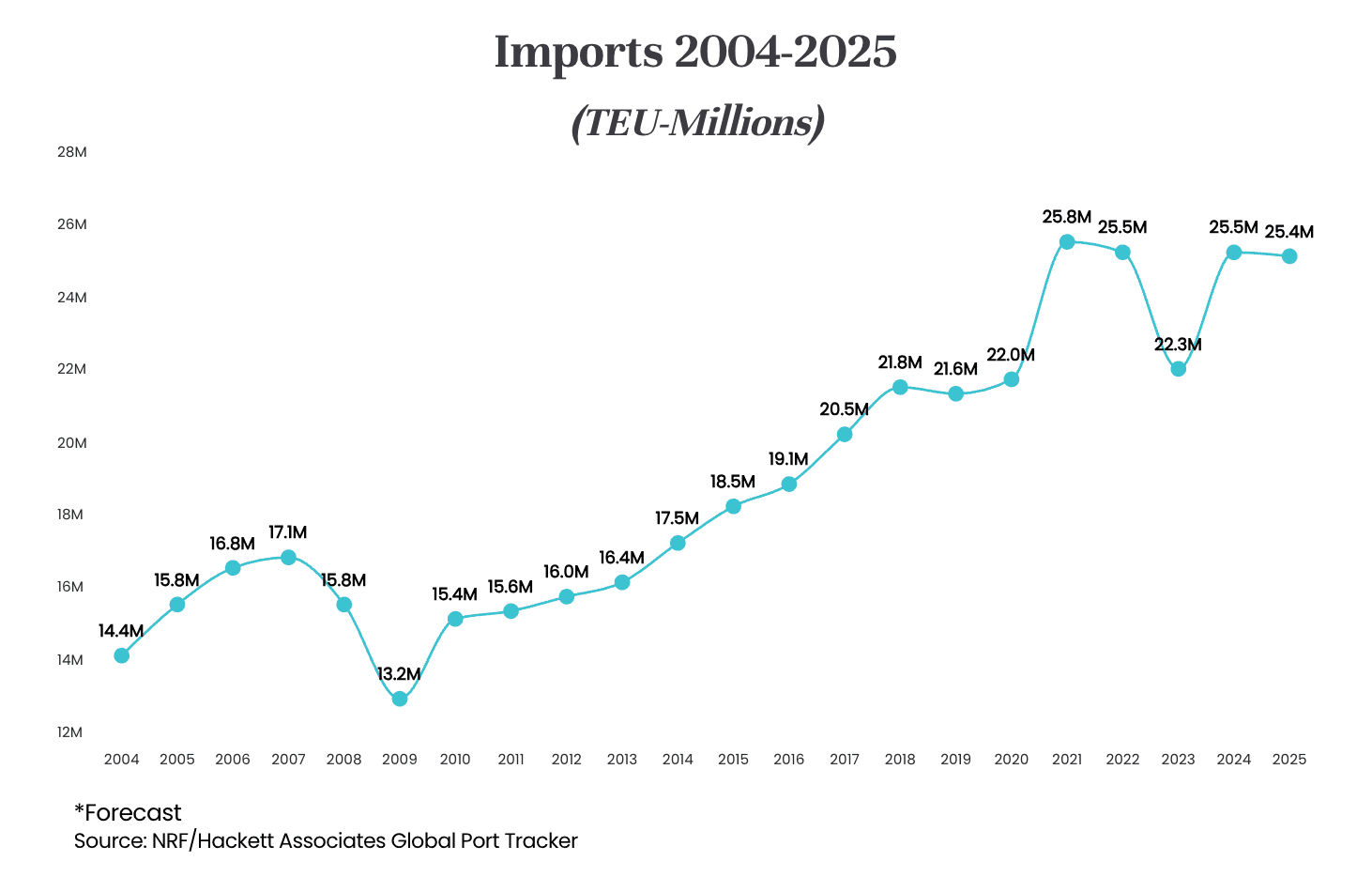
Overall, these estimates predict that total U.S. container imports for the first half of 2026 will be 12.21 million TEU, down 2.5% from 12.53 million TEU in the same period of 2025. In 2025, full-year imports reached 25.4 million TEU, a slight drop from 25.5 million TEU in 2024.
While tariff policy is the main factor affecting these projections, analysts are also closely monitoring the escalating conflict involving Iran for its potential economic impact.
Ben Hackett, founder of Hackett Associates, mentioned that the immediate effects on U.S.-bound containerized trade will likely be minimal since not much cargo heading to the U.S. comes from the Middle East. However, he cautioned that prolonged disruptions could still have broader economic effects, especially in energy markets.
“The immediate impact on containerized traffic to the United States is not likely to be substantial, as little U.S.-bound container cargo is sourced from the region,” Hackett noted. “While it is too early to see these trends in the monthly data, rising oil and gasoline prices could lead to structural inflation if the conflict continues. This inflation could reduce consumer spending and U.S. manufacturing over time, ultimately decreasing import volumes in the long run.”
Global Port Tracker monitors container volumes across major U.S. gateways, which include locations like Los Angeles and Long Beach, Oakland, Seattle, and Tacoma on the West Coast; New York and New Jersey, Virginia, Charleston, Savannah, Port Everglades, Miami, and Jacksonville on the East Coast; and Houston on the Gulf Coast.