
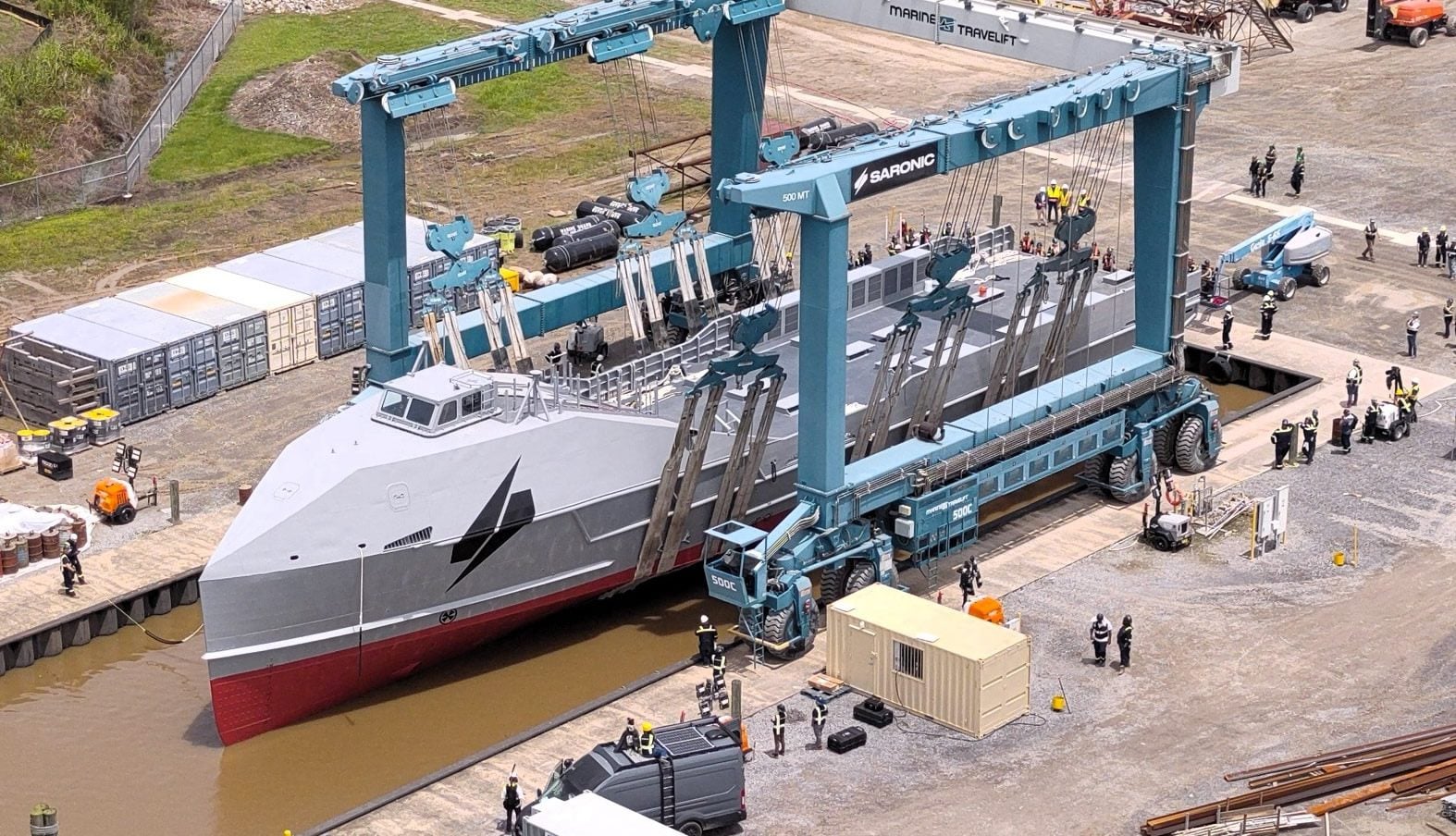
By Captain John Konrad (gCaptain op-ed) Let me start with a clear point: Saronic's Marauder, a Medium Unmanned Surface Vessel (MUSV) created for the US Navy, is truly impressive. The company has built something that the Department of Defense actually needs, and I support funding for it. Keep that in mind, as what follows may sound critical, but it's really a call for honesty because the truth is always a better narrative.
This week, Saronic introduced its first Marauder, a 150-foot medium unmanned surface vessel, moving from design to water trials in less than a year. That's great. However, the issue lies in the exaggerated claims made by the company and its CEO, Dino Mavrookas, which have been echoed across the media: *a pace American shipbuilding hasn’t seen since World War II.*
Saronic isn't alone in this; during the Navy's Sea Air Space conference earlier this year, unmanned surface vessel manufacturers repeatedly used the terms “shipbuild” and “autonomous ships” — yet many of the displayed products were hardly larger than small boats.
While Saronic's Marauder is indeed larger and can carry four shipping containers, it's not quite a ship; it's more of a semi-autonomous crewboat. Describing it as a ship is misleading unless you haven't visited an actual shipyard.
This isn’t a once-in-eighty-years miracle. It’s Tuesday.
Using the term “ship” is deceptive and seems aimed at attracting significant funding for shipbuilding, especially now that media attention has finally turned to the plight of our shipyards.
But the confusion doesn't stop there.
Designing, constructing, and launching a 150-foot aluminum workboat in under a year is not unprecedented. American shipyards do this every year — with tugs, towboats, ferries, patrol boats, crewboats, dredges, and barges — by the hundreds and often under tight schedules.
Data is accessible if you take the time to look. WorkBoat’s recent survey tracked 925 U.S. vessels that were either delivered, under construction, or on order in one year alone, marking a 34 percent increase from the previous year. ShipbuildingHistory has recorded numerous American yards producing similar vessels continuously since 1945. We build so many workboats under 250 feet that the Department of Transportation struggles to keep track of them all.
Want proof of a thriving market? The largest maritime trade show in the U.S., the International WorkBoat Show in New Orleans, attracts over 1,000 exhibitors and more than 13,000 attendees each December, a record turnout. No oceangoing shipbuilding event in the country comes close because that part of the industry is actually on the decline. The workboat sector is not in revival mode; the United States has always been a world leader in this area.
The U.S. has a strong track record in building workboats, and we should highlight that strength instead of painting boatbuilding as a failure. Misrepresenting our capabilities could mislead voters and diminish interest in marine highway projects that capitalize on our ability to build boats and barges quickly, helping ease trucking congestion.
Saronic didn’t conjure the speed. It bought then improved it.
Here’s something Dino didn’t mention in his celebration. Saronic didn’t create this rapid development pace from scratch. They acquired Gulf Craft, a Louisiana yard with many years of experience, and built the Marauder using the yard’s existing workforce, slips, and knowledge. The speed they’re celebrating was already present before Saronic rebranded it.
This is not a criticism of the acquisition; it was a smart decision. But let’s be clear: Saronic didn't revive American shipbuilding. They did not build massive dry docks or cranes. They utilized the infrastructure that the workboat sector has been developing for generations and labeled themselves as “shipbuilders” to secure a larger share of expanding Department of Defense budgets.
Why the lie does real damage
I could overlook the promotional exaggeration, as it’s common for companies to inflate their achievements. However, words matter, and these particular words are damaging in two significant ways.
First, this narrative allows a company thriving in a flourishing market to divert attention and resources from the shipbuilders who genuinely need support to survive. The larger shipyards that construct hulls and capital ships are at risk. They require costly facilities because you can't just lift a destroyer out of the water like a 150-foot aluminum vessel. They are fighting to stay alive, and when funding goes to parts of the industry that are already succeeding, it neglects the areas that are in crisis.
Second, and more concerning: a voter or congressman who has never been to a shipyard may read “a pace not seen since World War II” and mistakenly think that Saronic saved the Navy. It didn’t, and it can’t. A fleet of autonomous workboats might seem impressive, but logistics are what win wars, and logistics are measured in ton-miles.
For perspective, a single Chinese-built containership can carry more cargo than all the Marauders that could be launched this decade combined. The Marauder can move the equivalent of eight TEUs, while China produces boxships rated for 24,346 TEUs. That’s over 3,000 times more capacity. And this is before considering the total tonnage. Historically, ships have been categorized by tonnage, not length.
My U.S. Coast Guard captain’s license states “Unlimited Tonnage,” not “Unlimited Length.” The expertise needed to operate a massive steel ship in harsh ocean conditions is far greater than that required for a small, lightweight aluminum vessel designed for coastal operations.
While autonomous USVs are an important capability, they will never replace the industrial base needed to build large oceangoing vessels.
Truth is the better story.
The team at Saronic has created a commendable company that addresses a real need efficiently, using American labor in a Louisiana workspace. That's impressive enough on its own. There's no need to embellish it with a fairy tale that undermines the shipbuilders trying to stay afloat.
It's not just Saronic Technologies either; every competitor in the autonomous vessel sector follows a similar strategy, combining genuine products with inflated narratives to ride the current wave of concern about shipbuilding. These startups have realized that crafting a heroic origin story is the quickest way to secure defense contracts, and this narrative overshadows the essential discussions about America's real needs for naval strength. Shipbuilding lobbyists in D.C. have embraced this story too, attracted by tech investors, which further confuses lawmakers.
So, let’s stick to the truth. The workboat sector is thriving, while traditional shipyards are struggling, and unmanned vessels are vital complements to a fleet of large steel ships, not replacements.
Both boatyards and shipyards require increased investment. Shipyards need support to recover, whereas boatyards should focus on accelerating their growth.
All that’s needed is one thing: honesty about the distinct differences.
With that out of the way, let’s talk about what they did accomplish — because it’s impressive.
The Marauder is a significant achievement. With a speed over 25 knots and a range that spans thousands of miles, it can quickly reposition and undertake extended missions. It can operate fully autonomously or under remote human supervision, performing mundane, risky patrols without putting a crew at risk. That's a capability the Navy genuinely needs, and Saronic is delivering it.
The key achievement lies in streamlining and digitizing the production process. Saronic integrates design, manufacturing, and autonomy in one location in Franklin. Each new hull benefits from the lessons learned from the previous ones. The first hull went from design to launch in under a year; the second is currently being completed and is expected to be 25 percent faster, while the third and fourth are already being built. Once the yard's expansion is completed at the end of this year, Saronic claims it will be capable of producing around 20 Marauders annually.
“China’s shipyards utilize advanced automation and robotics along with vertically integrated software and hardware systems,” said engineering physicist Andrew Côté. “In contrast, boatyards often rely on traditional methods like whiteboards and magnets since it’s considered 'good enough.' The real question is how to improve this, and the answer lies in what Saronic has done: they took an established yard with an experienced workforce and introduced modern automation methods in both design and operations.”
Moreover, the autonomy features are genuinely innovative. The Marauder is designed for software control from start to finish: every hardware component has monitoring and actuation interfaces, live telemetry, subsystem status updates, logging, and remote intervention capabilities for diagnostics.
That constitutes real, valuable work. None of it requires an exaggerated WWII tale to make it appealing.