
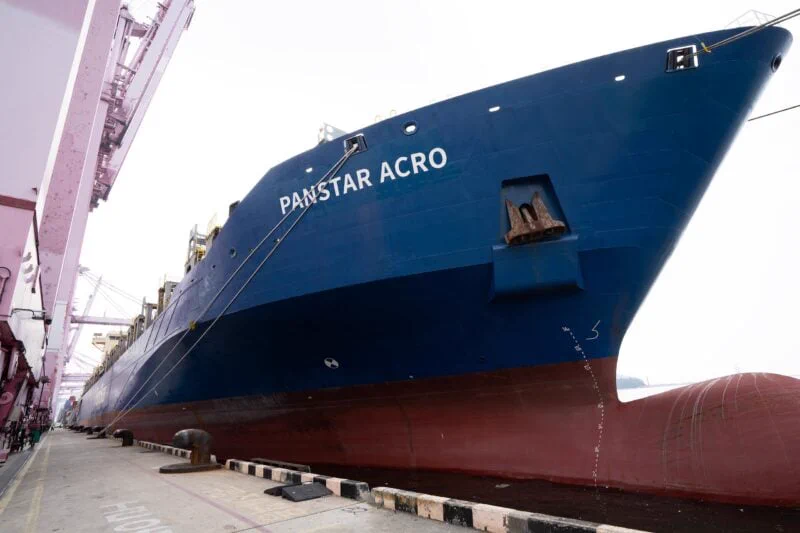
South Korea recently conducted its first container ship trial along the Northern Sea Route, highlighting the challenges of navigating the Arctic. Crew members reported that they almost had to abandon the journey due to drifting ice that blocked their way. Now, the operator is thinking about selling the ship after just one trip and is reportedly in talks to sell it back to its previous owner, HMM.
The difficulties faced by the South Korean ship show a clear gap in experience compared to China. Chinese operators have spent years gaining experience transporting container ships through Arctic waters, while PanStar was on its first expedition. This voyage helped illustrate that having operational know-how is as crucial as the vessel's ice-class ratings.
“When we got stuck among numerous ice floes, I thought we might not be able to continue. Every day brought many unexpected challenges,” said first officer Park Ji-jeong at a press briefing organized by South Korea’s Ministry of Oceans and Fisheries on October 22. “I feel relieved that we safely returned in the end.”
The PanStar Acro, a container ship with a capacity of 2,758 TEU, faced drifting ice near Wrangel Island in the Chukchi Sea during the night of August 31 to September 1.
“There were large amounts of ice drifting around us. We couldn’t see ahead and had to rely just on our radar,” Park recounted. “The conditions were so tough that continuing was difficult, but fortunately, visibility improved after a while, and we could resume our journey.”
Captain Seo Myeong-won mentioned that they thought about turning back. Instead of navigating blindly, he consulted an ice pilot and decided to wait for daylight.
“It would have been better to wait until morning to find a route if it was too dark,” Seo explained in an interview released by the South Korean government. “We chose to stay put and about three hours later, the route became clear.”
The vessel's situation is reflected in its AIS track. On August 31, the Acro moved back and forth for several hours in the waters southeast of Wrangel Island. The Centre for High North Logistics, using data from Kpler and MarineTraffic, estimated that the vessel made only about 16 nautical miles westward during this time, adding approximately eight hours to its journey.
The ship also ran into large ice floes near Vilkitsky Strait and faced issues with its cold-weather equipment, which affected fuel and oil circulation. It completed both Arctic passages without help from icebreakers, but the trip revealed limitations regarding its capability for continuous polar operations.
PanStar is considering selling or leasing the Acro and acquiring a more ice-capable and fuel-efficient vessel for further Arctic trials planned for 2027. Reports from Korean media indicate HMM, the ship's previous owner who sold it to PanStar in August, is interested in buying it back, and price negotiations are currently taking place. No agreements have been reached yet.
The voyage also didn't achieve its commercial goals. The ship managed to transport only 737 TEU of loaded exports and returned with 1,743 TEU of empty containers, failing to secure any import cargo. The Korea Shipowners’ Association provided KRW 3 billion in basic voyage support, with an additional KRW 1 billion available if cargo volumes exceeded 2,000 TEU. It’s unclear if empty containers count towards this threshold.
Meanwhile, South Korea's government has reiterated its commitment to Arctic shipping. In a statement, Oceans Minister Hwang Jong-woo called the trial a “meaningful achievement” in showcasing a new maritime route for container ships carrying Korean exports.
“We will keep preparing to ensure this achievement leads to further voyages and that the Northern Sea Route becomes a new opportunity for our economy,” he added.
For PanStar, finding a replacement for the Acro might be necessary to continue with the project. However, this first voyage also demonstrated that simply having an ice-class vessel doesn't guarantee reliable operations. China's accumulated experience indicates that developing the skills to understand ice conditions, handle unexpected situations, and stick to schedules will be just as crucial.