
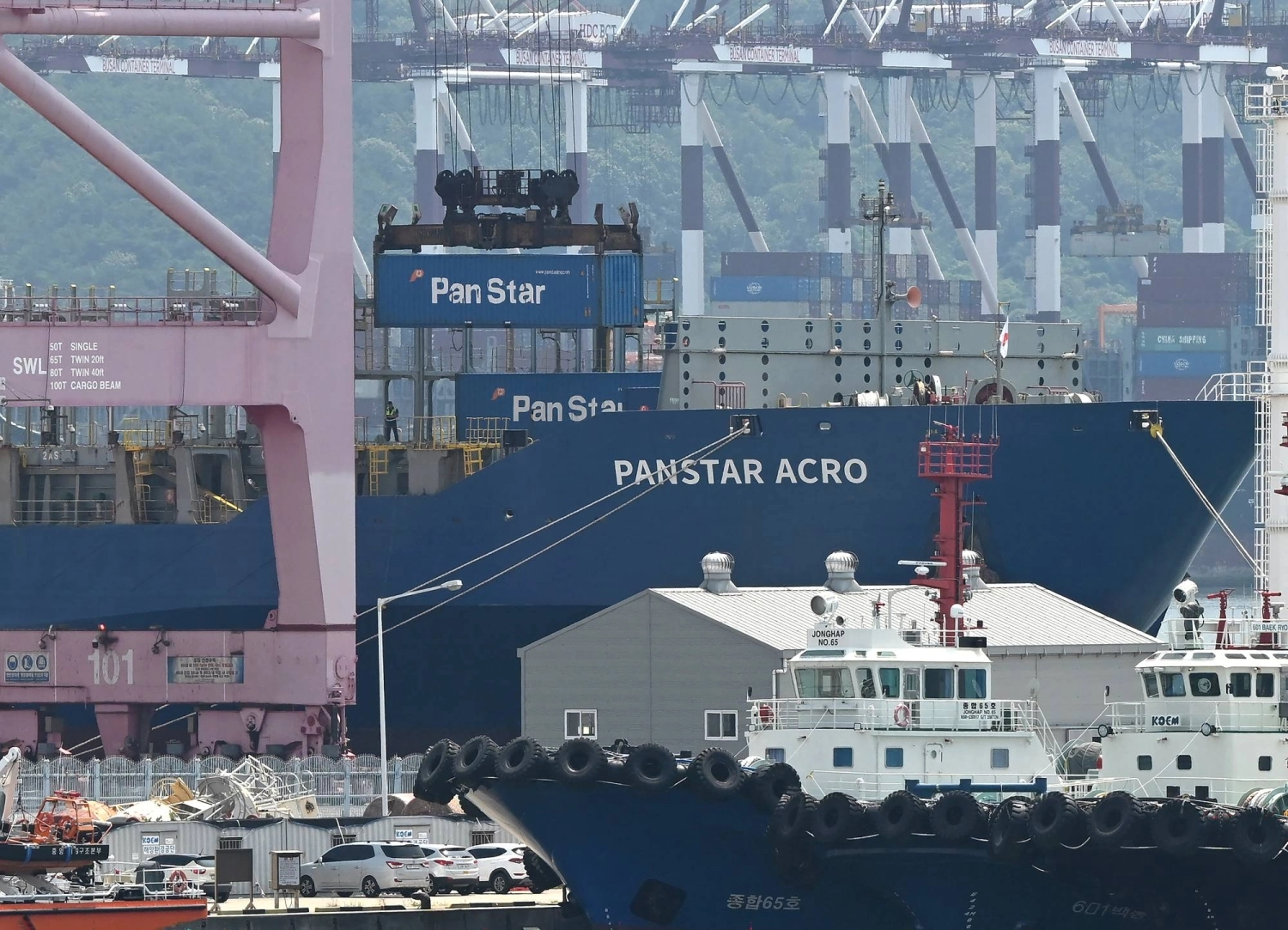
By Hyunbin Kim (Bloomberg) — South Korea’s PanStar Group is set to expand its Arctic container shipping routes starting next year. They have recently completed a trial run to Europe that took about 20 days and believe that a seasonal service focused on high-value cargo can compete with larger Chinese firms.
The Northern Sea Route along Russia's Arctic coastline offers a much quicker passage from Asia to Europe compared to the Suez Canal. This route has historically been used for transporting Russian energy but is gaining interest from container shippers due to climate change and concerns over disruptions to traditional shipping routes. However, unpredictable ice conditions and a limited sailing season have hindered its potential as a mainstream alternative.
Chairman Kim Hyun-kyum mentioned in a recent interview in Busan that PanStar is planning up to three voyages next year, with plans to gradually increase the number of trips. The company aims to operate during the period from July to October when the Arctic waters are more navigable and there’s strong demand for cargo heading to Europe.
China presents the biggest challenge for PanStar. Chinese shippers began trial voyages on the Northern Sea Route last year and are moving toward commercial operations. Many of their container ships are now being built with ice-capable features, as noted by Kim.
“Right now, China is really the only competitor,” Kim said. “China moves extremely fast once it decides to enter a market.”
Rather than trying to match major carriers in size, PanStar plans to utilize vessels that can carry about 3,000 Twenty-Foot Equivalent Units (TEU) or even smaller ships, focusing on time-sensitive and high-value cargo from Korea and Japan. Over time, Kim mentioned that PanStar could collaborate with Korean and Japanese carriers to increase sailing frequency and better compete with China.
For their trial voyage, the 2,758-TEU PanStar Acro left Busan on August 22 and arrived in Felixstowe, UK, on September 12, before continuing on to Rotterdam and Gdansk. This journey took roughly one-third the time needed on the Suez route, including usual port stops, Kim explained.
PanStar is targeting shipments where speed is essential but air freight costs are too high. This includes temperature-sensitive chemicals, shipbuilding equipment, and heavy wind-turbine components. For the trial, the PanStar Acro transported 20-ton industrial rings, which usually demand freight rates that are two to five times higher than normal, according to Kim.
“The Northern Sea Route is not likely to replace the Suez Canal anytime soon, but it could serve as a supplementary route,” said Hwang Jinhoi, a senior research fellow at the Korea Maritime Institute. “For container shipping, time-sensitive cargo that can fill a vessel from the start and be shipped quickly would be a natural fit.”
Piston Voyage
PanStar’s strategy includes what Kim refers to as a “piston voyage” — a fast, direct service that avoids the multiple stops of standard carriers.
“If we tell shippers 20 days, we will arrive in 20 days,” Kim stated.
However, the trial was not without its challenges. Dense ice forced the vessel to divert approximately 350 kilometers (218 miles), and extremely cold seawater made things difficult for the ship's engines.
Costs are another concern. Kim noted that fuel prices increased nearly 40% in the three months leading up to the departure due to conflicts in Ukraine and the Middle East, meaning the first voyage likely resulted in a loss.
The PanStar Acro carried around 700 containers, significantly less than the usual capacity of about 1,500. Finding return freight would improve the economic situation, and the company has contacted Korean firms in Europe for shipments that are typically sent by air when delivery times are tight, such as automotive parts and machinery.
In the future, PanStar is also considering using smaller, faster vessels to lower fuel consumption. Kim noted that data from the trial will help the company determine the best approach for regular Arctic shipping.