
By Gavin Maguire
LITTLETON, Colorado, Aug 14 (Reuters) – Transportation in the U.S. is becoming more efficient due to new engine technologies, better infrastructure, and advanced logistics systems.
The next phase of this transformation involves automation, which is making transportation networks smarter. These systems will use less energy per unit of cargo, operate longer, ease labor shortages, and change how fuels and electricity are consumed.
From rivers to roads, railways, and air travel, software is increasingly controlling energy use and the movement of goods across the U.S.
Driverless trucks are already operating in Texas, while AI is being used on towboats in the Mississippi River. Rail companies are turning to automated inspection systems, and aviation regulators are looking ahead to a future where cargo flights may require less human input.
While each of these developments may seem small on its own, together they indicate a shift towards a more autonomous and efficient freight economy.
Transportation is the largest energy consumer in the U.S., making up about 37% of total energy usage, as reported by the Energy Information Administration (EIA). It is also responsible for around 70% of the nation’s petroleum demand.
Any significant changes in the transportation sector could significantly impact both U.S. and global energy markets in the next ten years.
THE MISSISSIPPI GOES DIGITAL
The Mississippi River, North America’s oldest freight route, is now embracing AI technology.
The U.S. inland waterways transport hundreds of millions of tons of goods each year, including fertilizer, grain, biofuels, and petroleum products.
Transporting goods by water is one of the most energy-efficient methods, with water transport using only 4% of U.S. transportation fuel.
Traditionally, navigation relied on the skills and experience of human captains. They used local knowledge and visual cues to adapt to changing river conditions, but that is changing.
Last year, Southern Devall equipped a commercial towboat on the Mississippi with Mythos AI's Advanced Pilot Assist System, which uses machine learning to assist navigation.
The system helps assess hazards, track vessels, calculate stopping distances, analyze river conditions, and find ways to save fuel.
These advancements will have wide-reaching effects.
River transport is already more energy-efficient than trucking, as towboats utilize the river's natural flow. Currently, one gallon of fuel can move a one-ton load over 500 miles on a barge, compared to about 60 miles by truck, according to the U.S. Army Corps of Engineers.
Automation can enlarge this gap by minimizing fuel waste, improving planning, reducing delays, and making barge traffic more reliable.
This is important since many goods moved on these waterways are energy-related, including crude oil, coal, and biofuels. Lower transport costs could lower prices for many energy-intensive products.
TRUCKS THAT NEVER SLEEP
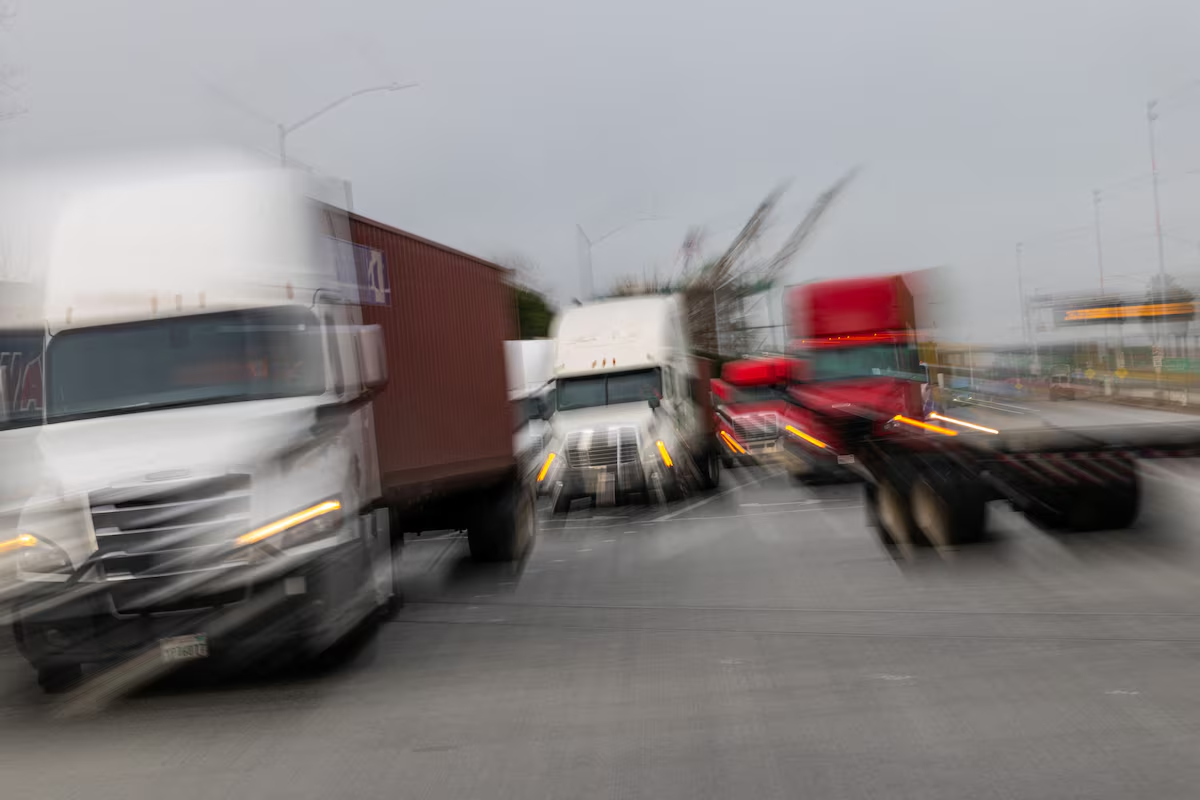
The revolution in automation is most clearly seen on American highways. Trucks, accounting for over 60% of U.S. transportation fuel use, are on the brink of a major change.
For years, trucking improvements focused on better engines, aerodynamics, and logistics software. However, truck operations still depended on drivers taking breaks. Autonomous trucks aim to eliminate this limitation.
Companies like Aurora Innovation have shown that driverless freight operations can work in Texas, moving towards a model where trucks can operate almost continuously.
Instead of being limited by mandated driving hours, autonomous trucks could transport goods around the clock.
This represents a new form of productivity gain compared to past transport advances.
In the industrial era, improvements were based on creating more powerful machines. Today, automation enhances productivity by maximizing the use of these assets.
A truck that operates for 20 hours a day rather than 10 essentially doubles its productivity, minimizing the need for idle equipment in the freight network.
The energy implications of this is complex.
Automation can help optimize speed, braking, and acceleration, which lower fuel use per mile. Better routing and convoy driving, where trucks follow each other closely to reduce air drag, may further reduce fuel consumption.
However, lower shipping costs might increase demand for freight. Historically, improvements in efficiency typically lead to more overall activity. If driverless technology greatly reduces shipping costs, it could lead to an increase in freight volumes that might offset fuel savings.
Over time, autonomous fleets could accelerate the transition to electric trucking through optimized charging and better fleet management, shifting energy use from diesel to electricity.
RAIL’S QUIET REVOLUTION
Railroads provide one of the most advanced examples of automation that often gets overlooked. While the spotlight shines on autonomous trucks, rail improvements are quietly happening through advanced sensors, digital mapping, and predictive analytics.
Freight railroads have been increasingly using automated track inspection systems while trains are still operating. Lasers, cameras, and machine learning are used to continuously monitor track conditions and equipment performance, achieving results far beyond traditional methods.
This change marks a shift from infrequent inspections to continuous monitoring.
In the past, rail maintenance relied on manual inspections that often detected problems only when they became significant. Today, automated systems are finding issues much earlier.
Another important advancement is the Pathfinder, developed by Wabtec, a leading rail technology firm. This device enables regular locomotives to have digital capabilities and use cameras for autonomous operation.
With thousands of locomotives in use in the U.S., upgrades like Pathfinder could help smaller rail operators integrate advanced technologies such as Positive Train Control, improving safety and performance.
These advancements lead to faster train movement, reduced bottlenecks, and better asset utilization.
Since rail is the most energy-efficient form of land transportation, accounting for just 2% of U.S. transportation fuel use, any shift from trucks to rail can significantly lower overall energy consumption.
This could be one of the most important benefits of automation: promoting the use of transport methods that already use less fuel.
AVIATION’S NEXT FRONTIER
Aviation currently has the least automation, but that is changing. The Federal Aviation Administration (FAA) is beginning to develop regulations for more automated operations.
At the same time, companies like Reliable Robotics are working on FAA-certified autonomous cargo planes that could operate from start to finish with remote assistance. The U.S. Air Force is also investing in pilotless cargo aircraft for civilian airspace integration.
In aviation, automation mainly focuses on increasing operational flexibility. Autonomous cargo aircraft could link smaller communities, improve logistics, and establish new freight networks that aren’t currently cost-effective.
While immediate energy savings from aviation may be modest, since the sector is already highly optimized and uses only 9% of U.S. transportation fuel, automation could open up new transportation models, especially in regional cargo and electric flights.
The impact of aviation automation may be similar to the early days of the internet: the most valuable effects may arise not from making current practices cheaper but from creating new alternatives that were previously unavailable.
WHAT THIS MEANS FOR ENERGY MARKETS
The common story about transport automation is that machines are taking over jobs. This oversimplifies the situation. A better way to understand it is that software is eliminating inefficiencies.
Idle trucks, empty backhauls, delays on rivers, unnecessary fuel use, preventable slowdowns in rail, and underused aircraft all create hidden energy costs throughout the economy. Automation aims to target these inefficiencies directly.
As transportation systems become more advanced, freight movement becomes smoother, assets operate more hours, maintenance shifts to predictive methods, and logistics networks synchronize with each other.
This could lead to an economy that can handle significantly more cargo without a corresponding rise in energy use.
NON-STOP LOGISTICS?
Changes in energy usage are often seen as transitions in fuel types. However, history shows that significant economic shifts usually come from productivity advancements.
The importance of steam power lay in its ability to enhance human work output. Electrification boosted productivity in industries and homes, while computing made information cheaper and more accessible.
Transportation automation is part of this legacy. From AI-powered towboats on the Mississippi to self-driving trucks in Texas, the U.S. is creating a freight system that uses time and fuel more efficiently and maximizes output from current infrastructure.
The key transportation question for the next decade may not be whether trucks use diesel, electric batteries, or hydrogen, but rather whether they ever need to stop.