
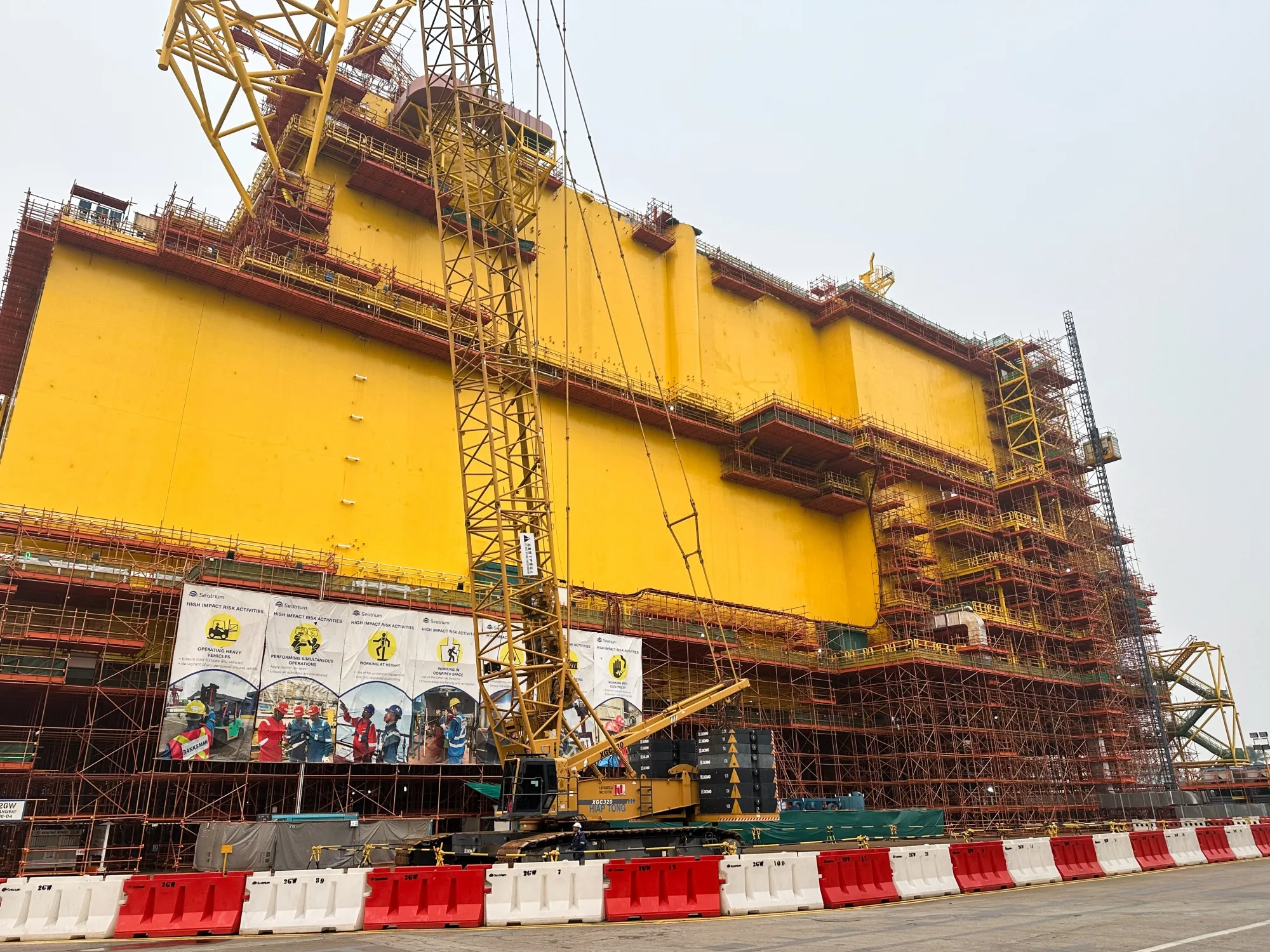
In a shipyard in northern Singapore, a massive yellow structure resembles a 15-story building and stands tall amidst cranes and scaffolding. This 30,000-ton platform, known as a high-voltage direct current (HVDC) converter, is set to travel to Europe in 2028, where it will be installed 60 kilometers offshore to help transmit electricity from wind turbines back to the mainland. This is part of Singapore's efforts to support Europe's green energy initiatives.
Singapore is leveraging its decades of experience with the offshore oil and gas industry to transition into renewable energy. One of the main opportunities is exporting these large HVDC platforms to Europe, where they are essential for transmitting power from offshore wind farms over long distances.
Despite the challenges faced by the offshore wind sector—where global investments dropped by 72% to around $12 billion in the first half of 2026—HVDC technology stands out. Few shipyards possess the necessary knowledge and facilities to produce these platforms, which could lead to a supply shortage as the European Union continues its expansion plans.
Seatrium’s HVDC platforms can manage about 2 gigawatts of electricity, making them the largest of their kind globally. Each platform takes five years to build and has a lifespan of 40 years, with GE Vernova Inc. providing the HVDC technology.
Recently, Singapore and surrounding regions have increased their share of global HVDC platform capacity to 20%, a significant rise from just a few years ago, according to Ember analyst Lam Pham. As Europe builds more wind farms further offshore, this demand is expected to grow, providing an opportunity for local shipyards.
Chris Ong, CEO of Seatrium, remarked that the company's investment highlights the potential for this sector.
Seatrium, partly owned by Singapore's state investor Temasek Holdings Pte, has been commissioned by European grid operator TenneT Holding BV to construct four platforms for North Sea projects. Around 7,000 workers are engaged in building these structures in Singapore and Batam, an Indonesian island just a short ferry ride away. Each platform and its connecting infrastructure can cost up to €5 billion ($5.6 billion), according to TenneT.
These platforms are essential for driving global offshore wind growth, which faces issues like high costs, supply chain limitations, and regulatory challenges. Yet, Europe is continuing to develop its offshore wind capacity to achieve ambitious renewable energy goals. For instance, the UK recently awarded a record 8.2 gigawatts of capacity in a subsidy auction, while Germany and the Netherlands are adopting new protective revenue measures. With sufficient government support, BNEF predicts installations could double by the end of the decade, led by China, the UK, and Germany.
Singapore aims to become the preferred choice for European developers. Competing shipyards in the Middle East are disrupted by regional conflicts, while those in China and South Korea are primarily focused on domestic needs, and Europe’s facilities are booked for military shipbuilding.
Lam believes that Singapore’s production will be more cost-effective, even with shipping costs taken into account, as labor-intensive industries in Europe face high labor costs.
While wind turbines generate alternating current, offshore developers rely on HVDC platforms to convert this power to direct current, enabling it to travel longer distances with minimal energy loss. This trend is likely to grow as wind farms are located further from land.
Ong, who previously led oil rig builder Keppel Offshore & Marine before it merged with Sembcorp Marine to form Seatrium in 2023, is optimistic about meeting the demand for offshore wind projects in the coming years. As of July, the company was pursuing S$9 billion ($7 billion) in HVDC and HVAC projects across Europe and Asia Pacific, with clean energy contracts now constituting about 40% of its total order book.
At the shipyard in Singapore, the future of offshore wind energy is taking shape, with workers welding steel panels and assembling the large yellow structure piece by piece. Ong emphasizes that the need for this infrastructure is not only driven by the energy transition, but is also crucial for Europe’s future power security.
“The scale and the massive need for offshore wind is a significant security concern,” he stated. “It has to happen.”