
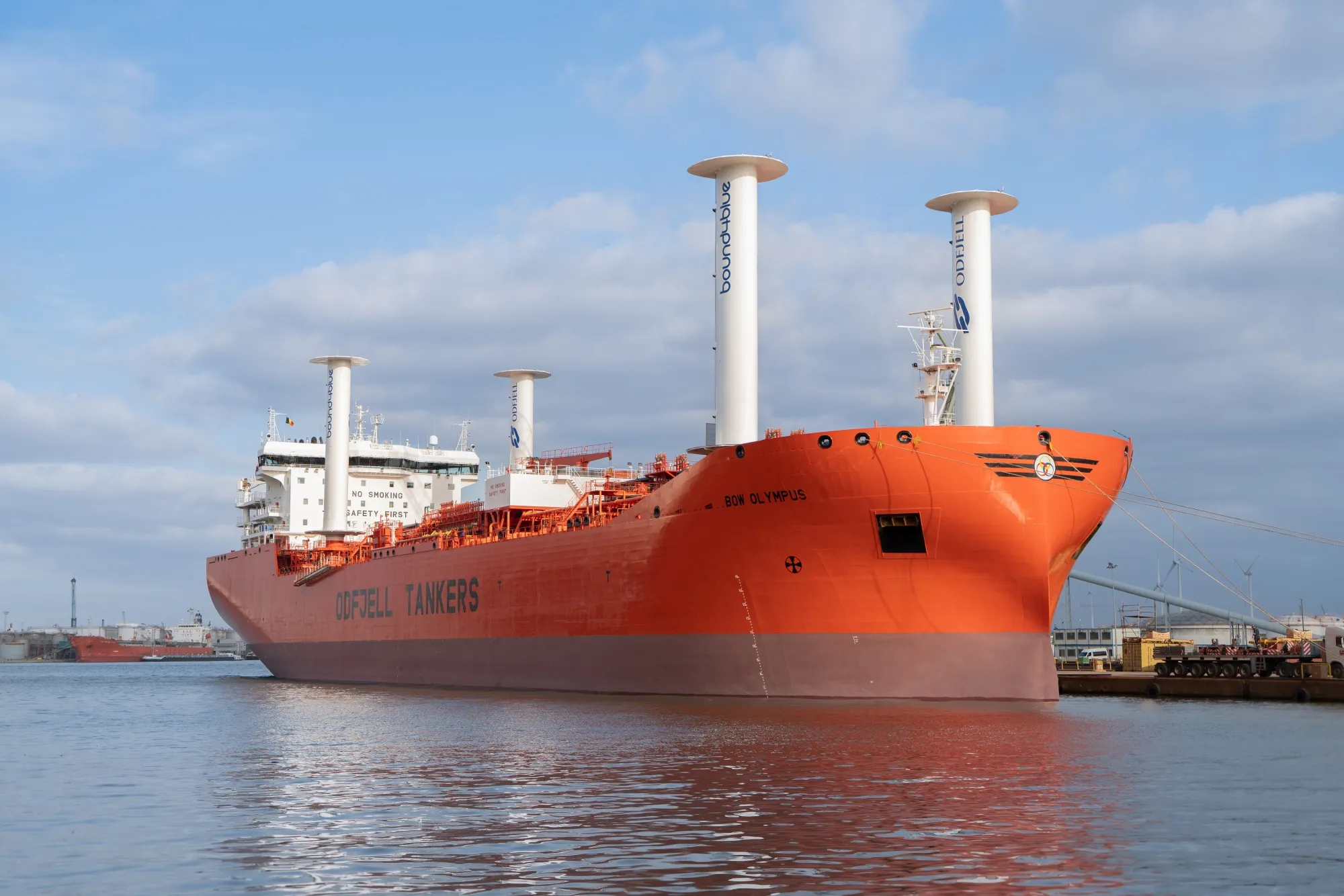
Asian and Norwegian shipping families are backing new sail technology that could significantly reduce fuel use for ships. The family office of Norway's Odfjell SE and Singapore's Octave Capital, supported by the Tsao Pao Chee Group, recently raised $44 million for bound4blue, a company that develops wind propulsion systems.
Bound4blue, based in Spain, has created technology featuring tall, tube-like structures that capture wind during a ship's journey. These structures use fans to generate thrust, potentially reducing fuel consumption and emissions by up to 40%. Companies like Maersk Tankers A/S and Eastern Pacific Shipping Pte. are already using this technology, which has been deployed on seven vessels so far.
This fundraising effort also included support from investors like the ReOcean Fund, which is co-managed by the Prince Albert II of Monaco Foundation and Monaco Asset Management. The funds will help expand manufacturing from Spain to China and other parts of Asia.
According to CEO José Miguel Bermúdez, China, South Korea, and Japan account for nearly 90% of the world's shipbuilding. He noted that moving production to China could lower total costs by about 20-30%.
Wind propulsion technology is a growing field, with various innovations being tested. Jeremy Genin, managing director of ReOcean Fund, emphasized that the low barriers to adoption could accelerate the implementation of these technologies. The fund aims for a net internal rate of return of 15% to 20%.
Bound4blue's focus on fuel efficiency comes at a time when countries are struggling to address emissions from shipping, which contributed to nearly 1.4% of global greenhouse gas emissions in 2024, surpassing aviation.
A recent decision by the International Maritime Organization to delay a vote on a significant carbon tax for ships could impact investment in cleaning up the maritime industry. The UN Trade and Development report indicates that decarbonizing the global fleet will require an annual investment of between $8 to $28 billion through 2050.
May Liew, CEO of Octave Capital, stated that the case for wind propulsion technology is more about fuel savings than carbon prices. "We're focused on reducing fuel consumption to deliver direct and bankable operating savings," she explained.