
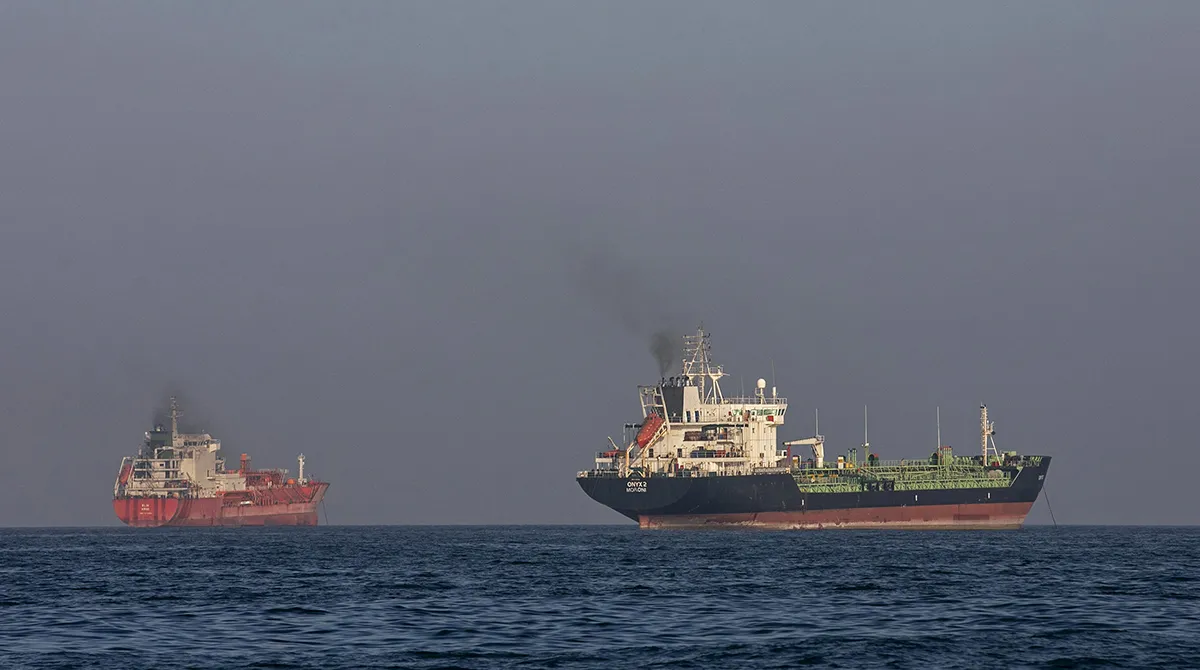
(Bloomberg) — A recent US-Iran agreement to reopen the Strait of Hormuz soon has raised some concerns among shipowners and traders, many of whom want more information to determine if safe passage is achievable after a series of false starts.
The Strait of Hormuz is crucial for global oil and gas transportation and has been at the center of conflict since strikes on Iran began. The need to resume traffic has been a key topic in ongoing peace talks. The disruptions have severely impacted the global energy market, isolating some major producers and forcing them to use risky transit methods.
The announcement of a long-awaited deal between the US and Iran, along with the possibility of ending a dual blockade, caused Brent oil futures to drop nearly 5%. However, those involved in transporting oil and gas are still unsure about the practical implications of the reopening, which US President Donald Trump has stated will occur on Friday.
According to Iran’s semi-official Fars News Agency, transits will be free for the first 60 days, after which Iran plans to charge fees. The management of "navigation services" in the strait will be decided by Iran and Oman. BIMCO, the leading global organization for shipowners, warned that essential details still need to be clarified before transit can be deemed safe.
“From our perspective, it looks very different from what the headlines suggest,” said Angad Banga, CEO of The Caravel Group, which includes Fleet Management Limited, one of the largest ship management firms globally. The company currently has several crews stranded in the Persian Gulf. “We’ve seen positive signals in the past, but what’s most important is what actually happens.”
Major Japanese shipping firms, among the first to respond to the deal, emphasized that safe navigation is dependent on finalizing the details. Mitsui OSK Lines mentioned the need for close coordination with governments and insurance companies before they could send ships through the strait again, while Nippon Yusen KK stated that resuming traffic relies on the specifics laid out in the agreement.
In the hours following the announcement, traffic in the strait was limited, with only one liquefied natural gas tanker, Disha, cautiously making its way into the eastern part of Hormuz towards the Gulf of Oman.
“Shipowners have different levels of risk tolerance — Japanese, Koreans, and Chinese are typically less willing to accept high risks, while Greeks might be more inclined,” said Anoop Singh, global head of shipping research at Oil Brokerage Ltd. “However, most of the market is still looking for more details and guarantees before moving forward.”
Since US and Israeli airstrikes began at the end of February, traffic through the strait has significantly slowed, dropping to a fraction of the pre-war average of about 135 daily transits. Some oil and gas producers have found alternatives to send tankers through, sometimes with US assistance or through government negotiations, but the total number of crossings is still far lower than before.
Out of hundreds of vessels waiting in the Persian Gulf, nearly 300 are loaded and ready to cross at any moment, with a similar number waiting empty in the Gulf of Oman to return to major export terminals, according to Muyu Xu, a senior crude oil analyst at Kpler. About 250 more are ballasting in the Persian Gulf, positioned to start collecting cargoes for possible outbound trips.
The count of ships is subject to change as vessels that had turned off their tracking systems resume operation. An electronic interference that has complicated tracking in the area is expected to diminish.
Theoretically, a temporary peace deal could free millions of barrels of oil that have been stuck in the Persian Gulf for months. However, there are still numerous challenges — including practical issues like removing barnacles from ship hulls and ensuring crews are ready to sail.
For now, security remains the main concern, as past purported agreements have sometimes resulted in Iranian forces attacking ships or seizing vessels.
Fars reported that after the first 60 days of free transit, Iran will start charging for safety, navigation, environmental, and insurance services.
BIMCO stated that important aspects of the agreement need clarification before navigation can be considered safe.
“Credible assurances from both parties must be provided before traffic can return to pre-conflict levels,” said Jakob Larsen, the organization’s chief safety and security officer. He added that mine clearance remains a crucial issue and that the large number of trapped vessels means departures must be coordinated carefully.
Brett Erickson, a managing principal at Obsidian Risk Advisors, noted that security is a top priority for all ships and companies operating in the area.
“The maritime industry is fully aware of this. Captains and crews understand it,” he stated. “They know that one wrong move, a single strike, or a political decision could create more tension and put their lives at risk.”
Managing a significant increase in traffic through the strait will also be challenging, even if other concerns are resolved.
The strait is only 24 miles (39 kilometers) wide at its narrowest point, with shipping lanes just two miles wide in each direction, raising the risk of collisions if vessels rush to exit. The situation is complicated by electronic interference and irregular transponder use, which can misrepresent vessel locations.
“During times of heavy traffic, the risks of collisions and groundings can significantly rise. These factors must be carefully considered in transit planning,” a guidance document released last month by major industry groups like BIMCO, Intertanko, and the International Chamber of Shipping stated.
“Don’t rely on AIS,” it cautioned, referencing the automatic identification system used for tracking ship locations.