
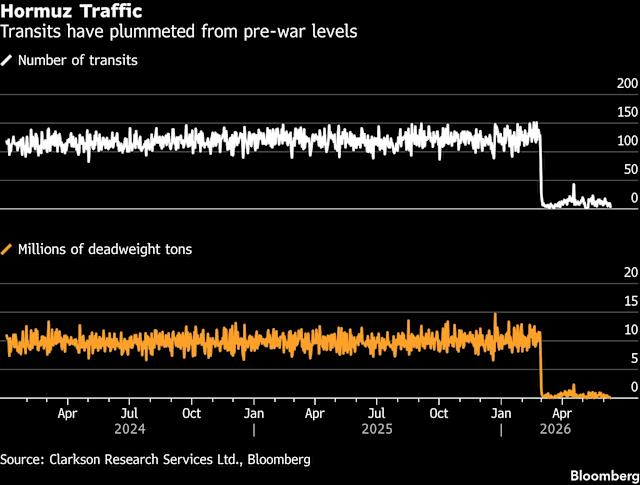
June 15, 2026 (Bloomberg) – A recent US-Iran agreement aimed at reopening the Strait of Hormuz has met with skepticism from shipowners and traders. Many are looking for more information to determine if safe passage is possible after months of uncertainty.
The Strait of Hormuz is crucial for global oil and gas shipments, and since the start of strikes against Iran, it has been central to the ongoing conflict. The urgent need to restore traffic has been a key focus during recent peace talks. The disruption has greatly impacted the global energy market, isolating some of the world's leading oil producers and forcing many to navigate through less secure routes.
Following news of the long-awaited deal between the US and Iran, oil futures saw a slight uptick in early trading on Monday, with Brent crude prices dropping nearly 5%. However, those involved in shipping crude and gas remain unsure about what the reopening will truly mean in practice. US President Donald Trump mentioned that the reopening could happen on Friday, but uncertainty persists.
Muyu Xu, a senior crude oil analyst at Kpler, expressed caution: “There are so many timelines involved, and it’s unclear if there’s a clear order for implementing the terms. A lot can happen during these windows, and Iran might close the strait again if it perceives any threatening actions from the US or Israel.”
Despite the news, very few vessels moved through the strait shortly after the announcement. Only one liquefied natural gas tanker, the Disha, was spotted testing the waters as it made its way toward the Gulf of Oman.
Since US and Israeli military actions began in late February, traffic in the strait has slowed significantly, dropping to just a small fraction of the usual average of about 135 daily transits. Some oil and gas producers have managed to find ways to send tankers, sometimes with US support or through government negotiations, but the overall traffic remains very low.
Among the hundreds of vessels waiting in the Persian Gulf, nearly 300 are loaded and ready for immediate crossing, while an equal number are empty and waiting in the Gulf of Oman, ready to return to major export terminals. Approximately 250 vessels are also positioned in the Persian Gulf, prepared to pick up cargoes for potential outbound voyages.
Security concerns are paramount, as previous agreements have led to instances where Iranian forces shot at ships or seized vessels. Additionally, there is uncertainty about underwater mines in the strait, making careful navigation and insurance coverage critical.
Major Japanese shipping companies, quick to react to the deal, emphasized that safe navigation can only happen after all details are confirmed. Mitsui OSK Lines stated close coordination with governments and insurance providers is necessary before resuming operations in the strait, while Nippon Yusen KK noted that normalizing traffic will depend on the specifics of the agreement.
Brett Erickson from Obsidian Risk Advisors highlighted that safety is a primary concern for all maritime operations in the region. “The maritime industry is well aware of the risks. Captains and crews know that one wrong move or decision could heighten tensions and endanger their lives,” he stated.
Even if concerns over security lessen, managing a surge in traffic through the strait will pose additional challenges. The strait is only 24 miles (39 kilometers) wide at its narrowest point, with shipping lanes just two miles wide, which increases the risk of vessel collisions if traffic resumes rapidly. Complicating matters further, electronic interference and irregular use of transponders can lead to inaccurate location reporting.
A guidance document released last month by major industry groups, including Bimco, Intertanko, and the International Chamber of Shipping, warned that during times of heavy congestion, the risks of collisions and grounding could significantly rise. It advised careful planning for pre-transit activities and added, “Do not rely on AIS,” referring to the automatic identification system used for vessel tracking.