
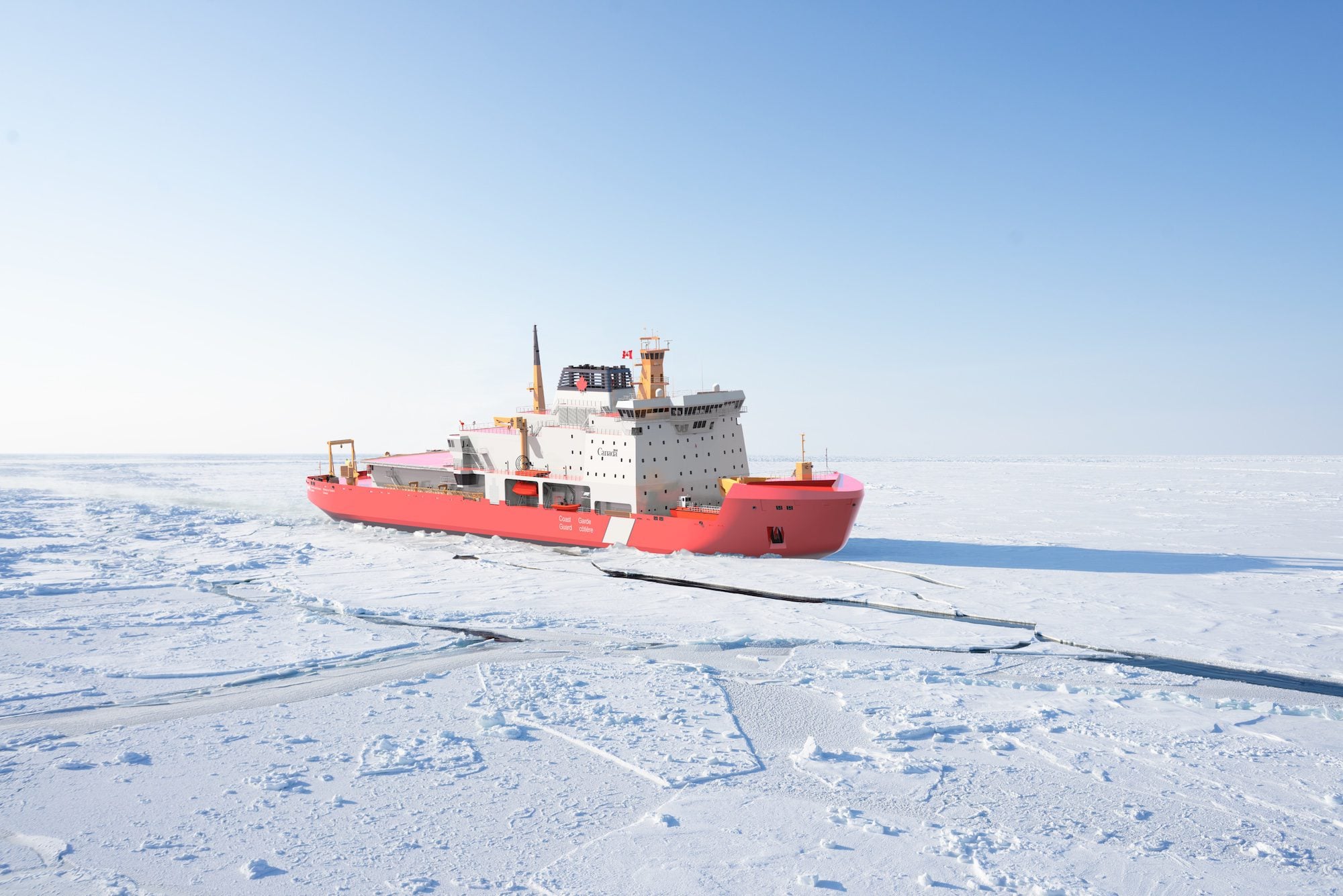
Seaspan Shipyards in Canada has announced that it has finished the first major construction block for a new heavy polar icebreaker for the Canadian Coast Guard. This marks significant progress on what is expected to be one of the most advanced icebreakers in the world as Western nations enhance their Arctic capabilities.
Based in Vancouver, Seaspan reported that more than 49 blocks for the 158-meter (518-foot) vessel are currently under construction, just a year after the initial steel cutting began as part of Canada’s National Shipbuilding Strategy.
This first large block, weighing 330 tonnes, includes sections for the propulsion motor room, fuel tanks, and other essential spaces. Seaspan announced that this block has now been structurally completed.
Construction is proceeding on schedule at Vancouver Shipyards, with additional work also happening at facilities on Vancouver Island.
The new vessel is engineered to operate all year round in the extreme Arctic conditions, with temperatures that can drop to minus 50 degrees Celsius. It requires thick steel and specific welding techniques to ensure durability.
Seaspan explained that for the propulsion motor foundations, they are using 50 mm thick steel plates, while other parts of the ship will use steel up to 60 mm thick to withstand the harsh ice conditions in the Arctic.
“A year ago, we started cutting steel here at Vancouver Shipyards. Today, we have built a skilled Canadian workforce capable of welding thick steel suitable for Arctic ice," said Seaspan Chief Executive John McCarthy.
Once completed, the 26,000-tonne Polar Class 2 vessel will serve as the flagship for the Canadian Coast Guard's icebreaking fleet and will be among the most powerful conventional icebreakers worldwide.
This vessel is one of two heavy polar icebreakers ordered by Canada. Seaspan obtained the contract for this first vessel in 2025, while Davie Shipbuilding in Quebec received a separate contract for another heavy icebreaker that follows the Polar Max design from Helsinki Shipyard.
The move towards dual procurement reflects an increasing focus on Arctic strategy among Western governments as climate change opens new shipping routes and heightens geopolitical competition.
Seaspan has also become a significant contributor to the U.S. Coast Guard’s Arctic Security Cutter (ASC) program. In collaboration with Bollinger Shipyards, Seaspan and Aker Arctic Technology developed a production-ready icebreaker design that has been selected for up to six ASCs for the U.S.
Initially, the first vessels will be built in Finland by Rauma Marine Constructions and Bollinger in the U.S., with plans for larger-scale production in the U.S. later on.
Davie is also involved in the U.S. Arctic expansion with a separate ASC contract for up to five additional cutters, while working on the Polar Max icebreaker program for Canada.
The speed of construction at Seaspan contrasts sharply with the slower progress on the U.S. Coast Guard’s troubled Polar Security Cutter (PSC) program, which is being built by Bollinger in Mississippi. The PSC program, aimed at producing the U.S.'s next heavy polar icebreaker, has faced numerous delays and rising costs over the years.
In comparison, Seaspan's heavy icebreaker program has transitioned from prototype testing to full-scale production in about two years, utilizing extensive expertise from Finnish design and a well-established supply chain.
“On behalf of the Canadian Coast Guard, I want to congratulate Seaspan Vancouver Shipyards on their progress in creating Canada's future heavy polar icebreaker,” said Kevin Brosseau, commissioner of the Canadian Coast Guard. “This milestone showcases Canadian expertise and partnership and brings us closer to having a vessel that will support Arctic operations and Canada’s sovereignty for many years.”