
August 8 – Movies have shown sharks as summer villains, from the shark in “Jaws” to the tornadoes in “Sharknado.” However, sharks swimming off the U.S. East Coast might be doing more than just hunting; they could also be collecting valuable data that helps scientists predict hurricane intensity before it hits land.
Researchers from the University of Delaware are exploring if sharks can act as mobile observers, equipped with sensors that measure ocean conditions. This data is useful for oceanographic, atmospheric, and climate studies.
The CTD tags they use are small devices that measure ocean conductivity, temperature, and depth as sharks swim. These metrics are closely related to salinity.
“Animal-borne sensors have been beneficial for oceanographers for years, especially with elephant seals in remote areas where data is limited,” said Aaron Carlisle, the principal investigator and a professor at the university's School of Marine Science and Policy.
Carlisle added that sharks provide a new opportunity for research since they are plentiful, widely found, and easier to study than some protected marine mammals.
Previously, tagging sharks mainly tracked their movements and habitats. Now, researchers are selecting species that can gather information critical for hurricane studies. They prefer species that come to the surface frequently enough for the tags to send data to satellites. They identified shortfin mako sharks, blue sharks, smooth hammerheads, and juvenile great white sharks as ideal candidates in the North Atlantic.
“We’re particularly interested in the heat content of the ocean’s top layer, known as the mixed layer,” Carlisle explained. “This layer drives hurricane intensity; a warmer mixed layer leads to stronger hurricanes, as it contains the heat that fuels them.”
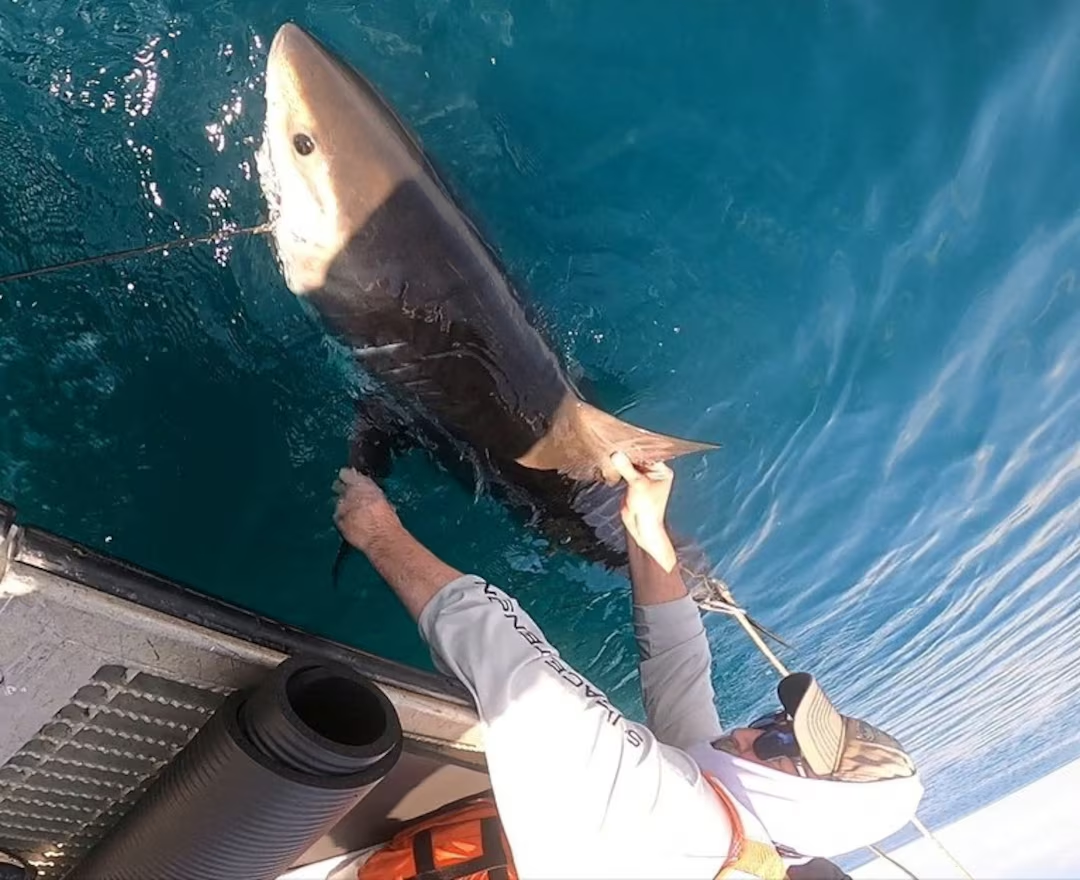
The tagging process starts in early May when migratory species get closer to the coast from their winter habitats in the Atlantic, according to Caroline Wiernicki, a doctoral candidate in marine science at the university. Researchers travel 30 to 40 miles offshore on a research vessel, use baited lines, and usually wait about two to three hours for a shark to bite.
“The tags go on the dorsal fin, and each time the shark swims at the surface, the tag can send data to satellites,” Carlisle noted.
‘A PIT CREW’
The tagging is done quickly, like a pit crew in a car race, often taking less than five minutes to complete.
The process is done under controlled animal care to minimize impact on the sharks. The tags are designed to corrode and eventually fall off. Each shark also undergoes a health check before being released, as a stressed shark may act unnaturally, skewing the data.
Wiernicki contrasted the dramatic portrayals of sharks in movies with their actual behavior, saying it’s not as intense as the great white shark from “Jaws.”
“It’s more like Bob from Accounting, clocking in with the day’s temperature profiles before heading back out,” she joked.
This project is very different from the “Sharknado” film series, as Wiernicki humorously pointed out, “We aren’t deploying sharks in and out of waterspouts, yet,” but she also mentioned that working with sharks can be “a lot of fun.”
If the project is successful, data gathered by sharks could lead to better hurricane forecasts as they near the U.S. East Coast. This information could help communities from North Carolina to Massachusetts prepare for stronger storms.
Many people may never see a shark in person, but they often know them through scary stereotypes. However, Carlisle said, “They are remarkable animals perfectly adapted to the ocean. We can learn a lot from them, and if we show how sharks can help people, it’s a win-win situation.”