
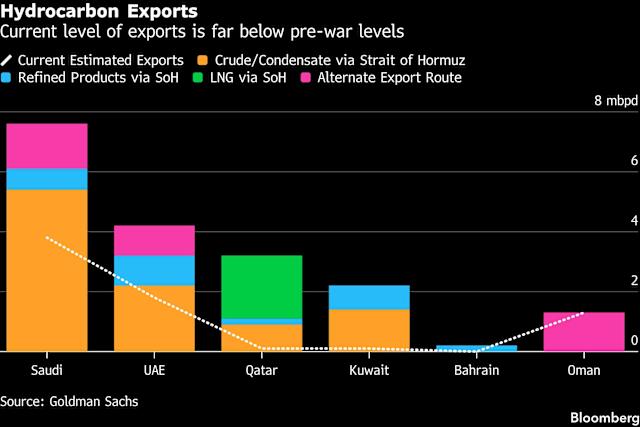
May 1, 2026 (Bloomberg) – The blockade of the Strait of Hormuz is causing major economic changes among oil exporters in the Persian Gulf. Saudi Arabia and Oman are likely to benefit significantly, while others like the United Arab Emirates are experiencing a drop in oil revenue.
Saudi Arabia is gaining an advantage over most of its Gulf neighbors because it can redirect most of its crude exports to the Red Sea. According to Goldman Sachs, the higher oil prices have more than made up for the lost shipments from the strait. In contrast, the UAE is facing a significant decrease in oil income, as its redirected shipments can only partially offset the loss from the Hormuz blockade.
Goldman estimates that oil revenue in Saudi Arabia rose by 10% compared to pre-war levels, while the UAE's revenue fell by about 25%, according to Middle East and North Africa analyst Farouk Soussa in a recent report.
This financial disparity could worsen the growing competition between the two largest economies in the region, which was recently highlighted by the UAE's surprising decision to leave OPEC. By exiting the Saudi-led group, the UAE plans to pump more crude and monetize its reserves once the Hormuz strait reopens, especially as global demand may decline with the ongoing energy transition.
The financial impact of the war on this critical energy region is severe. The six members of the Gulf Cooperation Council are reportedly losing around $700 million in oil revenue for each day the strait remains closed, as noted by Goldman in a separate report on March 20.
Since the conflict began in late February, Riyadh has redirected about 4 million barrels of oil daily to its East-West pipeline, connecting oil fields to the port of Yanbu. Meanwhile, the UAE has increased its oil shipments through its own pipeline that bypasses Hormuz, managing to export about 2 million barrels each day in March, which is still only half of its exports from February.
Oman, whose oil ports are outside of the strait, has been able to maintain its exports and has seen an impressive 80% increase in revenue since the conflict started, according to Goldman. Conversely, Kuwait, Qatar, Bahrain, and Iraq are facing the most significant challenges, experiencing a sharp decline in income from oil and natural gas due to limited options for bypassing Hormuz.
“The war is splitting the region into winners and losers,” stated Ziad Daoud, chief economist for Bloomberg Economics.
The varying oil revenues are also reflected in the stock performance of GCC countries. Stocks in Oman and Saudi Arabia are outperforming those of the other four nations.
Since the Iran war started, crude prices have surged, causing a near-total shutdown of the waterway through which about a fifth of the world's oil and liquefied natural gas usually flows. On Thursday, global benchmark Brent hit over $126 a barrel, the highest since the aftermath of Russia's invasion of Ukraine in 2022. Though it has since eased to $108, this marks an almost 80% increase in 2026.
Oil revenues only partially illustrate the broader consequences of the war. Iran's airstrikes across Gulf states in revenge for US-Israeli attacks have damaged infrastructure and hit non-oil economies, as fewer tourists are visiting. Goldman estimates that the UAE’s fiscal surplus, which stood at 6% of GDP before the war, has almost entirely vanished, while Saudi Arabia's deficit is expected to improve only slightly.
According to Soussa, Oman’s fiscal balance has shifted from a deficit of 7% of GDP to a surplus of 8%. Meanwhile, Bahrain, Qatar, and Kuwait now have deficits of 17%, 20%, and 40%, respectively.
JPMorgan Chase & Co. estimates that the GCC's fiscal balance has worsened by approximately 3.6% of GDP since the war began.
Saudi Arabia, the UAE, Kuwait, and Qatar are better equipped to withstand the effects of the conflict due to their substantial foreign reserves and wealth funds, according to Daoud from Bloomberg. However, Bahrain and Iraq do not have this cushion and rely heavily on oil revenues for fiscal stability.
Aramco Windfall
If the blockade is lifted soon, some of the damage to public finances might be reversed, notes Goldman’s Soussa.
Saudi Aramco's first-quarter results, expected on May 10, may provide further insight into the kingdom's resilience. Analysts anticipate the oil giant will report its highest profit since the third quarter of 2023, with net income predicted to reach $32 billion, driven by higher prices and lower seasonal costs despite a drop in production, according to Citigroup analysts.
Debt Market
Since the war began, sovereign and corporate borrowers in Qatar and Kuwait, typically less active in the global bond market, have raised billions through private sales, as reported by Bloomberg data. Bahrain also engaged the UAE for a $5.4 billion currency swap.
UAE issuers, including Abu Dhabi, tapped into markets too, albeit not as heavily as in the same period last year. Generally, Saudi Arabia, the region's largest borrower, has reduced its issuance.
Goldman estimates that the net government borrowing requirement across the GCC has doubled from around $1.7 billion a week to $3.5 billion. “This may lead authorities to continue optimizing their funding sources as long as the disruption persists,” Goldman added.