
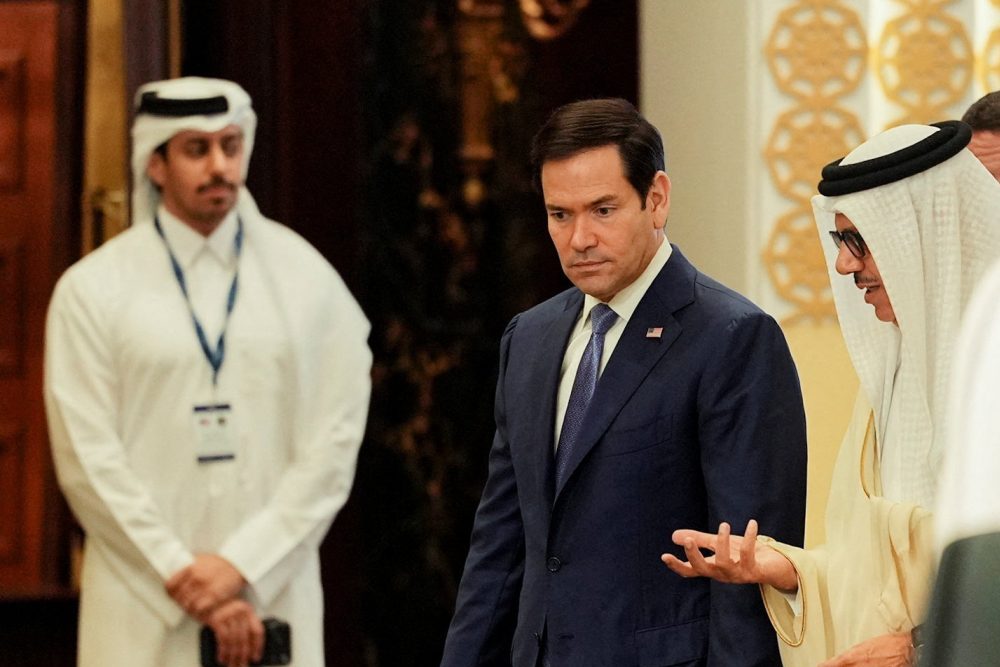
MANAMA/DUBAI, June 25 (Reuters) – U.S. Secretary of State Marco Rubio assured Gulf allies on Thursday that any agreement with Iran would consider their concerns. This statement came as he concluded a visit to the Middle East, aiming to gain the trust of regional partners who are skeptical about the initial deal.
Speaking during a gathering of Gulf Arab foreign ministers in Bahrain, where the U.S. Navy's Fifth Fleet is located, Rubio emphasized that the U.S. is seeking a lasting peace with Iran that won't compromise the security of its allies in the oil-rich area. Many Gulf states view the deal as too lenient due to recent Iranian attacks.
Iran has faced off against powerful military forces like the U.S. and Israel, managing to control the crucial Strait of Hormuz, which has disrupted oil supply routes and affected global energy markets and economies.
Rubio noted that Gulf allies have serious concerns and want to be kept informed about each step of the peace agreement, including details regarding the Strait of Hormuz.
He stated, "If Iran threatens or blocks ships in the Strait of Hormuz, then we’re going to have a problem," stressing that "no country on Earth has the right to charge for the use of international waterways," and that shipping fees would not be included in any agreement.
Rubio also mentioned that he didn’t discuss a proposed $300 billion reconstruction fund for Iran, which Gulf states fear might enhance Iran's military capabilities.
Bahrain’s Foreign Minister Abdullatif bin Rashid Al Zayani, who led the meeting, appreciated Oman’s announcement about creating a corridor for safe vessel passage through the strait. Oman confirmed that future arrangements for the Strait of Hormuz would not include transit tolls.
REASSURING WARY REGIONAL ALLIES
This three-day trip by Rubio was the first high-level diplomatic effort since the U.S.-Iran framework agreement was reached last week, aimed at bringing an end to the conflict that began on February 28 with U.S.-Israeli attacks on Iran.
During previous stops in the UAE and Kuwait, Rubio worked to reassure officials that the proposed deal is not overly favorable to Iran, which had attacked several Gulf states during the conflict.
He stated, "We’re not going to do anything that undermines the security of our allies, our longstanding allies in the region," while speaking to reporters in Kuwait.
U.S. President Donald Trump recently claimed that Iran had agreed to permit nuclear inspections indefinitely, a statement that Tehran contested, denying such concessions were made during talks.
After concluding the first round of negotiations in Switzerland, both countries offered differing views on financial incentives for Iran and issues related to the Strait of Hormuz, as well as Israel's ongoing conflict in Lebanon.
All six Gulf Cooperation Council (GCC) nations – Saudi Arabia, Qatar, Oman, the United Arab Emirates, Bahrain, and Kuwait – are key U.S. allies that provided some logistical support during the war. All of them faced risks from Iranian airstrikes as a consequence.
They form the core of the U.S. security framework in the Middle East, and any changes in their security alliances with the U.S. could significantly influence American military strategy in the region.
The draft U.S.-Iran agreement has no restrictions on Iran’s ballistic missiles, includes a $300 billion reconstruction fund, and contains elements that might increase Tehran's leverage in the region and its control over essential oil shipping routes.
Some Gulf state officials privately express worry that the interim deal might ease U.S. relations with Iran, a predominantly Shiite nation viewed as a primary rival by Sunni-led GCC countries.