
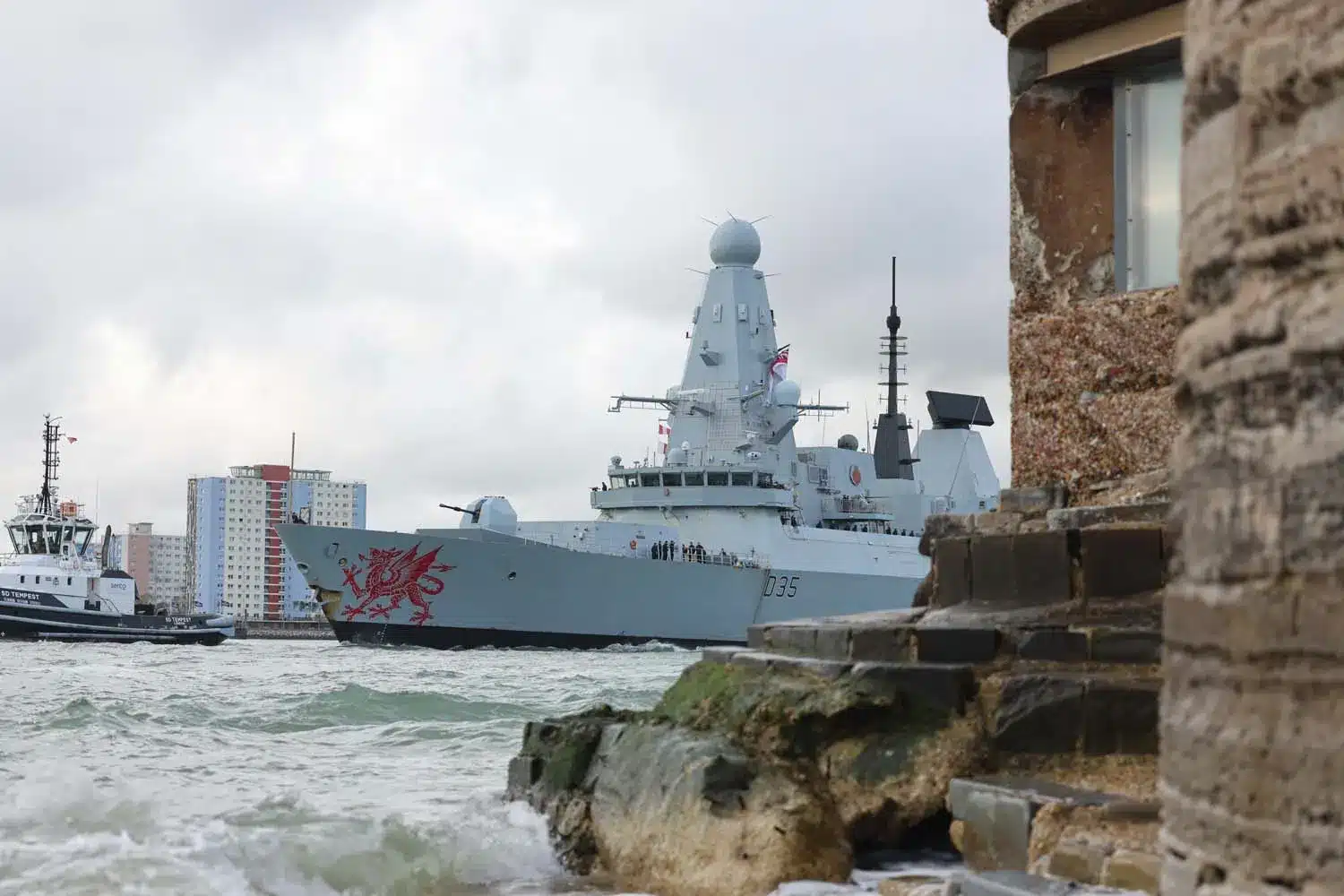
The HMS Dragon set sail from the Royal Navy's base in Portsmouth, England, on Tuesday, heading to the Eastern Mediterranean as the UK increases its military presence in response to rising tensions in the area and threats to British interests.
Supporters gathered along the seawall to bid farewell as the Portsmouth-based air-defense destroyer left the harbor. This deployment aims to protect UK assets and allies in the region amid ongoing Iranian attacks targeting Western interests in the Middle East due to U.S. and Israeli strikes.
The mission will utilize Dragon’s advanced Sea Viper air-defense system to tackle aerial threats such as drones, aircraft, and missiles. This system enables the Type 45 destroyer to track hundreds of targets at the same time and deal with multiple threats simultaneously, launching missiles that can travel up to four times the speed of sound.
Royal Navy officials mentioned that the ship will be supported by additional aviation units already deployed in the region. The 815 Naval Air Squadron has sent Wildcat attack helicopters armed with Martlet missiles to Cyprus, and a Merlin Mk2 surveillance helicopter from the 820 Naval Air Squadron is on-site for early warning of aerial threats.
Vice Admiral Steve Moorhouse, Fleet Commander, stated that this rapid deployment shows the Royal Navy's readiness to tackle emerging threats. "I am proud of our skilled personnel who quickly prepared HMS Dragon and the Wildcats from 815 Naval Air Squadron for their mission," Moorhouse said.
The UK Ministry of Defence indicated that this decision to send more naval and aviation support builds on an already enhanced defensive position in the region. Recently, the UK has also stationed radar systems, air-defense units, and F-35 Lightning II fighter jets for air defense patrols.
Commander Iain Giffin, the commanding officer of Dragon, mentioned that the crew has been intensively preparing for the mission.
“My ship’s company have worked tirelessly to ensure we are ready for our mission to the Eastern Mediterranean,” he stated. “We are trained for this, we are ready for this, we have the equipment and people.”
The Type 45 destroyers, with a crew of about 200 sailors each, are the Royal Navy’s key air-defense platforms.
The capabilities of the Sea Viper system were recently showcased during operations in the Red Sea, where its sister ship, HMS Diamond, intercepted multiple drones. Diamond also successfully shot down a Houthi anti-ship missile aimed at a merchant vessel in the Gulf of Aden, marking the first time a Royal Navy ship has intercepted a missile in combat since 1991.
Dragon also proved its effectiveness during an international exercise off the coast of Scotland last year, becoming the first British warship to destroy a supersonic missile target using the Sea Viper system.
UK Defence Secretary John Healey commended the quick organization of the deployment, highlighting that what usually takes six weeks of preparation was accomplished in just six days.