
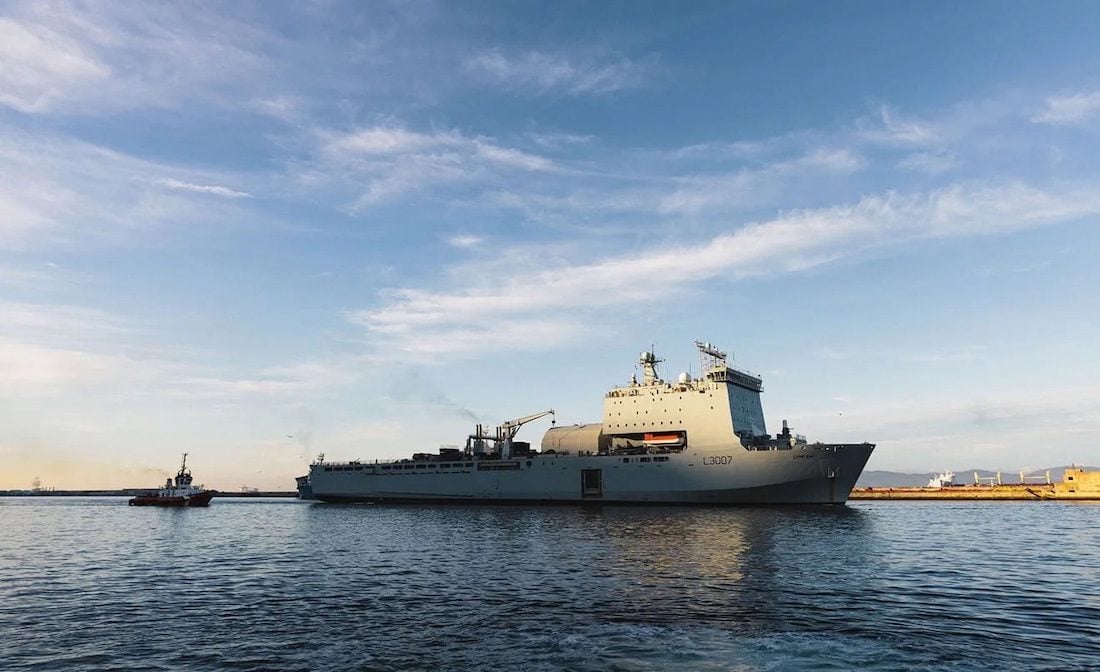
The Royal Navy has recently introduced a new underwater mine disposal system on the RFA Lyme Bay as the UK and France work together to prepare for a multinational operation. This operation aims to remove naval mines from the Strait of Hormuz once a political agreement allows for the resumption of commercial shipping.
This deployment is a clear indication that Western military strategists are getting ready for what many in the shipping industry see as a major hurdle to reopening this crucial waterway: naval mines.
As reported by Bloomberg, the UK and France have finished preparations for a coalition mission that could involve up to 15 countries, ready to start mine-clearance operations as soon as the U.S. and Iran reach an agreement to restore safe navigation through the strait.
The RFA Lyme Bay left Gibraltar last month, equipped with advanced autonomous mine-hunting technology and over 100 specialized Royal Navy personnel on board.
Included in this team is the Royal Navy's Diving Threat and Exploitation Group, which has recently completed rapid training on the Video Ray Defender-Viper system. This portable remotely operated vehicle is designed to locate, identify, and neutralize underwater mines. It has also been used by Ukrainian forces and is part of a broader suite of autonomous mine warfare tools aboard the Lyme Bay, which is heading towards the Middle East as a potential command center for mine warfare.
The system consists of the Defender underwater vehicle, a Viper attachment that secures explosives to a mine, and the Tornado firing system, which detonates the explosives from a safe distance. Royal Navy officials have noted its effectiveness against buoyant mines located just beneath the surface, which can detonate when vessels pass over them.
Lieutenant Commander James Carpenter, the commanding officer of Delta Squadron, emphasized that "a fundamental principle of Explosive Ordnance Disposal is to use remote means whenever possible, so if we have this tech, we need to use it."
This deployment comes at a time when focus is shifting from diplomacy to the practical issues of ensuring safe navigation through one of the world’s key maritime routes.
On Wednesday, President Donald Trump stated that U.S. forces had already cleared many mines, claiming, "we’ve gotten most of them." Earlier this week, Secretary of State Marco Rubio informed lawmakers that Iran had mined significant portions of the waterway during the ongoing conflict.
According to Bloomberg, military planners from several nations are now almost fully coordinated in a mine-clearing effort led by the UK and France, with more countries expected to provide personnel, equipment, and naval support.
This planning highlights rising concerns that even if Washington and Tehran come to an agreement, commercial shipping may not return to normal right away.
With over three months of conflict, traffic through the Strait of Hormuz has dropped significantly, as shipowners, charterers, and insurers are still weighing the risks posed by mines, drones, missile attacks, and regional instability.
Although Iran has shown interest in participating in mine-clearance operations, Bloomberg reports that British and French officials prefer to have the multinational coalition lead the effort, expressing doubts about Iran’s capabilities in countering mines.
The UK has already sent additional resources to the region. The Royal Navy destroyer HMS Dragon has recently passed through the Suez Canal and is now in the Middle East, prepared for possible coalition operations. This Type 45 destroyer is equipped with the Sea Viper air-defense system and Wildcat helicopters, which are designed to address drone threats.
The focus on mine clearance aligns with ongoing concerns from industry groups that naval mines pose a significant challenge to rebuilding confidence in the Strait of Hormuz. BIMCO has warned that restoring full shipping operations could take weeks of focused mine-clearance work, even after a ceasefire or political solution is reached.
As diplomats continue their discussions on a broader agreement, military planners are increasingly concentrating on the next challenge: persuading shipowners, insurers, and energy traders that this vital energy corridor is safe for business once more.
About one-fifth of the world’s oil and LNG supplies typically pass through the Strait of Hormuz, making the success of any mine-clearing operation essential for restoring global energy flows and maritime trade.