
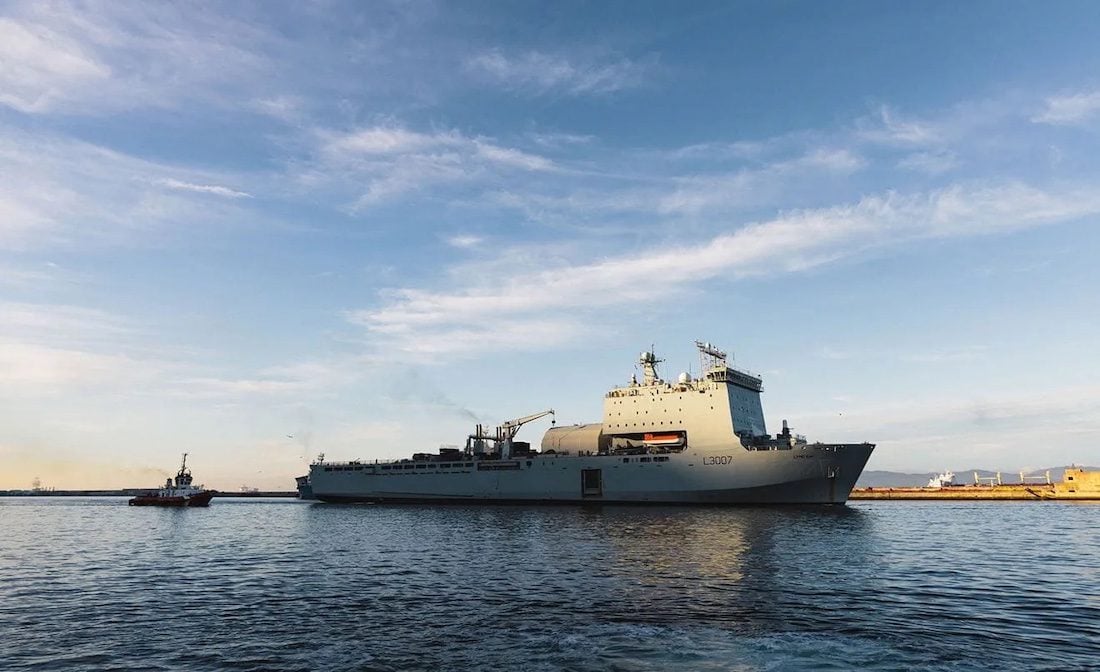
The United Kingdom is preparing for a potential multinational mission in the Strait of Hormuz, as the Royal Fleet Auxiliary vessel RFA Lyme Bay has left Gibraltar. It carries advanced autonomous mine-hunting systems and over 100 specialized Royal Navy personnel.
This deployment highlights Britain's increasing emphasis on mine warfare and unmanned maritime operations, as Western allies get ready for a possible long-term initiative to boost commercial confidence in this crucial shipping route.
According to the Royal Navy, Lyme Bay will act as a “mine-hunting mothership” that can deploy autonomous surface and underwater systems to detect and neutralize naval mines, ensuring sailors are not put at risk in minefields.
The Bay-class support ship set sail from Gibraltar with personnel from the Royal Navy’s Diving and Threat Exploitation Group (DTXG) and Mine and Threat Exploitation Group (MTXG), along with various unmanned mine-warfare technologies.
Onboard is the 12-meter uncrewed surface vessel RNMB Ariadne, designed to locate and eliminate naval mines remotely. Other systems include Seacat autonomous underwater vehicles, which can create detailed 2D and 3D sonar maps of the seabed, and Remus uncrewed underwater vehicles, used for seabed surveys and mine detection.
“Personnel from MTXG will join RFA Lyme Bay with a specific purpose: to provide an effective, modern Mine Countermeasures capability,” stated Commander Dan Herridge, MTXG's Commanding Officer.
“Thanks to the Minehunting Capability Programme, they will use advanced sensors enabled by autonomy and AI to detect threats in some of the world’s most challenging maritime environments,” he added.
This initiative comes as concerns about naval mines remain a major barrier to restoring normal commercial shipping activities in the Strait of Hormuz, following months of conflict and disruption in the region.
While Western officials are still discussing future coalition escort and maritime security operations, industry groups like BIMCO and the IMO have cautioned that confidence among shipowners and insurers is unlikely to improve until effective mine-clearing operations are in place and safe transit guarantees are established.