
By Eamon Akil Farhat, Rachel Graham, and Sasha Draeger-Mazer
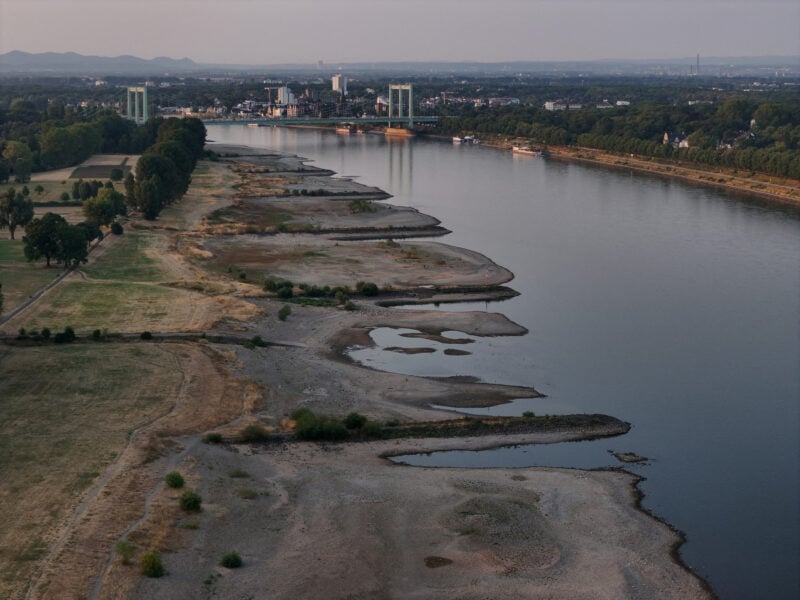
(Bloomberg) – Water levels in the Rhine River are continuing to drop, and there seems to be no end in sight. This situation is forcing companies that depend on this waterway to adapt quickly to keep their goods moving.
At Kaub, Germany — the lowest point of the Rhine — water levels have hit their lowest since records started in 1880 and might decrease further as Europe faces another heat wave this week. Weather forecasters indicate that it would take weeks of steady rain to bring the river back up to normal levels, suggesting that the issue could continue into October.
The Rhine serves as a vital shipping route through Europe’s industrial core, stretching from Switzerland to Rotterdam, the busiest port in the continent. The disruptions along the river are creating supply chain difficulties for various companies, including steelmaker Thyssenkrupp AG, BASF SE, and Lanxess AG.
“Shipping by boat is heavily restricted, with vessels carrying much lighter loads than usual,” said Lanxess, a company that specializes in chemicals, in a statement on Tuesday. “As some loading and unloading points are no longer accessible, we're switching to rail and road transport when feasible. The situation is very dynamic.”
While officially, the river does not close, some industry players, including shipping broker Riverlake, are warning that it has become nearly impossible to navigate at Kaub.
“Barges parked on the Upper Rhine cannot return to the ARA area,” Riverlake mentioned in a note on Tuesday, referring to the Antwerp-Rotterdam-Amsterdam shipping hub. “Barges from ARA are unable to proceed further upstream.”
 A man sunbathes on the exposed riverbed on the Rhine near Kaub.
This disruption risks the supply of goods typically transported by the river, such as diesel, heating oil, coal, grains, and cocoa. German utility EnBW usually depends on coal shipments from Rotterdam, while Germany’s Miro oil refinery ships gasoline via barges. EnBW has estimated that the river disruptions could reduce its earnings by a low double-digit million-euro figure.
“The low water levels in the Rhine are limiting inland shipping capacity and creating significant challenges for logistics and supply chains,” stated Evonik Industries AG, a chemical firm, on Tuesday. The company is responding with various precautionary measures, shifting some of its freight to rail and road.
Similarly, BASF noted some bottlenecks but mentioned that it is maintaining shipping on the river by using vessels designed for low-water conditions. When necessary, they are also using land transportation.
According to Germany’s Inland Waterway Transport Cooperative, barges can still navigate at Kaub, with vessels able to pass when the clearance level drops to around 10 centimeters, or about four inches. Currently, the level is at 14 cm at Kaub.
Whether a barge can move through such low water depends on the number of propellers it has and how much cargo it carries. Water levels at Kaub have been declining for months, leading one barge owner to have vessels idling since late July. The clearance level does not reflect the actual depth of the navigation channel, but provides a guideline for vessels. According to German federal waterway calculations, a reading of 14 cm corresponds to a navigable depth of about 1.27 meters. Forecasts indicate the level could fall to 9 cm by Friday.
Parched Earth
Limited rainfall and continuous heat have impacted the basin that feeds the Rhine, which has also seen reduced runoff due to melting alpine snow and glaciers, according to David Hannah, a hydrology professor at the University of Birmingham in England.
While cooler temperatures and possible rain are expected next week in Germany, this relief may be temporary as weather models predict a return to drier conditions, according to Don Keeney, lead forecaster at Vaisala.
To ease transport bottlenecks, the northern German state of Schleswig-Holstein has joined other regional governments in temporarily lifting a ban on trucking during Sundays and public holidays. “To keep vital logistics chains stable for public and economic supply, they must shift — at least partially — to road transport,” the state’s economy ministry said.
Nonetheless, trucking can only provide limited help. Covestro AG, a German manufacturer of polymers and high-performance plastics, stated that it requires 60 trucks to replace a single barge carrying 1,500 metric tonnes. The situation is now affecting its raw material supplies and production at various sites, as well as the delivery of certain products.
Extreme Heat
Europe is preparing for its fifth heat wave of the summer, with exceptionally high temperatures anticipated in France, Germany, and Poland. Temperatures are expected to peak toward the end of the week and into the weekend. Drought conditions have worsened region-wide, according to data from the European Commission.
“A significant rise in water levels is unlikely before October,” wrote Ralph Solveen, a senior economist at Commerzbank, in a note. If water levels remain critically low through mid-September, this could reduce Germany's GDP by about 0.35 percentage points this quarter, he estimated.
The Danube is facing similar extreme conditions and saw a slight improvement when water levels rebounded from record lows, which allowed Hungary to increase electricity production at its Paks nuclear plant on Monday.
However, Prime Minister Peter Magyar cautioned that there are still no signs that the drought will improve soon, and engineers are prepared to reduce the functionality of the nuclear plant’s turbines if necessary.
Emergency services are battling fires across Hungary, as months without significant rainfall have dried out vegetation, although most of the fires are currently contained.