
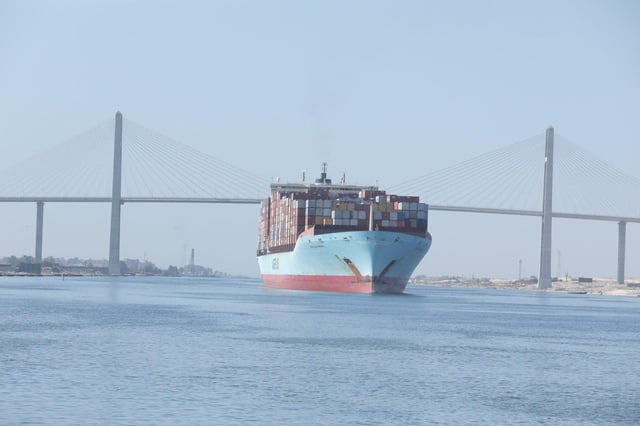
Less than a month after resuming limited transits through the Red Sea, Maersk has started rerouting some of its services around the Cape of Good Hope. This change highlights the ongoing instability of the industry's return to the Suez Canal.
The Danish shipping company cited “unforeseen constraints arising from the wider operating environment in the Red Sea region” as the reason for potential delays, leading to diversions in its ME11 and MECL services. The affected voyages will avoid the Suez Canal and take the longer route around Africa instead.
This decision marks a setback for the cautious but promising reopening of one of the world’s most important shipping routes. In early February, Maersk and partner Hapag-Lloyd announced the first structured return of their ME11 service to the Red Sea, with westbound sailings starting on February 4 and eastbound transits beginning on February 3.
According to the company's vessel schedules, the westbound Maersk Houston (voyage 608W) and Astrid Maersk (voyage 609W) will now travel via the Cape of Good Hope when they depart Salalah on March 5 and March 12, respectively. On the eastbound side, the Maersk Hamburg (voyage 608E) and Maersk Huacho (voyage 610E) will also take the longer route around the south.
For the MECL service that connects the Middle East and India to the U.S. East Coast, the westbound Maersk Detroit (voyage 609W) will likewise divert around the Cape when it leaves Salalah on March 11.
“We are sharing this information so you can adjust your logistics and insurance as needed,” the company told its customers, promising to provide updated transport plans soon.
The timing is important, especially as the industry is already facing financial pressures. Maersk reported a $153 million loss in its Ocean division for the fourth quarter of 2025, marking its first quarterly loss in years as it deals with the challenges of shifting between Cape diversions and Suez transits. The company has issued broad guidance for 2026, predicting a possible loss of $1.5 billion to a profit of $1 billion, reflecting uncertainty about the long-term reopening of the Red Sea route.
The benefits of using the Red Sea route are still attractive—westbound ME11 sailings save 19 days compared to taking the Suez route, while eastbound journeys are seven days shorter. Maersk continues to argue that this route is “the fastest, most sustainable, and most efficient way to serve our customers.”
However, these frequent changes are damaging something potentially more valuable than time: predictability. As Xeneta senior analyst Destine Ozuygur pointed out when CMA CGM rerouted services around the Cape in late January, “Unpredictability is toxic for supply chains.”
The crisis in the Red Sea began on November 19, 2023, when Houthi forces hijacked the Galaxy Leader off the coast of Yemen. Since then, over 100 merchant vessels have been attacked, four ships sunk, one seized, and at least eight seafarers killed. Before the attacks, the Suez Canal managed approximately 80 container ships weekly; by mid-January 2026, this number had fallen to just 26.
Maersk clarified that today’s announcement is “a temporary adjustment” and that the company still prioritizes the Trans-Suez route for these services on all future sailings. They stated they would keep customers informed about the situation and invited anyone with questions to contact their local representatives.
For Egypt, the impact of these changes goes beyond logistics. Suez Canal tolls are a crucial source of foreign currency, and canal authority chairman Admiral Ossama Rabiee has predicted a return to normal traffic levels by the second half of 2026. After nearly 800 days of diversions around the Cape, this timeline now seems increasingly optimistic.